[Exclusive] Korean National Police Agency Triples Crime Prevention Budget... Performance Evaluation Still 'Post-Event Focused'
- Input
- 2026-09-15 14:08:19
- Updated
- 2026-09-15 14:08:19
[Financial News] It has been confirmed that the police are evaluating the effectiveness of their 'crime prevention' policy, which aims to identify and eliminate risk factors before crimes occur, based on the speed of response following 112 calls and the number of crimes that have already occurred. Although the related budget for next year is set to increase nearly threefold compared to this year, there are no indicators to directly measure the effectiveness of actual prevention activities, such as improving vulnerable areas or reducing repeated reports, leading to calls for improvements to the performance evaluation system.
Question mark over the effectiveness of crime prevention performance indicators
According to the Korean National Police Agency's '2027 Performance Plan' obtained by Financial News on the 15th, the performance indicators for the 'Crime Prevention and Response' program consist of two items: the rapid processing rate of 112 emergency calls and the number of occurrences of the five major crimes per 100,000 people. The weighting for each of the two indicators is 50%.The '112 Emergency Call Promptness,' which accounts for half of the total evaluation, measures how quickly the police responded after receiving a report. It is closer to evaluating response capabilities after a report is made, rather than preventive activities such as identifying vulnerable areas or eliminating risk factors before a crime occurs.
The remaining half, the 'number of major crimes per 100,000 people,' was newly introduced this year. While the scale of crime can indirectly verify the effectiveness of prevention policies, this is also a result indicator calculated based on crimes that have already occurred. Since the number of crimes can be influenced by various factors such as population structure, mobile population, and regional security environments, in addition to prevention activities, there are limitations in directly demonstrating the performance of individual prevention projects.
The Korean National Police Agency stated that it introduced the number of occurrences of the five major crimes as a new indicator starting this year to address the fact that the existing evaluation system was skewed toward post-incident response. The rationale is that since the ultimate goal of prevention policy is to reduce the occurrence of crime itself, the effectiveness of prevention activities can be evaluated through the number of incidents.
"Previously, evaluations focused on how quickly 112 calls were responded to, but there were criticisms that this was reactive," an official from the Korean National Police Agency explained. "We added the number of occurrences of the five major crimes per 100,000 people to reflect the aspect of crime prevention."
Repeated reports and risk factors must also be examined
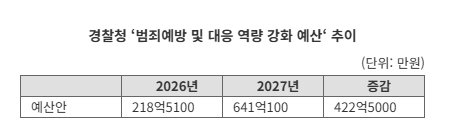
As the budget for crime prevention is significantly expanded, the appropriateness of performance evaluation indicators is becoming increasingly important. The Korean National Police Agency has allocated 64.101 billion won for next year's budget to "strengthen crime prevention and response capabilities." This represents an increase of 42.25 billion won compared to this year (21.851 billion won), growing approximately 2.9 times in just one year.The increased budget is scheduled to be invested in strengthening crime prevention activities prior to the occurrence of crimes. The Korean National Police Agency plans to deploy dedicated personnel, such as metropolitan prevention patrol units specialized in crime prevention and response, to the field, and to establish and implement prevention measures after analyzing crime vulnerabilities using crime prediction analysis systems. As the focus of the initiative shifts toward proactive prevention, there is a growing need to establish performance indicators to verify changes and effectiveness in prevention activities resulting from the budget allocation.
Experts point out that there are limitations to judging the effectiveness of prevention policies solely based on the number of crimes and the speed of report processing. They explain that an evaluation must be conducted not only on whether crimes occurred, but also on how effectively risk factors in vulnerable areas have actually been improved, how much recurring reports have decreased, and whether on-site measures were appropriate.
Park Jong-cheol, a professor of police administration at Songwon University, emphasized, "Simply arriving at the scene quickly to handle a 112 call does not necessarily mean it is highly effective for crime prevention." He added, "Examining whether appropriate measures were taken in accordance with the report, along with whether reports occur repeatedly at the same location or for the same incident, can be a more important factor in evaluating crime prevention performance."
[email protected] Lee Dong-hyeok Lee Hae-ram Reporter