Aviation Fuel Soars Above Crude Oil... Aviation Industry Profitability 'Red Alert'
- Input
- 2026-09-14 15:55:20
- Updated
- 2026-09-14 15:55:20
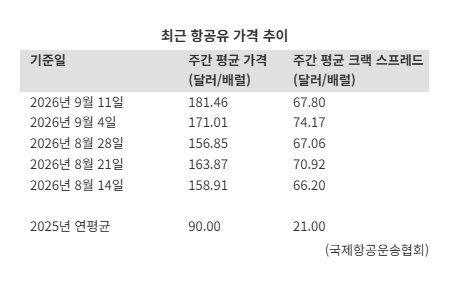
According to the International Air Transport Association (IATA) on the 14th, the weekly global average price of aviation fuel as of the 11th was $181.46 per barrel, a 6.1% increase from the previous week's $171.01. Compared with $158.91 a month earlier, on August 14, it rose 14.2%. Of particular concern is the continued high premium of aviation fuel over crude oil. The crack spread between aviation fuel and crude oil (Brent Crude Oil) remained high at $67.8 per barrel.
The crack spread is the difference between the price of aviation fuel produced by refining crude oil and the price of crude oil, serving as an indicator of how much more expensive aviation fuel is traded relative to crude oil. On the 4th, the crack spread reached $74.17. Considering that the global crack spread averaged $21 per barrel last year, the current price gap has effectively surged to three times last year's average.
Consequently, the burden of fuel costs is also expected to rise significantly. The International Air Transport Association (IATA) projected that fuel expenditures in the global aviation industry will reach $350 billion this year, a 39.3% increase from $252 billion last year. It also forecast that fuel costs' share of total operating expenses will rise by 6 percentage points, from 25.4% to 31.4%. Since fuel consumption is expected to remain unchanged from the previous year at 104 billion gallons, the increase in costs is analyzed as being virtually entirely attributable to rising aviation fuel prices.
For major airlines with high fuel consumption, such as Korean Air, even small price fluctuations are a significant burden. According to Korean Air's '2026 Environmental, Social, and Governance (ESG) Report,' total fuel consumption last year was 181,062,676 gigajoules (GJ), equivalent to approximately 30.3 million barrels. A simple calculation shows that for every $1 increase in the price of aviation fuel per barrel, the annual exposure to fuel purchase costs increases by about $30.3 million (40.7 billion won).
Airlines typically mitigate the risk of fuel price fluctuations through various financial contracts based on crude oil prices. However, when aviation fuel prices rise faster than crude oil prices, as they have recently, such methods alone are insufficient to prevent the crack spread from widening. The weaker the correlation between crude oil and aviation fuel prices, the greater the actual fuel cost burden on airlines.
Even fuel surcharges, which pass on part of the increase in fuel prices to consumers, are insufficient to fully offset the rise in aviation fuel prices. This is because there is a time lag of several weeks before actual changes in aviation fuel prices are reflected in fuel surcharges, and factors such as fare competition and reduced consumer spending must also be taken into account.
Meanwhile, international oil prices are hovering above $100 per barrel due to concerns over supply disruptions in the Middle East. On the 11th, Brent Crude Oil closed at $104.61 per barrel, while West Texas Intermediate crude oil (WTI) closed at $100.05, with both rising by more than 8% on a weekly basis. The upward trend continued on the 14th, with Brent Crude Oil trading in the $107 range and WTI in the $103 range. The key variable driving the rise in oil prices is supply instability in the Middle Eastern crude oil transport network, including the Strait of Hormuz. According to the International Energy Agency (IEA), approximately 20 million barrels of crude oil and petroleum products normally pass through the Strait of Hormuz each day, accounting for about 20% of global oil consumption.
[email protected] Jeong Won-il, Kim Mi-hee Reporter