Barun Law LLC, Dongin Law Group Pursue Merger to Create Mega-Firm... Could It Reshape the Legal Industry? [Law Firm News]
- Input
- 2026-09-14 15:26:07
- Updated
- 2026-09-14 15:26:07
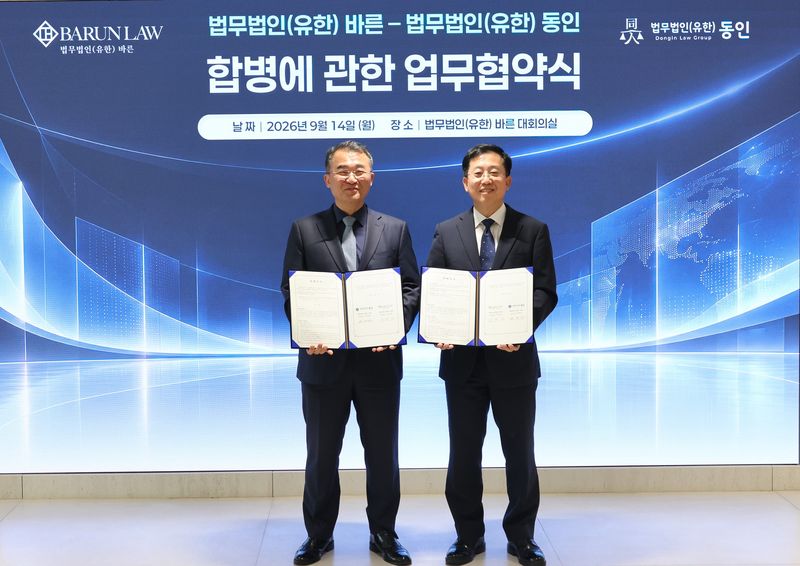
[Financial News] Barun Law LLC and Dongin Law Group have taken the first step toward a merger. If completed, the merger would create a major law firm with combined revenue of 187.7 billion won and 553 attorneys, based on last year’s figures.
Barun Law LLC and Dongin Law Group announced on the 14th that they had signed a memorandum of understanding (MOU) to pursue a merger at Barun Law LLC’s main conference room in Gangnam-gu, Seoul, and had begun related procedures. The tentative name of the merged firm is “Barun Dongin.”
The merger is being pursued on the principles of equality and mutual benefit, rather than through one firm absorbing the other. The two sides plan to combine their respective strengths in corporate advisory work, litigation and criminal matters, and corporate disputes to enhance their ability to handle large-scale, complex cases.
Using the same accounting standards, the two firms reported last year’s revenue at 107.6 billion won for Barun Law LLC and 80.1 billion won for Dongin Law Group, for a combined total of 187.7 billion won. Barun Law LLC has 303 attorneys, including 287 Korean attorneys and 16 foreign attorneys, while Dongin Law Group has 250, including 245 Korean attorneys and five foreign attorneys.
Once the merger is completed, the firm will grow into a major law firm with 553 attorneys, including 532 Korean attorneys and 21 foreign attorneys.
The two sides said they would focus not merely on expanding their size, but on combining their distinct professional capabilities. Barun Law LLC and Dongin Law Group have built experience across a wide range of areas, including civil and criminal litigation, corporate disputes, criminal investigations and trials, as well as corporate law, finance, fair trade, construction, labor, and taxation.
As corporate legal needs have recently become more complex—extending beyond traditional corporate advisory work to regulatory investigations, criminal investigations, civil and criminal litigation, and compliance—the firms plan to strengthen an integrated legal-services system covering everything from advice to dispute response through the merger.
The firms will also expand investment in growth areas such as AI, data, and advanced industries. They agreed to expand their pool of specialists and capabilities in these fields while upgrading their collaboration and support systems through joint investment in knowledge management, information security, and digital work environments. They will also pursue the possibility of bringing in additional specialized law firms or organizations based on the integrated entity.
The firms also agreed not to apply either side’s existing personnel, evaluation, or compensation system wholesale, all of which are considered key issues in the merger process. After comparing and analyzing their existing systems, they plan to adopt an appropriate system based on competitiveness and fairness, or design a new one that reflects the strengths of both sides.
The integration of these systems will also proceed in stages. For matters that could produce less favorable outcomes for some members than under the existing system, transitional measures or grace periods will be provided. Major issues, including governance, personnel and compensation, and the organizational structure, will be decided after gathering input from members.
To carry out the merger in earnest, the firms will form a merger committee with an equal number of attorneys from each firm, with no more than five attorneys from either side. The committee will discuss the merged firm’s governance and decision-making structure, personnel, evaluation and compensation systems, organizational and work structures, collaboration by practice area, branding, office space, and work-support systems.
The two sides will negotiate with the goal of signing a merger agreement within 12 months of the MOU’s effective date. The specific launch date and organizational and operational structure will be finalized after mutual due diligence, conflicts-of-interest reviews, internal approvals, and negotiations on the definitive agreement.
During the MOU’s validity period, the firms will also be subject to an exclusivity obligation prohibiting them from pursuing identical or similar merger negotiations with a third party without the other side’s prior written consent.
The firms will conduct preliminary reviews of potential conflicts of interest involving clients and cases, a key variable in the integration of major law firms. They will examine conflicts involving existing and current clients, opposing parties in cases, and major affiliated companies. If a conflict is identified, they plan to take measures such as obtaining client consent or transferring or closing the case in accordance with relevant laws and attorneys’ ethical rules.
However, the signing of the MOU alone does not finalize the merger. The final decision on whether to merge, as well as the specific rights and obligations, will be determined under the merger agreement to be signed after due diligence and internal approvals.
Lee Dong-hoon, managing representative attorney of Barun Law LLC, said, “We will pursue a merger that builds on the strengths of both firms and addresses their shortcomings under the principles of equality and mutual respect. We will carefully design the systems and processes so that our members can fully demonstrate their capabilities and provide clients with more systematic and consistent services.”
Changyeon Won, managing representative attorney of Dongin Law Group, also said, “This merger is not simply about adding our sizes together. It is a process of connecting the case experience, human resources, and client-service systems that both firms have accumulated over many years. We will create an organization capable of quickly bringing together the expertise needed when clients face more complex and difficult legal issues.”
[email protected] Yoo Seon-jun Reporter