[Exclusive] "Because of the 1,200% Rule"—Mega-Sized GAs Scrap Settlement Support Payments One After Another
- Input
- 2026-09-15 17:13:50
- Updated
- 2026-09-15 17:13:50

Settlement support payments scrapped one after another
According to the insurance industry on the 15th, mega-sized GAs with more than 3,000 agents—including INCAR FINANCIAL SERVICE, GA Korea and Toss Insurance—have abolished their settlement support payment programs since the 1,200% rule was introduced in July.
Hanwha Life Financial Service has not abolished the program entirely. However, it has reduced support payments for experienced agents and now operates a recruitment commission policy, including settlement support payments, mainly for new agents who are not subject to the 1,200% rule. The company said there would be no major change because, as a subsidiary of Hanwha Life, it had already voluntarily applied the 1,200% rule to its settlement support payment program.
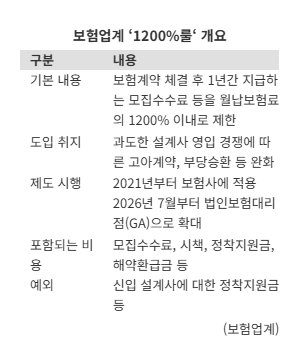
GAs are withdrawing from settlement support payments because the scope of the 1,200% rule, which had applied only to insurers since 2021, was expanded to GAs in July this year. The rule limits recruitment commissions paid to an agent during the first year of an insurance contract to no more than 1,200% (12 times) of the monthly premium. Its purpose is to prevent excessive competition to recruit agents and aggressive insurance sales practices.
Mega-sized GAs voluntarily abolished the settlement support payment program even without separate guidance from the financial authorities because those payments were included in the recruitment commission cap.
For example, if an agent secures a policy with a monthly premium of 1 million won, the first-year commission cap is 12 million won. If the settlement support payment is set at 5 million won, the combined amount available for the base commission, special incentives and surrender refunds is limited to a maximum of 7 million won.
An insurance company official said, "Because the monthly premiums generated by the top agents are around 1 million won, it is no longer possible to provide hundreds of millions or even billions of won in settlement support payments as before following the expanded implementation of the 1,200% rule. It means they are becoming similar to exclusive agents of insurers, who were already subject to the rule."
Payments made after the 13th month, beyond the 12th month specified by the 1,200% rule, as well as indirect payments structured as loans, are also expected to be blocked. The financial authorities have stated that they will respond strictly to irregular commission payments that run counter to the purpose of the system.
Concerns over agent recruitment difficulties: “the paradox of regulation”
As recruiting experienced agents becomes more difficult following the abolition of settlement support payments, GAs are turning their attention to training new agents. New recruits are exempt from the 1,200% rule for one year after hiring. The agencies also have greater incentive to focus on digital infrastructure and changes in sales methods rather than competing for personnel.
This has raised concerns that agents may leave GAs altogether. Because their earnings are capped, they may lose the motivation to conduct sales activities beyond that limit. Separately from the 1,200% rule, a four-year commission distribution system will be introduced for two years starting next year. Its key feature is to distribute over four years the commissions that were previously paid to agents in a lump sum during the early stages of recruitment.
Insurance industry observers warn that if the two systems overlap, the result could make it difficult to recruit both experienced and new agents, contrary to the stated goal of encouraging agents to maintain long-term contracts. In particular, beginning in 2029, the distribution period will be extended to as long as seven years, sharply reducing agents’ initial income.
An insurance industry official said, "Because the rule is applied uniformly regardless of the size of the GA, it may become more difficult across the industry to recruit agents. Strategies for securing agents will shift away from large upfront support payments toward other benefits and organizational culture."
[email protected] Kim Tae-il Reporter