Integrating the Four Pillars of Destiny into Teacher Recovery... Jeju Teachers’ Association Training Fills 80 Spots Early
- Input
- 2026-09-14 13:50:09
- Updated
- 2026-09-14 13:50:09
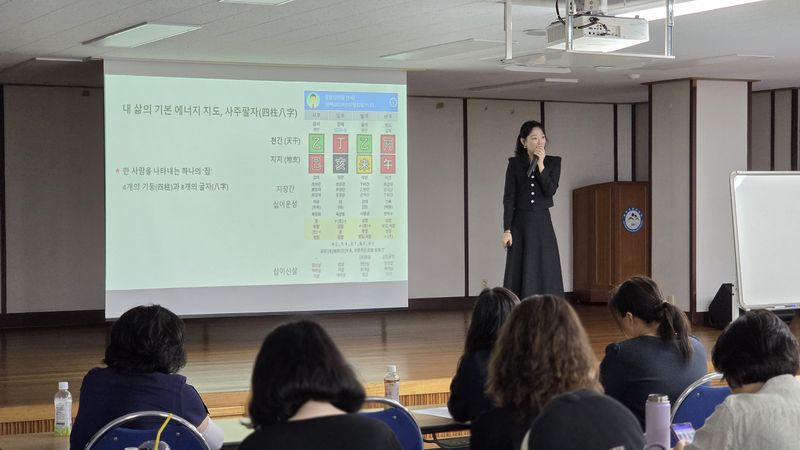
【Financial News Jeju = Jung Yong-bok】 An unusual healing program using the Four Pillars of Destiny was held in Jeju for teachers exhausted by violations of teachers’ rights, responding to complaints, and heavy workloads. Rather than using saju to predict the future, the training treated it as a tool for self-understanding and reflection. All 80 available spots filled early.
The Jeju Special Self-Governing Province Teachers’ Association said on the 14th that it held “A Walk to Find Myself, a Pause, and Release,” a healing training session for about 80 teachers from across the province at the Jeju International Education Institute on the morning of the 12th.
Applications were open to all teachers in the province, not only members of the Jeju Teachers’ Association. The 80 spots filled early on a first-come, first-served basis, and the Jeju Teachers’ Association covered the entire participation fee.
The lecture was led by Choi Ji-young, a teacher at Gwaggeum Elementary School. Choi serves as president of the Student Temperament Research Association.
To understand the training, it is first necessary to distinguish the nature of the Four Pillars of Destiny. It is a traditional East Asian interpretive system that examines a person’s temperament and the flow of life through the relationships among the heavenly stems, earthly branches, and the yin-yang and five-element principles associated with the year, month, day, and time of birth. The time of birth is divided into four pillars—the year, month, day, and hour pillars—and each pillar is represented by two characters, producing eight characters in total. This is the origin of the term “Four Pillars and Eight Characters.”
The system has traditionally been used to interpret personality, human relationships, career paths, and fortune. However, it differs in nature from standardized personality tests in modern psychology and scientifically validated psychological diagnoses.
The Jeju Teachers’ Association also did not structure the training as a fortune-telling course. Instead, it used the classification system of the Four Pillars of Destiny to help participants examine their own characteristics as expressed in their usual behavior, emotions, and relationships.
Participants entered their birth dates and times into a Manseryeok application to check their Four Pillars and Eight Characters. They then examined the relationships among the other characters based on the heavenly stem of the day pillar, which represents the day of birth and is known as the “Day Master.” In the Four Pillars of Destiny, the Day Master serves as one of the reference points for viewing oneself.
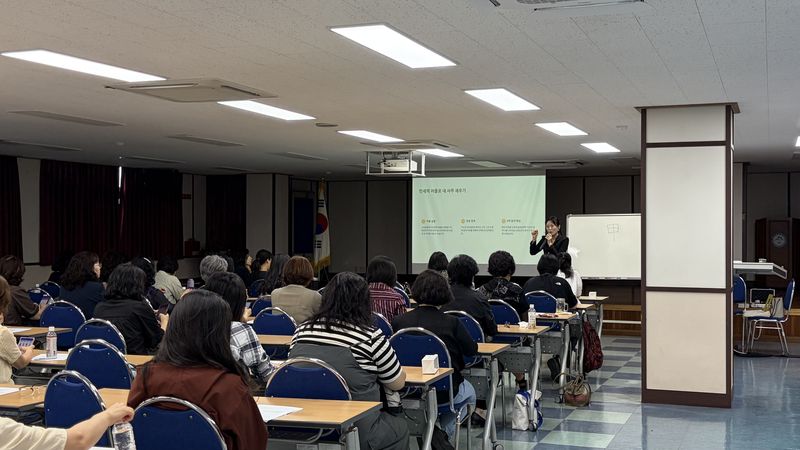
The lecture also used the concept of the “Ten Gods.” The Ten Gods classify and interpret the relationships between the Day Master and other elements into set patterns. Participants examined behavioral and relationship traits through categories such as the Officer, Resource, Output, and Wealth stars. Teachers applied the concepts to their own experiences and reflected on their usual behavior, emotional responses, and interpersonal relationships.
The training began with the recognition that teachers who observe their students’ dispositions and emotions also need time to reflect on themselves.
Teachers respond continuously to the needs and emotions of others while conducting classes, guiding student life, counseling parents, collaborating with colleagues, and handling various administrative tasks. The Jeju Teachers’ Association determined that teachers have relatively few opportunities in this process to examine their own emotions and behavioral patterns and recover.
One participating teacher said, “I have always paid attention to the children’s temperaments, but I had never really thought about my own.” The teacher added, “After understanding myself, I feel I have more room in my mind when looking at my students and colleagues.”
The Jeju Teachers’ Association said the meaning of the training lay less in the Four Pillars of Destiny interpretations themselves than in encouraging participants to ask themselves, “What kind of temperament do I have, and what am I pursuing?” Rather than replacing professional psychological counseling or testing, it was used as a voluntary recovery program that helps teachers reflect on their emotions and relationships in daily life.
The rapid influx of 80 applicants also demonstrates the demand for teacher recovery programs. The need for programs supporting teachers’ mental health and recovery is growing in schools, where violations of educational activities, responses to complaints, and heavy workloads continue.
Beginning with this training, the Jeju Teachers’ Association plans to expand its member programs in the second half of the year. It will sequentially offer domestic professional training, cultural tours, forest-path walks, volleyball, bowling, park golf, and camping for members in their 20s to 40s.
Jang Jeong-hun, president of the Jeju Teachers’ Association, said, “When teachers exhausted by violations of their rights and heavy workloads take care of themselves, it leads directly to the recovery of the classroom.” He added, “We will continue expanding training programs that support teachers’ mental health and recovery.”
[email protected] Jung Yong-bok Reporter