Pooling Community Resources to Help Students in Crisis
- Input
- 2026-09-14 13:42:17
- Updated
- 2026-09-14 13:42:17
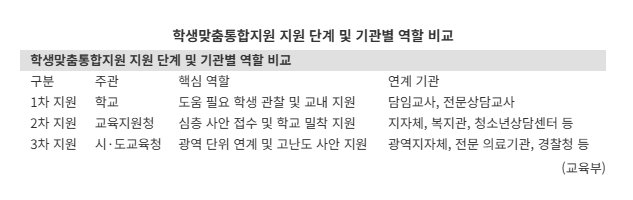
[Financial News] Schools and local communities are joining forces to help students in crisis, including those suffering from mental health problems or facing financial hardship at home. The Ministry of Education announced that it would hold the “2026 Second-Half Regional Cooperation System Joint Training for Student-Centered Integrated Support” from the 14th through October 7 to address gaps in student support that schools and education support offices cannot resolve on their own.
Until now, schools have faced clear limitations in helping students dealing with multiple problems at once, such as poor academic performance, depression, and domestic violence. Because education offices, local governments, and welfare agencies often operated separately, students in urgent need sometimes failed to receive assistance, while overlapping services created repeated inefficiencies.
Under the new approach, when a school identifies a child experiencing difficulties, the education support office holds a Student-Centered Integrated Support meeting with local welfare centers, hospitals, and local governments to develop a tailored solution.
Results from such cooperation are already emerging in the field. Dalseong Education Support Office formed an advisory group comprising 11 organizations, including Dalseong County Comprehensive Social Welfare Center; the county office’s welfare coordination and Dream Start teams; a family center; a youth center; and a welfare foundation. Through the group, isolated and withdrawn youths who had stopped leaving home were referred to counseling centers. Students experiencing psychological and emotional crises were connected with Dalseong County Mental Health Welfare Center and hospitals, helping them return to daily life.
Gwangmyeong Education Support Office also signed 25 memorandums of understanding over three years and provided 285 cases of tailored student support in cooperation with 32 organizations. These included career mentoring and talent donations from a business association, as well as family programs for vulnerable students run by an educational volunteer organization.
Students and parents who need help can also search directly for local welfare services online. By accessing the Ministry of Education’s Student-Centered Integrated Support website, users can check information on 20,390 welfare and counseling services provided by approximately 11,000 institutions nationwide.
About 800 officials from education support offices, metropolitan and basic local governments, specialized child protection agencies, youth counseling and welfare centers, the National Police Agency, and other related organizations will attend the training. It will be held six times across five regions: the capital area, Daegyeong, Honam, Chungcheong, and Busan-Ulsan-Gyeongnam. The schedule begins in Gwangmyeong-si on the 14th, followed by Daegu on the 15th, Jeonnam-Gwangju on the 29th, Daejeon on October 1, Seoul on October 2, and Busan on October 7.
Noh Jin-young, Director General of Student Support at the Ministry of Education, said, "Close cooperation among schools, education offices, and relevant local institutions is essential to eliminate gaps in student support." Noh added, "Through this joint training, we will strengthen regional cooperation systems for student support and ensure that students who need help receive tailored assistance at the right time."
[email protected] Kim Man-gi Reporter