Yeongjong Clean Net in Incheon Has Been Idle for More Than 10 Years; New Cathedral Must Spend 130 Million Won on Installation to Receive Completion Approval
- Input
- 2026-09-14 13:44:30
- Updated
- 2026-09-14 13:44:30
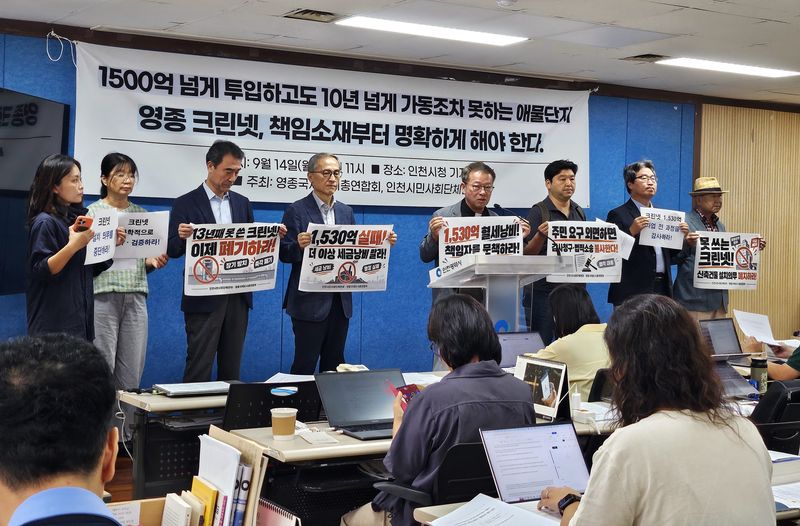
【Financial News Incheon = Reporter Han Gap-su】 A new building in Incheon’s Yeongjong International City is facing a bill of approximately 130 million won to install facilities related to Clean Net, an automated household-waste collection system that has not operated even once in more than 10 years. Residents are protesting, asking, "Who is this facility for?" They cannot obtain completion approval unless they install a system whose use remains uncertain.
The Incheon Civic and Social Organizations’ Solidarity and the Yeongjong-gu Apartment Association held a press conference at Incheon Metropolitan City Hall on the 14th, calling for an investigation into the long-term neglect of the Yeongjong Clean Net system, accountability from the relevant authorities, and an end to the requirement that new buildings install Clean Net facilities.
The controversy emerged when a cathedral in Yeongjong discovered the Clean Net installation requirement while going through the building completion process. Kim Il-hoe, standing representative of the Incheon Civic and Social Organizations’ Solidarity, said the cathedral had been informed that it needed to install Clean Net-related facilities to receive completion approval. The installation cost is expected to be approximately 130 million won, he added.
The cathedral asked whether it could install the facilities if Clean Net actually began operating, but the request was not accepted. As a result, it must install facilities whose use is uncertain in order to proceed with the completion process.
Clean Net is a system that automatically transports household waste through underground pipelines to a collection facility. In Yeongjong, it was completed in December 2014 at a cost of 153 billion won, but it has not operated normally for an extended period. Civic groups criticized the situation, saying, "The installation costs of a facility that is not operating are being passed on to new building owners and residents."
Under the district-unit plan for Yeongjong International City, new buildings are reportedly required to install Clean Net-related facilities. Critics say this structure continues to require building owners to spend additional money even though the effectiveness of the existing system remains uncertain.
Residents claim they have already paid for Clean Net installations. According to the Yeongjong-gu Apartment Association, approximately 2 million to 3 million won per household was included in apartment sale prices as an installation cost when the apartments were initially sold. Residents, however, currently use the conventional household-waste collection system.
Residents argue that some of the collection inlets inside the apartments have corroded after being left unused for a long time, and that the underground pipelines and collection facilities must also be tested to determine whether they can operate normally. They oppose restarting the system because apartment buyers could be required to pay for repairs to the facilities inside their buildings if operations resume.
The dispute over responsibility is also intensifying. Civic groups claim that the relevant authorities—including Korea Land and Housing Corporation (LH), which built the facilities, the Incheon Free Economic Zone Authority, and the former Incheon Jung-gu Office—have shifted responsibility without resolving the handover and operational issues.
According to LH documents, LH requested 11 joint inspections between 2014 and 2019 for the handover of the facilities and also requested meetings in 2021 and 2022. An agreement related to the handover was signed in 2023, but it has not led to normal operations to date.
Civic groups called for a comprehensive audit and investigation into the project’s implementation, budget execution, facility design and construction, handover, and the reasons for its prolonged nonoperation. They also argued that, rather than pursuing a restart because of past investment costs, authorities should objectively compare repair and operating costs and environmental impacts with those of the current household-waste collection system.
Residents demanded that the requirement for new buildings to install Clean Net facilities be suspended until an independent review is completed. They also called for all alternatives—including closure and partial operation—to be decided through public deliberation involving residents.
They called for △an audit of the entire project, worth around 150 billion won, △an investigation into responsibility for policy errors and poor management, △a comparison of the economic and environmental feasibility of Clean Net and the existing collection system, △public deliberation involving residents, and △the suspension of the Clean Net installation requirement for new buildings.
They said they would also pursue legal action, including requesting an audit and filing lawsuits, if the relevant authorities fail to take satisfactory measures.
[email protected] Han Gap-su Reporter