"Saemangeum’s Section 7 Was Still Sea Until June"... Hyundai Motor Group Completes Preparations for 9 Trillion Won Investment [On Site]
- Input
- 2026-09-14 14:40:14
- Updated
- 2026-09-14 14:40:14
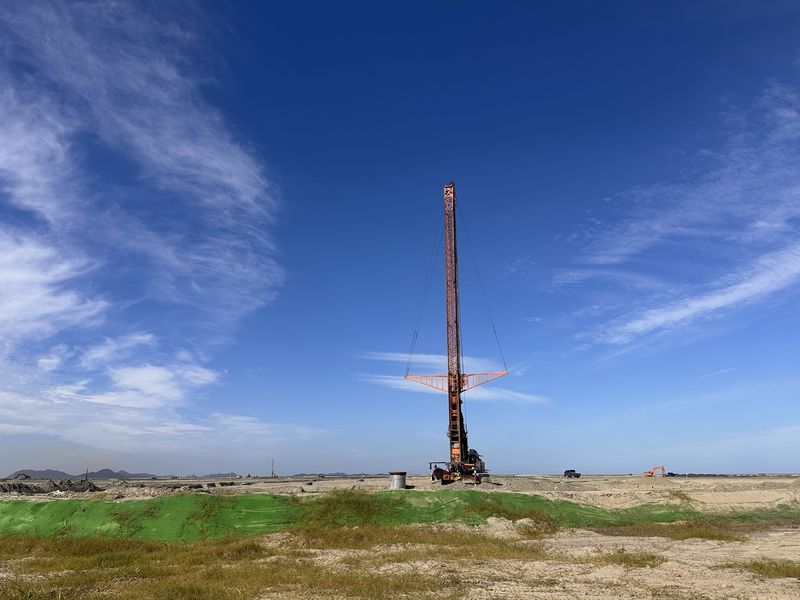
At the Saemangeum construction site in Gunsan City, North Jeolla Province, visited on the 11th, Section 7 stood out. The 1.4-million-pyeong site, where a Hyundai Motor Company plant will be built, was still sea until June but has now been reclaimed and turned into land. Construction was in full swing on the soil-covered site.
Equipment resembling cranes was operating, while workers moved busily around the site. Until recently, the area had been an empty expanse; now, it was filled with workers’ efforts to create a new industrial complex.
The government announced Hyundai Motor Group’s investment plan for the Saemangeum site in February. Hyundai Motor Group plans to invest approximately 9 trillion won to install and operate the country’s first robot manufacturing plant, an AI data center, and the nation’s largest water-electrolysis plant. The aim is to attract Hyundai Motor Group to Saemangeum in line with the government’s focus on balanced regional development and bring new economic momentum to North Jeolla Province.
Construction was underway not only in Section 7, where Hyundai Motor Company will move in, but also in Section 8, which will accommodate other companies. Unlike previous projects, Hyundai Motor Group is participating from the site-development stage. Development is scheduled for completion by the end of 2029.
The investment alone amounts to approximately 9 trillion won: 400 billion won for an AI robot manufacturing plant, 5.8 trillion won for an AI data center, 1 trillion won for a water-electrolysis plant, 400 billion won to support the development of an AI hydrogen city, and 1.3 trillion won for solar power generation. The investment will continue from as early as next year through 2035.
The large-scale industrial complex is expected to generate a production-inducing effect of 16 trillion won and create more than 70,000 jobs. A Saemangeum official said, "With the reclamation and landfilling work completed in June, we will accelerate construction and meet the completion schedule."
Landfilling work to cover the ground with soil was underway in Section 8. Large equipment, including cranes, was being used to survey the ground and identify areas where bedrock was buried.
A large-scale road network is essential for developing the industrial complex, and a solid foundation is needed to build roads capable of handling peak traffic volumes. The process involves rebuilding the road-support base on top of that foundation and compacting it so it can withstand the load.
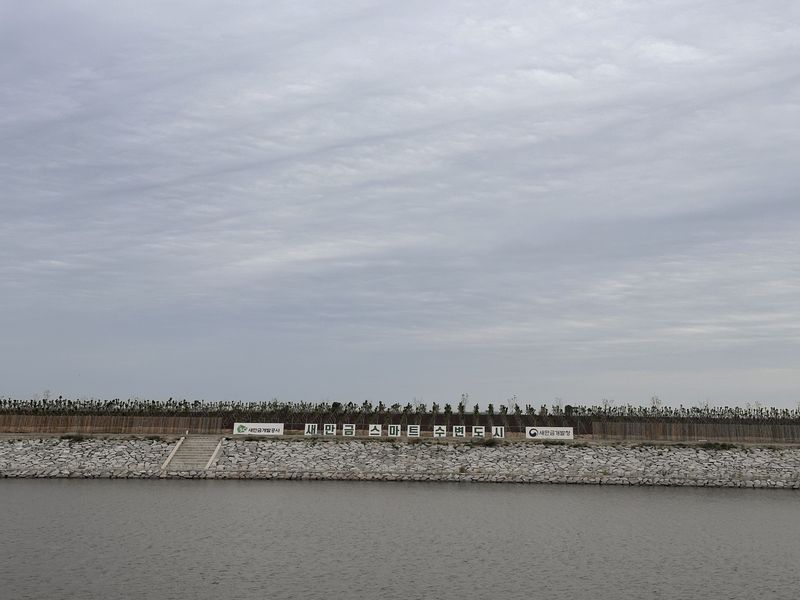
Saemangeum will feature not only the Hyundai Motor Company site, which will receive 9 trillion won in investment, but also a waterfront city where residents can live and work. Construction began in August 2019, with completion targeted for December 2028. The city is expected to accommodate 39,000 people and 19,000 households.
A mobility network, including robot taxis and autonomous shuttle buses, will also operate. Mixed-use residential and commercial complexes and education-focused facilities will be built, while detached houses and neighborhood commercial facilities will be offered for sale nearby. All detached houses priced in the 300-million-won range sold out in the first round, and a second round of sales is scheduled for this year.
Construction of transportation infrastructure was also continuing. Three bridges are scheduled to be built in the west to connect the waterfront city with other areas of Saemangeum, and Bridge No. 1 has already been completed.
Saemangeum plans to establish land, sea, and air transportation infrastructure through the construction of Saemangeum New Airport, KTX Saemangeum Station, and Saemangeum New Port. On land, services such as autonomous transportation between districts will be introduced alongside KTX. Another official explained, "We will focus on improving access to Saemangeum by building transportation infrastructure."
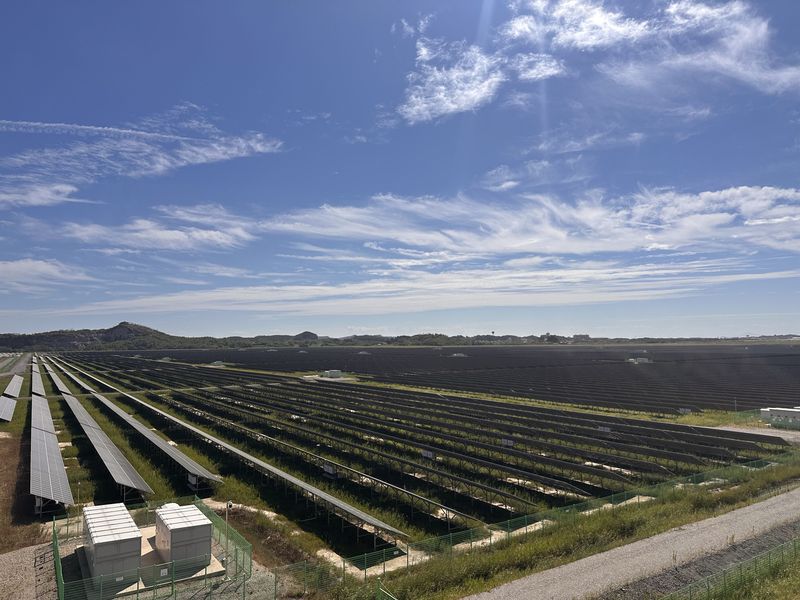
Hundreds of thousands of solar modules were also visible. Completed in 2021, the Saemangeum land-based solar power facility has 220,320 modules and a generation capacity of 99 MW, and will operate through 2041.
Its key feature is that the electricity generated there will be sold to companies located in the industrial complex, with part of the proceeds shared with the local community. Last year’s output was 426 GWh, exceeding the 422 GWh of residential electricity consumed by the 260,000 residents of Gunsan during the same period.
The project is backed by 10 public and private companies, including Korea South-East Power and Hyundai Engineering, reflecting a plan for companies and the local community to grow together through mutual cooperation.
Officials expressed their ambition to transform Saemangeum into a hub for the nation’s advanced strategic industries. Moon Seong-yo, head of the Saemangeum Development and Investment Agency (SDIA), emphasized, "We will strengthen Saemangeum’s competitiveness by focusing on advanced strategic industries such as robotics, AI, and hydrogen," adding, "We will lead balanced national development and secure Saemangeum’s future growth engines."
[email protected] Reporter Jeong Gyeong-su Reporter