TS Seeks Solutions to Achieve Early Commercialization of UAM
- Input
- 2026-09-14 13:00:00
- Updated
- 2026-09-14 13:00:00
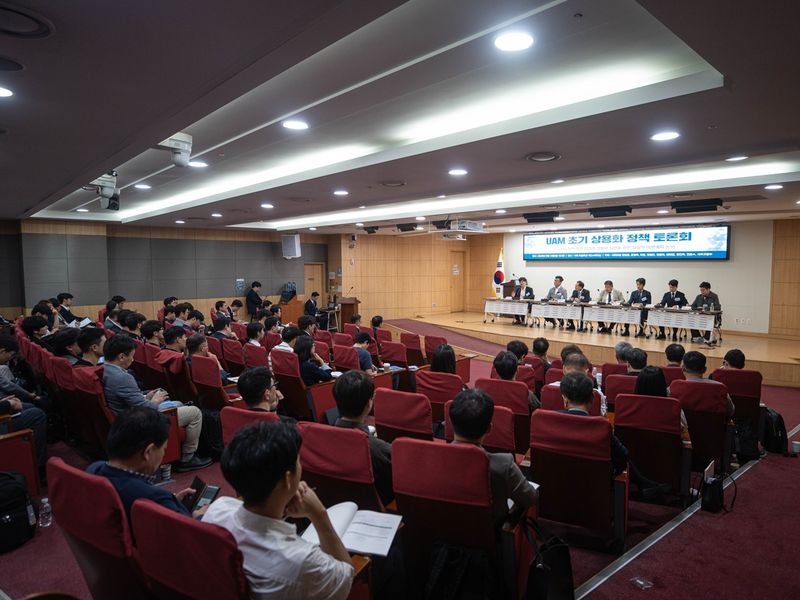
[Financial News] The Korea Transportation Safety Authority (TS) held a policy discussion on achieving the early commercialization of Urban Air Mobility (UAM).
According to TS on the 14th, the “UAM Early Commercialization Policy Discussion” was held that day at the National Assembly Members’ Office Building, with around 150 participants from academia, industry, and research institutions involved in UAM. The event was organized to review policy directions for the UAM industry and discuss practical implementation plans.
The discussion featured presentations on strategies for the early commercialization of UAM, measures to secure personnel, support for aircraft certification, and cases of local governments promoting commercialization. The Ministry of Land, Infrastructure and Transport (MOLIT) presented its “Strategy for Achieving the Early Commercialization of UAM,” while TS presented measures to secure personnel. The Korea Institute of Aviation Safety Technology introduced measures to establish a UAM safety system and support certification, and Jeju Special Self-Governing Province presented a case involving the development of a regional commercialization model.
The subsequent open discussion was attended by leading domestic UAM companies, including Korea Aerospace Industries (KAI), Sambo A&T, UI Helijet, GS Engineering & Construction, Aerobalance, and Verty. Industry representatives offered their views on support for demonstration projects, incentives for early operators, training specialized personnel in operations and certification, and the development of detailed safety systems.
Jang Jong-tae, a Democratic Party of Korea lawmaker on the National Assembly’s Land, Infrastructure and Transport Committee, said, "UAM policy has moved beyond the stages of conceptualization and demonstration and entered the stage of preparing for actual operations." He added, "Certification, the securing of specialized personnel, and regional business models must be closely connected within a single implementation plan." He also stated, "I will work to secure the necessary institutional improvements and budgetary support so that UAM does not remain limited to demonstration projects."
Yong-Sik Jung, chairman of the board, said, "We will continue to work with industry experts so that various commercialization policy tasks, including the UAM qualification and training systems, can be implemented in the right direction." He added, "We will do our utmost to establish a safety system so that UAM can become a means of transportation in everyday life."
[email protected] Jung Kyung-soo Reporter