Seoul City Bus Strike Threatened; 1,500 Free Shuttles and Free Seoul Bikes to Be Deployed
- Input
- 2026-09-14 11:37:39
- Updated
- 2026-09-14 11:37:39
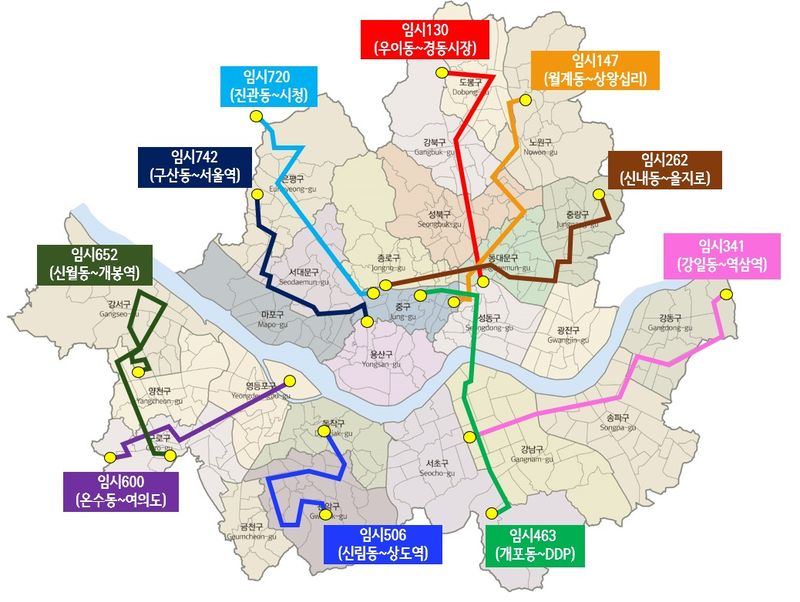
[Financial News] Seoul Metropolitan Government will activate emergency transportation measures in preparation for a strike by Seoul’s city bus labor union. It will deploy up to 1,500 free shuttle buses, add 202 subway trips a day, make Seoul Bike temporarily free of charge during the strike, and extend the last subway service until 2 a.m. the following day.
Seoul Metropolitan Government announced on the 14th that it had prepared these emergency transportation measures after the Seoul City Bus Labor Union announced plans to strike from the first bus service on the 16th. The union has said it will begin the strike with the first service the following day if no wage agreement is reached by the 15th.
Seoul Metropolitan Government will first significantly expand the number of free shuttle buses. The number of chartered buses, which stood at around 700 during the previous strike, will be increased to as many as 1,500 this time.
Of these, the 25 autonomous districts will deploy up to 1,300 buses to connect major hubs and residential areas with subway stations. The remaining roughly 200 buses will operate on 10 major arterial routes, including Gangnam-daero, Tongil-ro and Dobong-ro, to support travel between autonomous districts. If the strike is prolonged, the city plans to further expand shuttle bus services on arterial routes.
Subway services will also be substantially increased. If the strike takes place, a total of 202 additional trips will operate each day. Peak commuting periods will each be extended by two hours compared with normal operations. The morning peak period, currently from 7 to 9 a.m., will run from 7 to 11 a.m., while the evening peak period, currently from 6 to 8 p.m., will run from 6 to 10 p.m. The last subway service will also be extended by one hour, from 1 a.m. at the terminal station to 2 a.m. the following day.
The emergency transportation measures newly include village buses and Seoul Bike. Seoul Metropolitan Government plans to temporarily lift restrictions on the use of city bus stops for village bus operators that apply, allowing them to operate on major arterial roads after consultations with the autonomous districts.
Seoul Bike will be free of charge temporarily during the strike. The plan is to shift demand for short- and medium-distance trips of around 5 kilometers one way to Seoul Bike and reduce inconvenience caused by the suspension of city bus services.
To prepare for increased private-car use, roadside bus-only lanes operated by Seoul Metropolitan Government will be opened to regular vehicles during the strike. Median bus-only lanes, however, will remain unavailable to regular vehicles as before.
Temporary bus routes will also operate if some drivers do not join the strike or return to work during the strike. After checking whether each route can operate, shuttle services will run from bus depots to major subway stations. Routes with sufficient operating capacity will run along their entire routes.
Temporary routes will operate free of charge in principle. Vehicles operating as shuttles will display their service sections and identify themselves as shuttle buses on the front. Routes operating along their entire sections will provide arrival information through bus information terminals at stops.
Seoul Metropolitan Government plans to take firm action, in cooperation with the police, against illegal acts that obstruct normal operations during the strike. Officials will be stationed at each bus depot, and the city will respond if vehicles block depot entrances or interfere with the operation of buses running normally.
To reduce traffic congestion, the city asked elementary, middle and high schools, public institutions and private companies in Seoul to adjust school and commuting start times by one hour. It also recommended making active use of telecommuting and flexible work arrangements when necessary.
Real-time traffic information will be provided through the 120 Dasan Call Center, TOPIS, Seoul’s transportation information center, the Seoul Metropolitan Government website and social media channels, roadside electronic signs, and bus information terminals.
To prepare for the situation, Seoul Metropolitan Government will hold a meeting on the 14th with the transportation bureau chiefs of the autonomous districts and representatives of transportation companies to review the emergency transportation measures. It will hold another review meeting on the 15th, the day before the strike, to make a final check of its preparations.
Yeo Jang-kwon, head of Seoul’s transportation office, said, "We plan to operate as many alternative transportation options as possible to minimize inconvenience to citizens. As there is still time for labor and management to resolve the issue through dialogue, we ask both sides for understanding and concessions so that the negotiations can conclude at a reasonable level that citizens can accept."
[email protected] Seong Cho-rong Reporter