BRICS Summit Showed Strength—and Clear Limits—Amid Tensions [Yoon Jae-jun’s World View]
- Input
- 2026-09-14 16:04:40
- Updated
- 2026-09-14 16:04:40
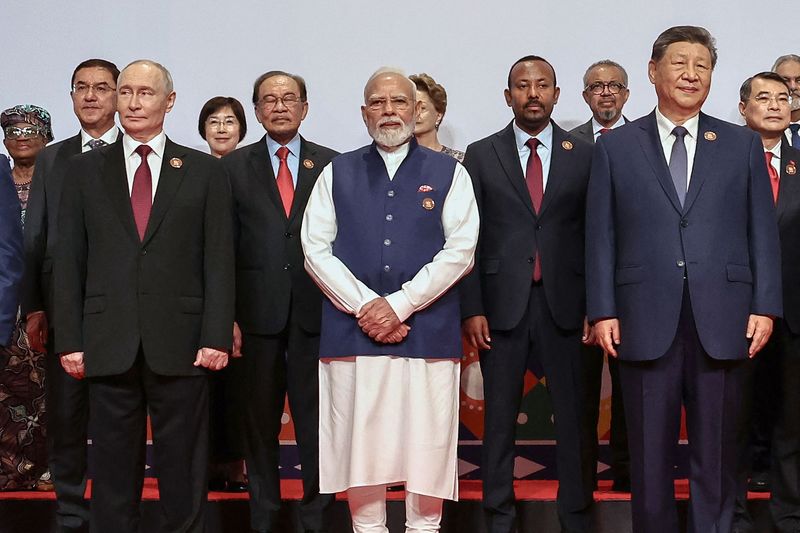
[Financial News] The BRICS summit held in New Delhi, India, on the 12th and 13th (local time) brought together some of the world’s most influential leaders. Indian Prime Minister Narendra Modi declared that "BRICS countries must no longer be ‘rule-takers’ who follow existing rules, but ‘rule-shapers’ who build a new international order," calling for the bloc to strengthen its standing.
The summit was attended by Chinese President Xi Jinping, Russian President Vladimir Putin, Iranian President Masoud Pezeshkian, South African President Cyril Ramaphosa, and Khaled bin Mohamed bin Zayed Al Nahyan, the Crown Prince of Abu Dhabi. The gathering itself was a diplomatic achievement for India, bringing together leaders whose countries have histories of border disputes and military confrontation. It also highlighted how the interests of various countries have become intricately entangled amid rapidly shifting global affairs, including the war in the Middle East.
China, Russia, and Iran have sought to use BRICS as a platform to weaken the influence of the United States and Western Europe. India, the host country, has instead been wary of BRICS being portrayed as an anti-Western bloc. At the summit, Prime Minister Modi emphasized that BRICS "is not directed against any particular country or group."
Anil Trigunayat, a former Indian diplomat, said, "Some members want an anti-Western alliance, but that is not the essence of BRICS." He added, "India is focused on securing ‘strategic autonomy’ in an era of war and strengthening practical cooperation among member states."
Despite differences among the members, the New Delhi Declaration was unexpectedly adopted on the first day. This represented progress, given that two ministerial meetings held earlier this year failed even to issue a joint statement. However, the prevailing assessment is that it was a compromise that deliberately excluded issues involving deep disagreements.
Regarding the situation in the Middle East, the declaration called for "maximum restraint" and criticized attacks on civilian and peaceful nuclear facilities, but it did not identify the perpetrator.
On the war in Ukraine, unlike previous declarations, it made no mention whatsoever of Russia’s invasion of Ukraine.
On trade, the declaration criticized "indiscriminate tariff increases" and unilateral sanctions, but avoided directly naming the United States, apparently mindful of opposition from the administration of U.S. President Donald Trump.
Praveen Donthi, a senior analyst at the International Crisis Group (ICG), noted, "Criticizing conflicts while avoiding the names of specific countries is a typical feature of the diplomatic language led by India."
Unlike the limited official declaration, notable diplomatic contacts took place on the sidelines. The Iranian and United Arab Emirates (UAE) leaders held talks, with Iranian President Masoud Pezeshkian and UAE Crown Prince Khaled bin Mohamed bin Zayed Al Nahyan meeting at the highest level between the two countries since the war in the Middle East began to discuss economic cooperation. Xi Jinping visited New Delhi for the first time in seven years since the 2020 border clash. Modi and Xi shook hands and pledged to remove trade barriers and strengthen economic and transport connectivity. However, tensions remained, as Xi skipped the official dinner and shortened his stay to less than 24 hours.
The New Delhi summit demonstrated that BRICS can create a forum where even countries with hostile relations can engage in dialogue outside Western-led institutions. Yet despite a shared desire for a more diversified international order, the bloc still failed to offer clear answers on what concrete alternative should replace the existing order or how it should be implemented.
At last year’s BRICS summit in Rio de Janeiro, speculation arose that China’s interest in the bloc was waning after Xi Jinping did not attend. At that meeting, BRICS made no progress on introducing a currency that could challenge the U.S. dollar. Some observers attributed this to members’ reluctance to adopt a new economic model because of their competitive relationships with one another.
At the next BRICS summit, a major challenge will be determining what should replace the existing order and how, as member states recognize the need for a new international order.
[email protected] Yoon Jae-jun Reporter