Closed Schools to Be Transformed into AI Education, Cultural and Experiential Facilities
- Input
- 2026-09-14 12:00:00
- Updated
- 2026-09-14 12:00:00
[Financial News] Schools that closed due to declining student populations will be transformed into AI and digital education facilities, cultural and sports spaces, and experiential facilities that make use of local resources.
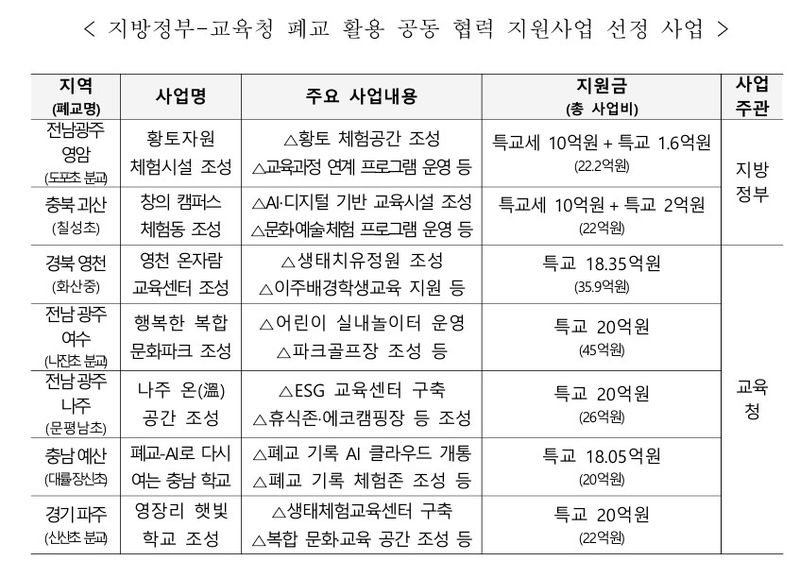
The Ministry of the Interior and Safety (MOIS) and the Ministry of Education announced on the 14th that they had selected seven projects in which local governments and education offices will jointly repurpose closed schools. The projects will receive a total of KRW 12 billion through special local allocation taxes and special grants. The initiative aims to turn school facilities that could otherwise be left unused because of declining student numbers into regional hubs shared by residents and students, thereby improving local living conditions.
This is the first joint initiative by MOIS and the Ministry of Education to repurpose closed schools. MOIS will support two projects involving schools owned by local governments, while the Ministry of Education will support five projects involving schools owned by education offices. The two ministries selected the seven projects after assessing their necessity, feasibility and potential for expansion to other regions.
Chilseong Elementary School in Goesan, North Chungcheong Province, will be transformed into the “Chilseong Creative Campus,” equipped with AI- and digital-based creative and convergence education facilities. It will also operate a Kimchi Atelier, a local food lab and woodworking programs, with the goal of increasing the number of people who stay in the area for education, training and experiential activities. Of the total project cost of KRW 2.2 billion, KRW 1 billion will come from a special local allocation tax and KRW 200 million from a special grant.
Najin-Yongchang Branch School in Yeosu, South Jeolla Province, will be transformed into a multifunctional cultural space for everyone from children to senior citizens. The school building will house a public indoor playground, a book café and a screen practice room, while a park golf course will be built on the athletic field. The total project cost is KRW 4.5 billion, including KRW 2 billion in special grants.
Munpyeongnam Elementary School in Naju will house an ESG education center and an educational supplies sharing and support center. Rooftop solar facilities, a park golf course, an eco-camping zone, a futsal field and a walking trail will also be created. The plan is to turn the aging school into a space used jointly by local residents, rather than a facility used only by the education office.
Sinsan Elementary School Yeongjang Branch in Paju, Gyeonggi Province, will be developed into the “Yeongjang-ri Sunshine School,” which will provide climate and energy education. Solar power generation facilities will be installed in the parking lot and on the roofs and exterior walls of the buildings, while a student farming experience area will be created beneath the solar panels. A residents’ rest area, walking paths and outdoor exercise spaces will also be established.
The projects also include efforts to make use of existing local resources. At Dopo Elementary School Susan Branch in Yeongam County, South Jeolla Province, an experiential space using local loess and an outdoor horticultural experience area will be created. Hwasan Middle School in Yeongcheon will be transformed into an educational and cultural complex featuring an ecological healing garden, an outdoor performance venue and a local market, and it will also be used for educating students from immigrant backgrounds.
In Yesan County, the history of the closed schools themselves will be preserved by combining it with AI. An experiential space will be created at Daeryul Elementary School, which closed in 1999, while a mobile outdoor exhibition space will be installed at Jangsin Elementary School. The plan is to operate “Talking School,” where users can converse with AI trained on materials from each closed school, and “My School Record,” in which residents can participate, using a public cloud platform.
MOIS and the Ministry of Education plan to provide not only special local allocation taxes and special grants but also project-specific consulting and publicity. They will also promote outstanding examples from the projects in other regions.
Kim Min-jae, vice minister of MOIS, said, "This is a meaningful attempt to transform closed schools from mere idle assets into future growth assets for local communities."
[email protected] Lee Bo-mi Reporter