"A Must-Visit Stop When You Come to Korea—Buy This Stock Now"... After Selling So Much Banana Milk [Shareholder Club]
- Input
- 2026-09-14 15:41:12
- Updated
- 2026-09-14 15:41:12
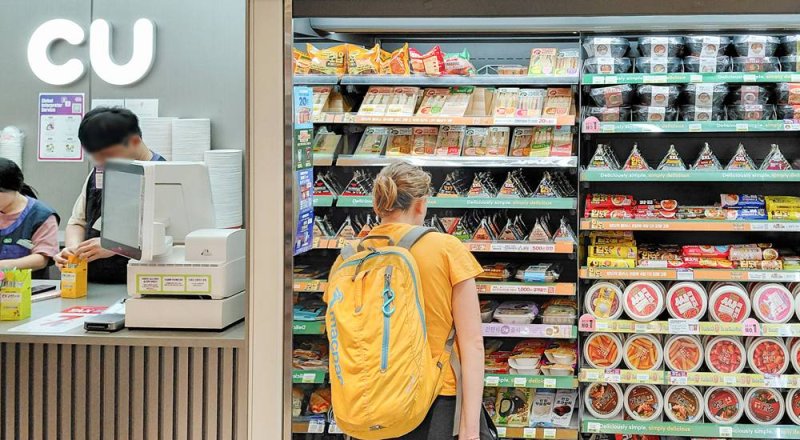
[Financial News] It is already well known that banana-flavored milk is one of the best-selling products at convenience stores in Incheon International Airport, a place foreign visitors to Korea invariably pass through. As banana-flavored milk and ready-to-eat foods displayed on convenience-store shelves have emerged as popular spots for foreign tourists to take proof shots, analysts say South Korea’s convenience-store industry— which has struggled for nearly two years with the aftereffects of quantitative expansion—is entering the early stages of a structural rebound.
In a report released on the 14th, Daishin Securities described convenience stores as "a must-visit destination for foreign tourists" and assessed that the industry, having completed its restructuring, is reaching a structural turning point amid a tourism boom. In the report, researcher Yoo Jeong-hyun noted, "After convenience stores cleared out underperforming locations and shifted toward a higher-quality store mix, the recovery in domestic consumption and foreign tourists’ use of convenience-store channels have begun to increase significantly."
Store count declines for the first time in 15 years... Foreign visitors to Korea bring a 'turnaround'
According to the report, South Korea’s convenience-store industry expanded through fierce competition to open new locations until the early 2020s. However, profitability per store deteriorated following excessive expansion, and the industry entered an intensive restructuring phase in 2024 and 2025. The number of convenience stores nationwide fell 1.3% in 2024 and 2.9% in 2025 from the previous year, marking the first decline in store count in 15 years. The industry as a whole also improved its fundamentals as the No. 1 and No. 2 operators began reorganizing around high-performing locations.
As a result, the convenience-store market’s growth rate swung from -0.7% in 2023 to 2.5% in 2024 and -0.4% in 2025. This was markedly different from the double-digit annual growth recorded from 2015 to 2022, driven by tobacco-price increases. The mood changed in the second half of last year, however. Market growth rose from 2.2% in the first quarter of this year to 4.5% in the second quarter. Industry observers point to the recovery in domestic consumption and increased use of convenience stores by foreign visitors to Korea as the main reasons.

Foreign sales in Busan rise 97.6%... Convenience stores emerge as 'K-food experience channels'
The most notable change is in foreign tourists’ consumption patterns. In the second quarter of this year, convenience-store industry sales to foreign customers surged 60.1% from a year earlier. By region, Busan posted the sharpest increase at 97.6%. Major tourist destinations also recorded broad-based growth, including Jeju Province at 62.8%, Incheon at 59.0%, Seoul at 55.2%, and Gyeonggi Province at 55.8%.
For foreign visitors, convenience stores are popular not only because they are easy to find almost anywhere, but also because they offer an affordable way to experience popular Korean foods. Researcher Yoo said, "Foreign consumers mainly buy food and beverages, such as drinks, snacks, and treats, as well as daily necessities they need immediately." He added, "Considering the current increase in the number of foreign visitors and the popularity of Korean convenience-store channels, it will not take very long for foreign sales to rise to 4% to 5% of total sales."
"I don’t buy cigarettes—I buy snacks": Foreign customers lift GPM to a record high with their strong margins
The increase in foreign sales is especially significant because it is translating directly into improved profitability, rather than merely expanding the top line. Tobacco accounts for the largest share of convenience-store sales, at about 36%, but it is a representative low-margin product, with a gross profit margin (GPM) of only around 9%. Foreign tourists, by contrast, mainly purchase non-tobacco general merchandise such as beverages, snacks, and treats. These products have an average GPM of around 20%, far higher than tobacco.
As a result, the convenience-store industry’s GPM entered the 19% range for the first time in the second quarter of this year. Since the third quarter is typically considered the peak season, following the second quarter’s high season, and GPM tends to be seasonally higher in the third quarter, some analysts expect this year’s third-quarter GPM to exceed 19% for the first time.
Researcher Yoo forecast, "Existing-store growth at convenience stores was limited to around 1% in July and August because of the high base created by last year’s consumption coupons, but it returned to a normal growth rate in September." He added, "With the extreme heat of August over, pleasant September weather for outings coinciding with the Chuseok holiday, existing-store growth is expected to be strong in the fourth quarter, paving the way for a full-fledged rise in share prices."
Reflecting this trend, Daishin Securities maintained its “Buy” ratings on convenience-store leaders BGF Retail and GS Retail, along with target prices of 200,000 won and 33,000 won, respectively. Both companies are expected to post double-digit growth in sales and operating profit in the third quarter. Analysts believe that BGF Retail, whose business is focused solely on convenience stores, could see a relatively larger improvement in earnings. GS Retail is also showing solid performance in its supermarket division, where existing-store growth has reached the 10% range, raising the possibility of a valuation re-rating.
[email protected] Hee-sun Kim Reporter