Regional R&D to Shift from Central Control... Jeju Allocated 8.8 Billion Won, with Regions Designing Projects
- Input
- 2026-09-14 09:41:27
- Updated
- 2026-09-14 09:41:27
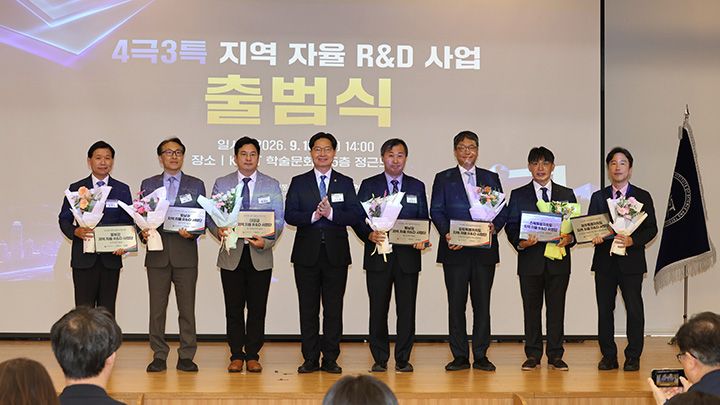
[Financial News Jeju = Reporter Jeong Yong-bok] The regional research and development (R&D) system, in which the central government determined specific research projects and sent them down to the region, is changing to a system where regions directly design growth strategies, key technologies, and research projects. 8.8 billion won will be invested in Jeju Province this year. With distributed energy and bio-based agriculture, livestock, and fisheries set as the two main pillars, a region-led R&D initiative is set to begin in earnest, integrating research and development with demonstration, talent cultivation, and commercialization.
According to the Ministry of Science and ICT on the 14th, the government issued an integrated recruitment notice for research groups for the '2026 4 Regions 3 Special Zones Science and Technology Innovation Support Project (Regional Autonomous R&D)' on the 11th. Prior to this, on the 10th, a launch ceremony for the project was held at KAIST in Daejeon, and growth models for seven regions were unveiled, including the Central, Honam, Daegu-Gyeongbuk, and Southeast regions, as well as Gangwon, Jeonbuk, and Jeju Special Self-Governing Province.
The budget allocated for this year is 78.9 billion won. The "4 Metropolitan Areas, 3 Special Areas" strategy is a national balanced development strategy that groups the entire country, excluding the Seoul metropolitan area, into four metropolitan areas and three special autonomous regions, allowing regions to independently identify future growth industries and concentrate their research and development capabilities.
The key change in this project is the way money is spent rather than the scale of research funding. Instead of the government individually determining specific tasks by field, it allocates bundled R&D funds to regions, and local governments, science and technology institutes, government-funded research institutes, universities, and companies analyze local industries and technology demands to design research projects and commercialization pathways.
This is why the Ministry of Science and ICT calls it 'block funding-type R&D.' Through joint planning by the government and regional innovation institutions, a total of 18 key technology fields were selected, with three each for the four metropolitan regions and two each for the three special autonomous provinces.
Jeju has selected distributed energy and bio-based agriculture, livestock, and fisheries. The total investment in Jeju Province this year amounts to 8.8 billion won. 5.183 billion won will be invested in distributed energy, and 3.617 billion won in bio-based agriculture, livestock, and fisheries. The plan is to connect Jeju's renewable energy demonstration environment and clean biological resources with research and development competitiveness.
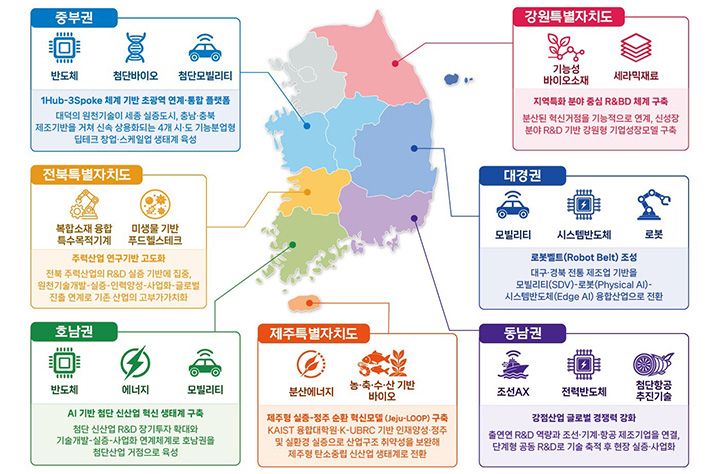
The actual research structure has also been concretized. In the distributed energy sector, 3.86 billion won will be provided for five projects to establish an industry-academia-research hub, 260 million won for two projects to regionally spread deep tech, and 715 million won for one project to train personnel tailored to future new industries.
For agriculture, livestock, and fisheries-based bio, 2.315 billion won was allocated to three projects for establishing industry-academia-research hubs, 354 million won to three projects for regional expansion of deep tech, and 715 million won to one project for training personnel tailored to future new industries.
405 million won will also be invested in establishing the K-UBRC, which connects the two technology fields. The K-UBRC is a model that connects the research experience of retired scientists and engineers with local universities and companies to support the resolution of technical difficulties, joint research, and technology commercialization. A total of 16 research projects are scheduled to be selected.
It is not a structure where only research institutions participate. Companies in the Jeju region have been appointed as lead organizations for two projects on the regional diffusion of distributed energy deep tech and three projects on the regional diffusion of agriculture, livestock, and fisheries-based bio deep tech. Government-funded research institutes, universities, and science and technology institutes can also collaborate as joint research institutions.
The intention is not to stop at merely transferring technology developed in the laboratory to local companies, but to incorporate corporate demand into the R&D system from the very beginning.
The Jeju Technology Commercialization Headquarters of the Korea Institute of Industrial Technology (KITECH) serves as the central hub for the Jeju project. KAIST leads the project team for the Central region, Gwangju Institute of Science and Technology (GIST) for the Honam region, Daegu Gyeongbuk Institute of Science and Technology (DGIST) for the Daegu-Gyeongbuk region, and Ulsan National Institute of Science and Technology (UNIST) for the Southeast region. The Gangneung and Jeonbuk branches of the Korea Institute of Science and Technology (KIST) oversee regional R&D for Gangwon and Jeonbuk, while the Jeju Technology Commercialization Headquarters of KITECH oversees R&D for Jeju.
The final model envisioned by Jeju is the 'Jeju-type Demonstration-Settlement Circular Innovation Model (Jeju-LOOP).' It is a cyclical structure that fosters talent for future industries in the region, settles them in Jeju, demonstrates technologies in real-world environments, and then links the verified technologies back to startups, investment, and corporate growth.
The cooperation between KAIST and Jeju National University (JNU) also falls under this structure. The Ministry of Science and ICT has specified the "establishment of a KAIST-Jeju National University (JNU) Convergence Graduate School" in the Jeju development model. It serves as a talent development axis aimed at cultivating high-level research personnel in the region to connect research outcomes, corporate activities, and settlement into a single ecosystem.
Related procedures are also underway in Jeju. Last July, the Future Economy and Industry Committee of the Jeju Provincial Council passed the motion to consent to funding the operation of the KAIST-Jeju National University (JNU) Joint Graduate School without amendment. Jeju Province is also pursuing a plan to expand the joint graduate school into a Jeju United Campus involving the four major science and technology universities in the long term.
However, the operation of the joint degree, the academic system, the roles of participating institutions, and the mid-to-long-term financial sharing are still at a stage where they need to be concretized.
The government plans to develop this project into a regional science and technology-based growth model by 2030 and expand the scale of investment starting next year. In Jeju as well, success is expected to hinge on whether research outcomes lead to increased corporate revenue and investment, as well as the settlement of local jobs and research personnel.
Koo Hyuk-chae, First Vice Minister of Science and ICT, said, "We will actively support the establishment of a virtuous cycle in the region where research results lead to corporate growth and good jobs, and new talent and investment further promote research and development."
[email protected] Jeong Yong-bok Reporter