2,000 Head and Neck Cancer Reconstruction Surgeries Performed, Saving Patients Who Lost Their Tongues
- Input
- 2026-09-14 10:02:16
- Updated
- 2026-09-14 10:02:16
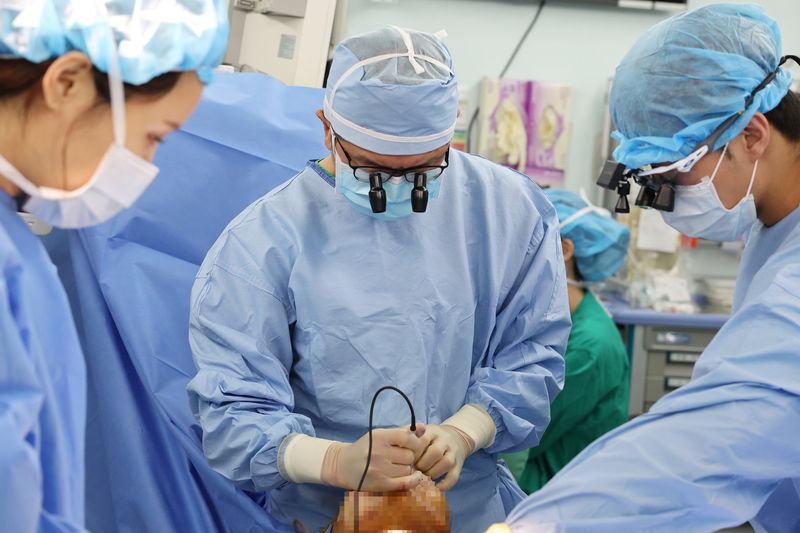
[Financial News] Microsurgical reconstruction for head and neck cancer, which averaged only 40 procedures annually in its early years, has more than tripled to over 140 procedures per year over the past seven years. The Head and Neck Reconstructive Plastic Surgery Team at Asan Medical Center has performed 2,000 such procedures, the first hospital in South Korea to reach the milestone.
In April, a 50-year-old man identified by his surname, Song, had to undergo complete tongue removal to treat oral cancer. Removing the cancer was a major operation in itself, but meticulous reconstructive surgery was essential to preserve his ability to speak and swallow as much as possible after surgery. The Head and Neck Reconstructive Plastic Surgery Team at Asan Medical Center transplanted an anterolateral thigh free flap (ALT), consisting of skin, soft tissue, blood vessels and nerves harvested from Song’s thigh, along with the gracilis muscle, into the defect. This highly complex procedure involved reconnecting blood vessels just 1–2 mm in diameter under a microscope so that blood could flow again through the transplanted tissue. The surgery was completed successfully, and after recovery and rehabilitation, Song regained the ability to speak and swallow and returned to his daily life.
The result was achieved by a team of professors from the Department of Plastic Surgery at Asan Medical Center—Choi Jong-woo, Oh Tae-seok, Jung Woo-sik and Kim Young-chul. They began performing the procedures in 1996, reached 1,000 cases in 2019, and completed another 1,000 in just seven years.
Head and neck cancer is a collective term for cancers that develop in various areas of the head and neck, including the mouth, pharynx, larynx, maxilla and mandible. Prognoses vary greatly depending on the site and stage of onset. Advanced head and neck cancer is particularly difficult to treat and is a serious disease associated with a substantially lower survival rate.
In treating head and neck cancer, it is crucial not only to remove the cancer completely but also to reconstruct the affected tissue in a way that restores the patient’s functions and quality of life. Cancer removal often requires resection of substantial portions of the tongue, oral cavity, pharynx, larynx, or upper and lower jawbones. Without appropriate reconstruction, patients may suffer severe impairment in basic functions such as speaking and swallowing, as well as significant deformities of the face and neck.
Free-flap reconstruction for head and neck cancer provides these patients with a foundation for speaking, swallowing and returning to daily life. In this highly complex procedure, skin, muscle or bone tissue is harvested together with its blood vessels from areas such as the thigh, arm, abdomen or calf and transferred to the site of cancer removal. Surgeons then use a microscope to connect tiny arteries and veins measuring about 1–2 mm in diameter, restoring blood flow to the transplanted tissue. Professor Choi’s team was also the first in the world to perform not only simple soft-tissue reconstruction but also functional muscle transplantation, dynamically restoring tongue movement and minimizing patients’ difficulty swallowing.
Head and neck cancer surgery often involves the head and neck cancer team from the Department of Otolaryngology removing the cancer and cervical lymph nodes over approximately 5–6 hours, after which the plastic surgery reconstruction team takes over and performs another five or more hours of reconstruction. Close cooperation among medical departments is therefore essential. The procedure also requires a high level of expertise because surgeons must restore the complex three-dimensional anatomy inside the mouth and perform meticulous suturing to prevent saliva from leaking into the surgical site.
The Head and Neck Reconstructive Plastic Surgery Team at Asan Medical Center has maintained a high success rate of approximately 97% in these highly complex free-flap reconstruction procedures. Precise reconstruction makes it possible to pursue active cancer treatment even when a wide area of tissue must be removed. It also plays an important role in helping patients return to daily life by restoring key functions such as eating and communicating after surgery.
Professor Choi said, "Microsurgical reconstruction for head and neck cancer involves operating on tiny blood vessels and is a highly complex procedure that continues for many hours immediately after cancer removal surgery. If a problem develops in the transplanted tissue after surgery, we may have to return for emergency surgery even in the early hours of the morning. Nevertheless, being able to see patients speak, swallow and return to their daily lives again is one of the aspects of plastic surgery that gives me the greatest sense of fulfillment."
He added, "Treatment and reconstruction for head and neck cancer can never be completed by a single doctor. Reaching 2,000 cases was possible because of the teamwork built over many years by medical professionals from multiple fields, including the head and neck cancer team in otolaryngology, plastic surgery, medical oncology, radiation oncology, rehabilitation medicine, dentistry and nursing. We will continue working not merely to treat the cancer, but to help patients regain as much normal function and quality of life as possible."
[email protected] Medical Reporter Jung Myung-jin Reporter