Canada to Become an 'EU Associate Member'... Prime Minister Carney's Challenge
- Input
- 2026-09-14 09:45:58
- Updated
- 2026-09-14 09:45:58
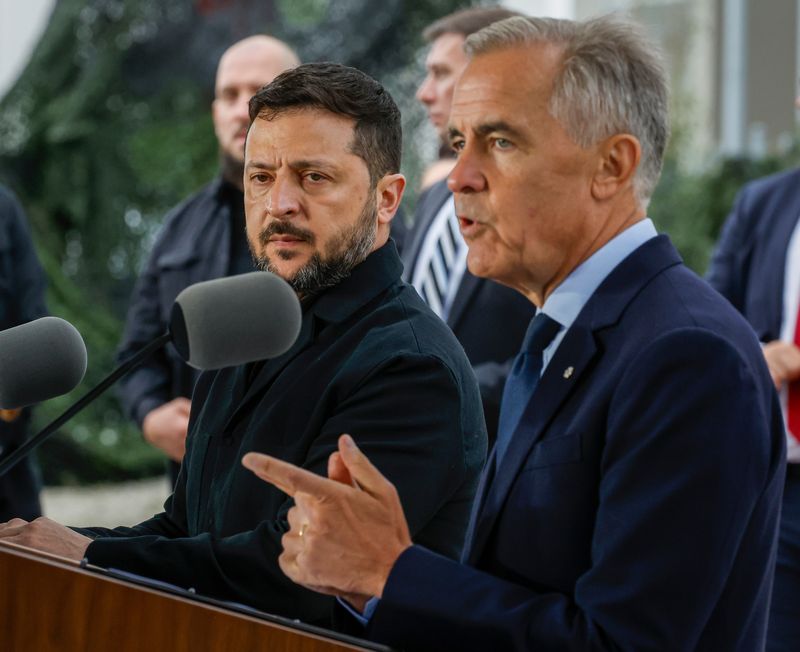
[Financial News] As trade tensions with the administration of United States President Donald Trump intensify, Canadian Prime Minister Mark Carney is seeking a breakthrough by moving away from the United States and strengthening cooperation with the European Union (EU).
Prime Minister Carney is expected to elaborate on his vision for strengthening ties with Europe at the European Parliament on the 17th.
The Wall Street Journal analyzed on the 13th the opportunities and challenges facing Prime Minister Carney as he pursues the bold challenge of making Canada an EU associate member.
Carney holds calls and private meetings with nearly all major European leaders
During the months of trade war with the United States, Prime Minister Carney held calls and private meetings with nearly all major European leaders, including the leaders of France, Italy, Germany and Scandinavian countries, as well as lesser-known European royals.
The main goal is to find ways to integrate Canada into the EU.
The Wall Street Journal described Carney's efforts by saying, "He is pursuing a speed-dating marriage to offset the pain of breaking with the United States."
Prime Minister Carney proposed to European leaders that Canada would be willing to become an "EU associate member."
Officials on both sides said that even the EU, which maintains strict rules on membership eligibility, has responded positively to the idea.
After months of negotiations, European and Canadian officials are exploring cooperation in energy, artificial intelligence, critical minerals needed for batteries and semiconductors, and the most urgent area of all—defense. Some observers say this could blur the EU's economic boundaries.
"Pursuing a speed-dating marriage with the EU amid a break with the United States"
Sources said that in conversations with French President Emmanuel Macron, Carney even discussed allowing Canadians to live and work in Europe without visas.
The two sides are also discussing laying undersea cables, building data centers and cloud storage systems less dependent on the influence of major U.S. technology companies, and jointly developing new satellite networks.
Other proposals include building pipelines to supply gas that could partially replace Russian gas and transporting Canadian fertilizer through Arctic routes.
They are also considering linking research institutions on both sides to build a network capable of competing with the U.S. university system.
Canada currently sends two-thirds of its exports to the United States by land. President Donald Trump expects this interdependence to bring Canada back to the negotiating table and secure concessions, but Prime Minister Carney's attention is focused on Europe.
Europe also sympathizes with Carney's efforts... $25 billion German submarine purchase
Last October, Prime Minister Carney appointed veteran diplomat John Hannaford as Canada's special envoy to Europe.
However, it took more than two months for European Commission President Ursula von der Leyen to appoint Joost Korte, a Dutch diplomat with 30 years of experience, as her counterpart.
European and Canadian officials said that several European leaders, including Italy's conservative Prime Minister Giorgia Meloni and United Kingdom Prime Minister Keir Starmer, were concerned about friction with the United States.
Two events—President Donald Trump's attempt to take control of Greenland and the war with Iran—prompted more European leaders to sympathize with Prime Minister Carney's reasoning and sense of urgency.
Prime Minister Carney frequently communicated with German Chancellor Friedrich Merz, whom he had known since his days as a banker, and finalized negotiations for Canada's $25 billion purchase of German submarines.
[email protected] International Affairs Specialist Lee Seok-woo Reporter