Bank overdrafts approach 70 trillion won... highest since late 2021
- Input
- 2026-09-14 09:41:54
- Updated
- 2026-09-14 09:41:54
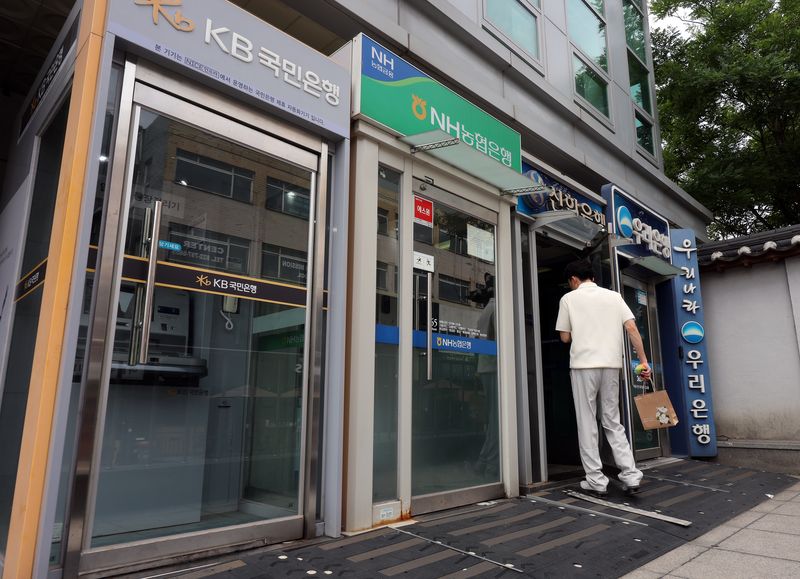
According to data submitted by the Financial Supervisory Service to Rep. Park Sung-hoon of the People Power Party, a member of the National Policy Committee of the National Assembly, on the 14th, the outstanding balance of overdraft loans at domestic banks totaled 69.7283 trillion won as of the end of last July. This represents an increase of 6.0874 trillion won (9.6%) compared to 63.6409 trillion won at the end of last year. This figure represents the actual amount borrowed by borrowers, not the loan limits approved by banks.
On the other hand, the number of overdraft accounts increased by only 24,317 (0.5%) from 4,869,319 to 4,893,636 during the same period. Although the growth rate in the number of accounts fell short of 1%, the total outstanding loan balance increased by nearly 10%.
The loan balance per account, calculated by dividing this balance by the number of active accounts that have not been closed, increased from approximately 13.07 million won at the end of last year to approximately 14.25 million won at the end of July this year. Over the seven months, the average borrowing amount per account increased by approximately 1.18 million won (9.0%).
The increase in outstanding overdraft loans this year was mostly concentrated between April and July. During this period, the increase in the balance reached 5.7827 trillion won, accounting for 95.0% of the cumulative increase from the beginning of the year through the end of July. Notably, even in July, when the domestic stock market underwent a sharp correction, the outstanding balance of overdrafts increased by 1.1496 trillion won.
The balance at the end of July this year was the largest since the end of 2021 (70.1814 trillion won) compared to the balance at the end of a past quarter. 2021 was a period when a stock investment craze among individual investors swept through the country, fueled by low interest rates and abundant liquidity immediately following the COVID-19 shock. The recent increase in overdraft balances is also analyzed to be closely related to the demand for "debt-financed investment" among individual investors.
The problem is that interest rates have increased compared to the end of 2021. The average interest rate on overdraft accounts, calculated by applying weights to outstanding loan balances by bank, rose by approximately 1.70 percentage points from 3.94% per annum at the end of 2021 to 5.64% at the end of July this year. This suggests that the burden of principal and interest repayment has increased.
Representative Park stated, "The fact that the amount of money withdrawn from overdraft accounts has skyrocketed while the account balances remain unchanged is evidence that households' dependence on emergency funds is increasing significantly," adding, "Policies that only manage the number of loans cannot solve the household debt problem while the cash flow for people's livelihoods is deteriorating."
[email protected] Ye Byeong-jeong Reporter