"Not the Number of Treatments, but Quality of Life": Samsung Seoul Hospital to Change Medical Evaluation Criteria
- Input
- 2026-09-14 09:00:00
- Updated
- 2026-09-14 09:00:00
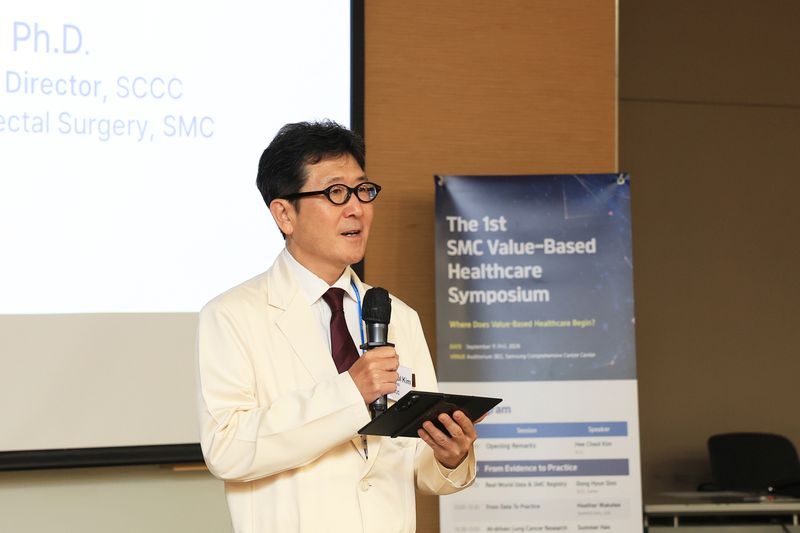
[Financial News] Samsung Seoul Hospital Cancer Hospital is working to expand value-based healthcare, which evaluates medical outcomes based on patients’ actual health outcomes and quality of life rather than the number of treatments or length of stay.
Samsung Seoul Hospital Cancer Hospital announced that it held the First Samsung Seoul Hospital International Symposium on Value-Based Healthcare at the hospital’s cancer center lecture hall on the 11th.
The symposium was organized to share domestic and international experience in evidence-based clinical practice and research, as well as patient-centered care supporting value-based healthcare, and to expand cooperation. This followed Samsung Seoul Hospital’s achievement in April as the first hospital in South Korea to receive ICHOM certification.
Value-based healthcare evaluates and improves medical outcomes by focusing on the health outcomes and quality of life patients actually achieve through treatment, rather than the volume of care or the treatment process itself. ICHOM is a nonprofit organization that develops and disseminates international standards for measuring clinical outcomes and quality of life that matter to patients in order to advance value-based healthcare.
Five international experts were invited to speak at the symposium. They included Heather Wakelee, chief of the Division of Medical Oncology at Stanford University School of Medicine and former president of the International Association for the Study of Lung Cancer (IASLC); Stanford Cancer Institute Professor Summer Han; Mary Duffy, a specialist nurse at Peter MacCallum Cancer Centre in Australia; Professor Maria Ptanou, director of a psychosocial oncology center; and Professor Shalini Vinod of Liverpool Cancer Therapy Centre, who co-developed Australia’s cancer treatment pathway model.
The symposium was divided into two sessions: “Finding Value in Evidence” and “Patient-Centered Care Is the Beginning of Value-Based Healthcare.”
The first session presented various cases aimed at measuring and improving patient treatment outcomes based on data and evidence. These included Samsung Seoul Hospital’s experience in establishing a clinical registry, evidence-based clinical practice and research in lung cancer, lung cancer research using artificial intelligence (AI), and its experience obtaining ICHOM certification.
The second session shared domestic and international experience in implementing patient-centered care in actual clinical settings. Topics included multidisciplinary care coordination for cancer patients, geriatric oncology models, the mental health of older cancer survivors, and nurse-led geriatric oncology care models.
From South Korea, Samsung Seoul Hospital professors Shin Dong-hyun of the Liver Cancer Center and Department of Gastroenterology, Lee Se-kyung of the Breast Cancer Center and Department of Breast Surgery, and Yang Kyung-mi of the Department of Radiation Oncology presented case studies.
Kim Hee-chul, director of Samsung Seoul Hospital Cancer Hospital and a professor of colorectal surgery, said, "It is difficult to fully capture the health and quality of life patients actually gain using only treatment-process indicators such as the number of treatments or length of stay." He added, "Samsung Seoul Hospital Cancer Hospital has managed not only treatment outcomes but also patient experience and quality of life as important elements of treatment performance."
He continued, "Evidence-based data provide the power to realize patient-centered care, while patients’ voices show us the direction in which the data should move." He added, "We hope this symposium will lead to greater sharing of experience and expanded cooperation with medical institutions at home and abroad, helping value-based healthcare spread further throughout South Korea’s medical field."
[email protected] Medical Specialist Jung Myung-jin Reporter