The Rediscovery of Lee Min-ho That Even Yoo Hae-jin Found Surprising: "Now the Story Comes First... I Became Freer Before and After 'Pachinko' [Interview]"
- Input
- 2026-09-14 09:02:34
- Updated
- 2026-09-14 09:02:34
[Financial News] "I only knew him as a Hallyu star, but after meeting him this time, I found him very smart and kind. He approached me so warmly that it was truly unexpected."
Actor Yoo Hae-jin praised his junior, Lee Min-ho, after working with him for the first time in the film 'Assassin(s)'. For Yoo Hae-jin, the project was also an opportunity to discover Lee Min-ho anew as an actor.
Lee Min-ho is opening a new chapter as an actor, moving beyond the familiar label of “Hallyu star” since the Apple TV+ series 'Pachinko'. In 'Assassin(s)', which opens on the 23rd, he takes on one of the film’s central roles alongside Yoo Hae-jin and Park Hae-il, two leading actors in Korea’s mainstream film industry. As Yoo Hae-jin noted, Lee Min-ho was curious about the world and had clear opinions of his own. Even while meeting with several reporters, he discussed his thoughts with a flexible and natural attitude rather than remaining guarded or trying to present a polished image.
"I wondered how I would blend in with Yoo Hae-jin and Park Hae-il."
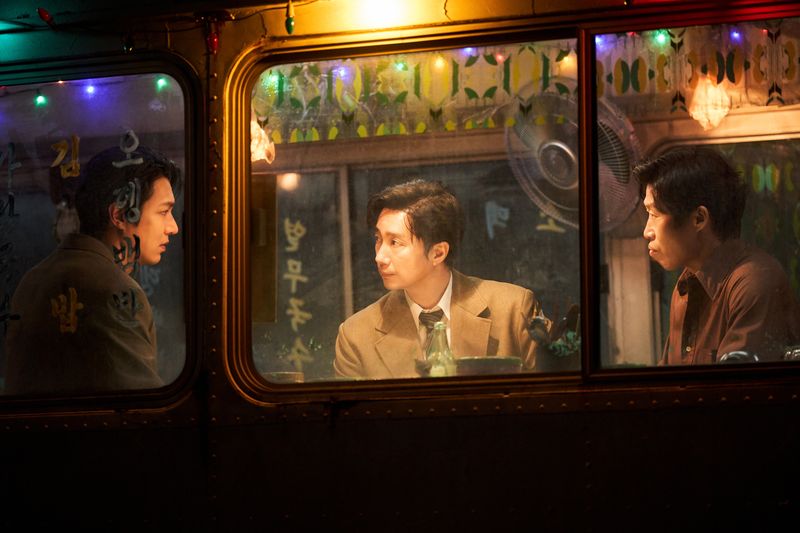
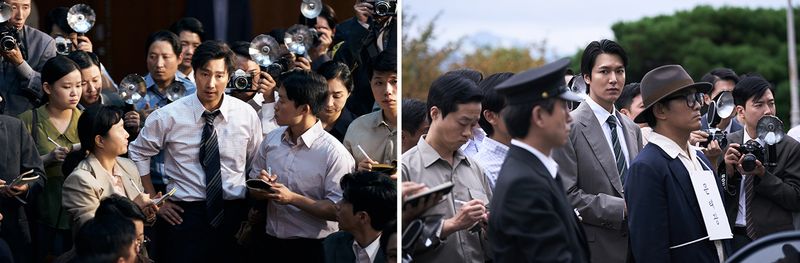
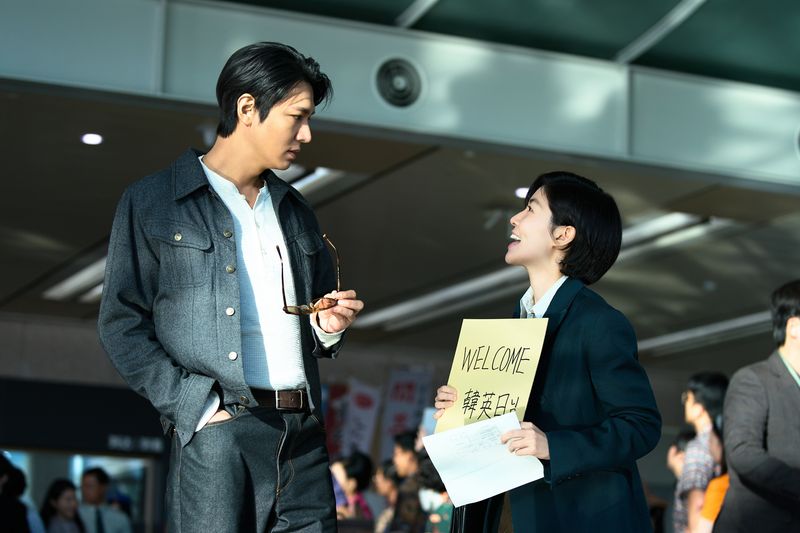
Hur Jin-ho’s new film 'Assassin(s)' is a mystery inspired by the shooting of the presidential first lady on August 15, 1974. It follows the investigation into the suspicions surrounding the incident and the forces behind it. Yoo Hae-jin plays Cheol-gu, a detective who witnesses the shooting, while Park Hae-il portrays Jae-hwan, the social-affairs editor of a newspaper who digs into the truth despite external pressure. Lee Min-ho plays Young-il, a rookie reporter who throws himself into the center of the case with ambition and persistence.
He said, "It was an incident I had come across with interest through YouTube’s algorithm even before receiving the screenplay," adding, "I found the process of approaching the case through the perspective of a character pursuing the truth appealing as well."
Unlike Cheol-gu and Jae-hwan, who are weighed down by the repressive era, Young-il brings vitality to the film. Although he grew up in a privileged environment, he does not remain in a comfortable life and instead chooses the path of a reporter for himself.
He said, "I wanted to capture the energy of a young person who had lived a sheltered life but still wanted to choose his own path without denying that background."
The background to Young-il’s decision to become a reporter reflects the atmosphere among young people who resisted the Yushin regime at the time. He said, "The anti-Yushin movement was active, particularly around prestigious universities," adding, "I thought that, for Young-il, becoming a reporter might have been a way to participate in the democratization movement on his own terms."
Lee Min-ho described Young-il as “a live fish of a character.” From the rehearsal stage onward, he constantly moved rather than standing still, bringing energy to each scene. In a scene where he approaches a woman to obtain information using a charm-based tactic, he even improvised the line, "Do you like ssanghwa tea?"
Above all, the set gave Lee Min-ho the chance to closely observe and learn from the performances of two highly experienced senior actors.
He said, "My biggest concern was whether I could blend naturally with the two seniors, who were firmly grounded," adding, "My mission was to look not like someone acting, but like a person who had actually lived in that era."
The two senior actors welcomed their “Hallyu star” junior without reservation. Park Hae-il, in particular, visited the set almost every day, even when he had no scenes scheduled. Lee Min-ho, too, naturally began spending longer periods on set.
He said, "When I saw that Park Hae-il came to the set every single day, I couldn’t stay away either," adding, "It felt like a family."
"I gained freedom before and after 'Pachinko'."
Around the time of 'Pachinko', Lee Min-ho’s perspective changed—not only as an actor but also in how he viewed life itself. He gained global popularity at a young age through dramas such as 'Boys Over Flowers', 'The Heirs', and 'The King: Eternal Monarch', but that attention remained an invisible burden for a long time.
He said, "If the period through 'The King: Eternal Monarch' was more than a decade of receiving enormous attention at a young age while carrying an unspoken burden, then afterward my mind was reset once," adding, "After turning 30, I became curious about other people’s stories, and once I reached an age where I could communicate with them, the way I chose and expressed projects also changed."
The key to that change is “freedom.” He said that interviews in the past had also been occasions on which he performed the role of an actor, whereas now he feels as though he sits down and talks as Lee Min-ho the “human being.”
He said, "Your 20s and 30s are clearly different," adding, "When I think about my 30s and 40s ahead, I need new energy, and I think I need to become freer in order to find it."
If the Lee Min-ho of his 20s was the protagonist of fantasies who fell in love with a mermaid in 'The Legend of the Blue Sea' and played the emperor of the Korean Empire in 'The King: Eternal Monarch', he is now more drawn to characters who live with their feet planted in the reality of their times. That is why he first considers what story a project contains rather than the size of a role.
'Assassin(s)' continues that trajectory. He found the film’s value in the “right to know.”
He said, "I think Korean society is overly conscious of and avoids uncomfortable stories or points that could become uncomfortable," adding, "Wouldn’t it be healthier to bring that discomfort into the open and exchange each person’s subjective views honestly?" He continued, "What was special was that audiences could experience different interpretations and emotions while watching an incident that actually occurred in history."
He is not particularly afraid of being judged. In fact, the greater the pressure, the more boldly he tends to act.
"I think I just need to do what I can in the situation I’m given, like Young-il."

[email protected] Shin Jin-a Reporter