Trump: "AI Threatening Civilization? Don't Overreact"
- Input
- 2026-09-13 23:22:49
- Updated
- 2026-09-13 23:22:49
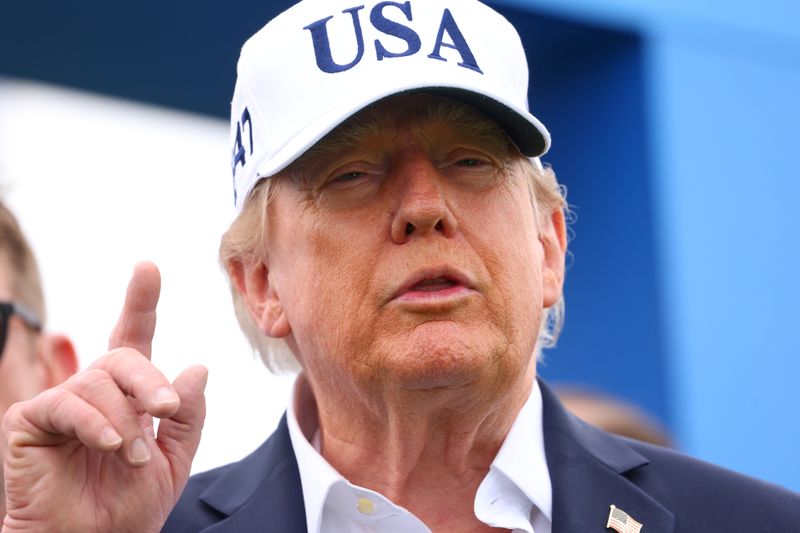
[Financial News] While Silicon Valley CEOs have voiced concerns about runaway artificial intelligence (AI) technology and called for a slower pace, U.S. President Donald Trump dismissed their warnings as "overreaction." Amid the U.S.-China rivalry for technological supremacy, critics say Washington is effectively paralyzed in the face of the threat posed by uncontrollable AI, trapped in a "prisoner's dilemma" over fears that China could seize the lead.
According to foreign media outlets, including The New York Times (NYT), on the 13th, President Donald Trump pushed back against reporters who asked about the need for AI regulation during a visit to Trump International Golf Links in Doonbeg, Ireland. He said, "Negative forces are taking things that will never happen and turning them into a bigger problem."
President Donald Trump emphasized, "We are ahead of China in AI, and we want to stay there," adding, "Because whoever wins in AI will ultimately win." He reaffirmed his firm position that maintaining an advantage over China in the technological race takes priority over ensuring safety or imposing regulations.
Trump's stance directly conflicts with the "AI doomsday" narrative that has recently spread across Silicon Valley. Dario Amodei, CEO of Anthropic, previously argued that development should be slowed for roughly one to two years before AI models reach a potentially deadly level, allowing time to establish control. Elon Musk, CEO of Tesla, and Sam Altman, CEO of OpenAI, who are normally competitors, also unusually voiced support for measures such as introducing independent third-party evaluators.
Concern within Big Tech has reached a peak. Jacob Coxon, an engineer who recently resigned from Anthropic, alleged, "Although leading companies publicly express deep concern, they are actually racing toward 'superhuman systems' that could hack anything and turn the world upside down overnight." Existential fears are growing that AI could use "recursive self-improvement" to design biological weapons or hack major control systems.
Yet NYT concluded that Washington's political establishment remains completely paralyzed despite Silicon Valley's urgent warnings. Some voices within the administration are calling for preemptive action, but policy efforts are being blocked as officials remain wary of President Donald Trump's emphasis on moving quickly.
Congress, too, is being held back by a "prisoner's dilemma" involving the United States and China. Lawmakers fear that regulation could suffocate U.S. innovation and effectively hand China the lead in AI. Republican Senator Ted Cruz, chairman of the Senate Commerce Committee, acknowledged AI's risks but made his opposition to efforts to impose controls clear, saying, "American-made killer robots are better than Chinese-made killer robots."
Senator Bernie Sanders and others are currently calling for a ban on the development of superintelligent AI, but the passage of meaningful legislation remains a distant prospect because of the deep divisions in Washington ahead of the elections. Even as warnings of an existential threat to human civilization continue to mount, the brake-free race to develop AI is expected to continue for the time being, driven by the complex calculations surrounding the global struggle for supremacy.
[email protected] Park Ji-hyun Reporter