"Even After Selling Stocks, They Couldn’t Repay Their Debts"—Unpaid Principal Among Leveraged Retail Investors Rises Fivefold in One Year
- Input
- 2026-09-14 05:20:00
- Updated
- 2026-09-14 05:20:00
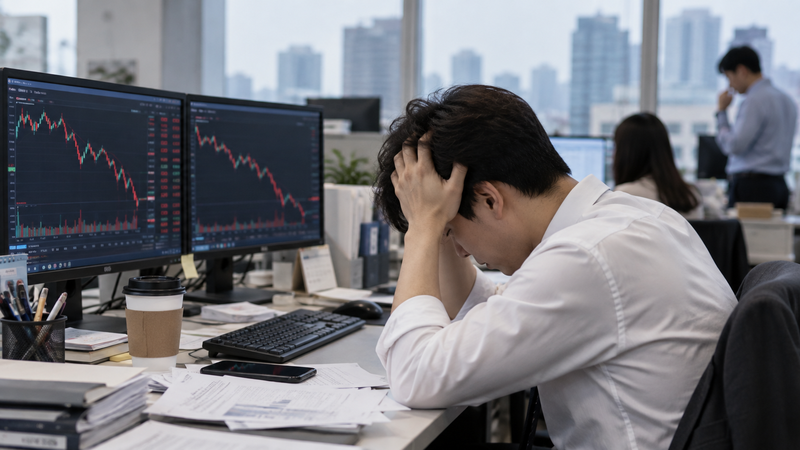
[Financial News] As retail investors’ enthusiasm for leveraged investing—borrowing money to invest—intensifies, the number of cases in which they failed to fully repay money borrowed from securities firms even after forced liquidation has risen sharply. The unpaid principal, or debt remaining after their stocks were forcibly sold, increased more than fivefold in one year.
Data obtained on the 7th by the office of Park Dae-chul, a People Power Party lawmaker on the National Assembly’s National Policy Committee, from the Financial Supervisory Service showed that the unpaid principal generated immediately after forced liquidation by individual investors totaled 37.79575 billion won from January through July this year. The data covered the 10 domestic securities firms with the largest equity capital: Korea Investment & Securities, Mirae Asset Securities, NH Investment & Securities, MERITZ SECURITIES, Samsung Securities, KB Securities, KIWOOM Securities, Hana Securities, Shinhan Investment & Securities, and Daishin Securities.
That was approximately 5.1 times the 7.45588 billion won recorded during the same period last year.
Unpaid principal arises when an investor who bought stocks with funds borrowed from a securities firm faces forced liquidation because stock prices fall, but the forced sale of the holdings is insufficient to repay the entire loan principal. However, this tally combines all amounts generated immediately after forced liquidation. The actual outstanding debt may decrease if investors subsequently deposit additional cash or securities firms recover the receivables.
By month, unpaid principal stood at 5.50132 billion won in January, fell to 1.99621 billion won in April and 2.48552 billion won in May, then surged to 13.11467 billion won in June. Another 8.8164 billion won was recorded in July. The sharp increase in June was analyzed as having resulted from large-scale forced liquidations after the stock market underwent a steep correction over a short period.
The KOSPI Composite Index started the year at around 4,000 and continued rising to approximately 9,385 on June 19, but then fell rapidly. Retail investors who had borrowed money from securities firms to invest after seeing the upward trend were hit by a sudden decline in stock prices, triggering a series of forced liquidations. Some were still unable to fully repay their debts even after their stocks were sold.
According to the Korea Financial Investment Association, the balance of credit-financing loans reached a record 38.6328 trillion won on June 24. This was when leveraged investing—borrowing money from securities firms to purchase stocks—was at its peak.
A total of 7,251 accounts generated unpaid principal from January through July this year. That was 2.3 times the 3,136 accounts recorded during the same period last year. However, the figure differs from the actual number of investors because unpaid principal can arise multiple times in a single account.
By securities firm, KIWOOM Securities recorded the largest amount of unpaid principal at 20.68504 billion won, accounting for 54.7% of the total. It was followed by Mirae Asset Securities with 6.12047 billion won and Samsung Securities with 4.82509 billion won.
The balance of unsettled receivables at the 10 securities firms, which can lead to forced liquidation, exceeded 1 trillion won for the first time in May this year, reaching 1.1953 trillion won. By the end of July, it had risen to 1.351 trillion won, setting another record high.
Unsettled receivables were also concentrated at KIWOOM Securities. Its balance stood at 650 billion won, accounting for roughly half of the total, followed by Mirae Asset Securities at 185 billion won and Korea Investment & Securities at 183.5 billion won.
[email protected] Han Seung-gon Reporter