IU’s Patulous Eustachian Tube: Why Her Voice Echoes Inside Her Ears [Health Talk]
- Input
- 2026-09-14 04:40:00
- Updated
- 2026-09-14 04:40:00

[Financial News] Singer IU released a new digital single, “I Byeol-ro-buteo,” on the 10th after postponing her concert and sixth full-length album schedule because her symptoms of patulous Eustachian tube worsened. Patulous Eustachian tube is a condition in which the Eustachian tube, which normally remains closed, stays abnormally open, causing a person’s own voice and breathing sounds to echo inside the ear.
IU released the digital single “I Byeol-ro-buteo” at 6 p.m. on the 10th. The new single includes the double title tracks “I Byeol-ro-buteo” and “Dear My Crazy Soulmate.” Both songs serve as pre-release tracks for her upcoming sixth full-length album.
IU previously canceled her Goyang concert, scheduled for September, and postponed the release of her sixth full-length album because her symptoms of patulous Eustachian tube worsened. The schedule changes were prompted by the continued abnormal opening of the Eustachian tube, which connects the space behind the eardrum with the area behind the nose.
The Eustachian tube normally remains closed
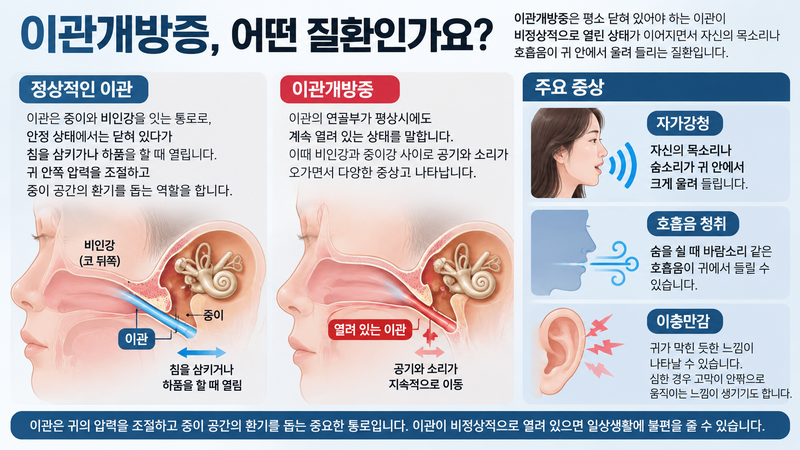
The Eustachian tube is a passage connecting the middle ear and the nasopharynx. It remains closed at rest and opens when a person swallows or yawns. The structure regulates pressure inside the ear and helps ventilate the middle-ear cavity.
Patulous Eustachian tube refers to a condition in which the cartilaginous portion of the Eustachian tube remains open even at rest. Air and sound then pass between the nasopharynx and middle-ear cavity, causing autophony, audible breathing, and aural fullness. Autophony is a symptom in which a person’s own voice or breathing sounds seem unusually loud inside the ear.
Patients may also complain of a feeling that their ears are blocked. If air continuously enters the middle-ear cavity from the nasopharynx, they may hear breathing sounds resembling wind. In severe cases, they may even feel the eardrum moving inward and outward.
Symptoms worsen when standing or singing
Symptoms of patulous Eustachian tube can vary depending on posture. Seoul National University Hospital explained that symptoms may lessen or disappear when a person lies down or bends their head forward, while they may worsen when standing or after using a nasal decongestant.
Symptoms may also develop after exercise. Dehydration during exercise or reduced congestion in the nasopharynx can trigger them. Symptoms may worsen during prolonged speaking or singing as the amount of nasopharyngeal mucus decreases.
For singers and others whose work requires prolonged singing and vocalization, patulous Eustachian tube can affect their schedules and activities. When their own voice echoes loudly inside the ear, it can make pitch, vocal production, and breathing control more difficult.
Rapid weight loss may also be linked
The causes of patulous Eustachian tube have not yet been clearly established. Known contributing factors include weight loss and tissue atrophy associated with chronic illnesses. Cases have also been reported in which patients lost weight before their symptoms began.
Severe dieting, wasting diseases such as tuberculosis and malignant tumors, and anorexia nervosa may also be present. If the fatty tissue around the Eustachian tube atrophies or decreases, the cartilaginous portion may remain open.
Hormonal changes during pregnancy may also play a role. Increased blood estrogen levels can reduce the viscosity of mucus around the Eustachian tube and the elastic recoil of its cartilaginous portion. Similar symptoms have been reported after the use of certain hormonal medications.
Diagnosis begins by checking eardrum movement
Patulous Eustachian tube is diagnosed through a medical history and physical examination. Doctors observe breathing-synchronized eardrum movement with an otoscope and examine the opening of the Eustachian tube using a nasopharyngoscope. If symptoms are not present during the examination, doctors may first induce them before testing.
Autophony and aural fullness do not necessarily mean that a patient has patulous Eustachian tube. If there is no breathing-synchronized eardrum movement or abnormal finding on nasopharyngoscopy, other causes must be considered. When a patient has aural fullness but a normal eardrum, doctors may also check for temporomandibular joint or musculoskeletal disorders.
Treatment depends on the severity and cause of the symptoms. Temporary symptoms that develop during pregnancy may disappear after childbirth, while symptoms caused by sudden weight loss after excessive dieting may improve once the patient regains weight.
Patients using nasal corticosteroids or nasal decongestants may be advised to stop them under medical supervision. Medication is generally tried first. If symptoms persist for a long time or significantly interfere with daily life, surgical treatments such as eardrum incision and ventilation-tube insertion, injection at the Eustachian tube opening, or Eustachian tube reconstruction may be considered.
[email protected] Han Seung-gon Reporter