Xi Jinping Proposes AI Cooperation to BRICS, Presents China-Led Cooperation Initiatives Including AI Open Source and Smart Manufacturing
- Input
- 2026-09-13 17:39:08
- Updated
- 2026-09-13 17:39:08
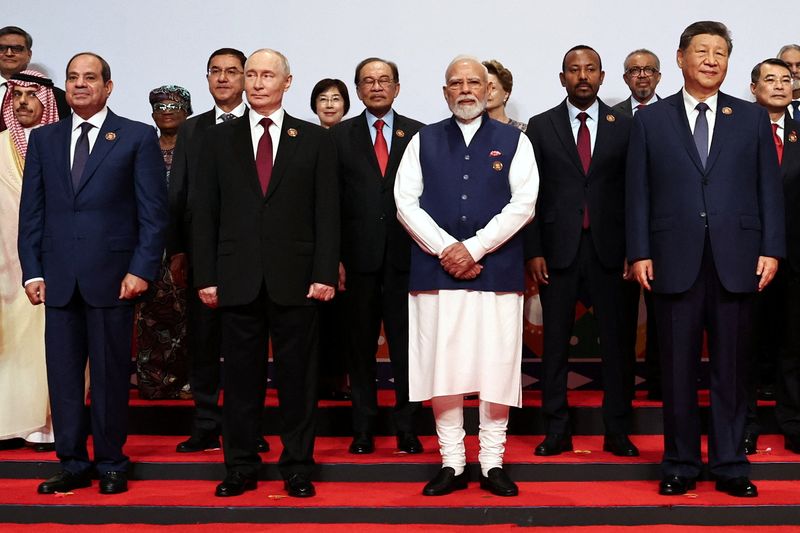
[Financial News] Chinese President Xi Jinping proposed artificial intelligence (AI) and digital cooperation to BRICS countries, a group of emerging economies led by China and Russia, and emphasized that China would play a role in building a related ecosystem.
According to Xinhua News Agency on the 13th, President Xi Jinping said this during a speech at the second phase of the 18th BRICS Summit held in New Delhi, India, stating, "To play a major role and achieve great development in BRICS, we must strengthen the foundation of working-level cooperation."
First, he proposed that China establish a dedicated AI open-source zone for BRICS countries and support cooperation in the development and application of large language models (LLMs), while also creating an open AI ecosystem through AI-related training and education. In addition, he stated that China would create a BRICS digital industry cloud platform to promote related technical education, exchange, and industrial linkages, and support the construction of smart factories and the transformation and upgrading of manufacturing in member countries.
China Establishes an AI Open-Source Zone and Supports LLM Development and Application for BRICS Countries
In the trade and investment sector, it was explained that a partnership for special economic zones among BRICS countries would be established, a smart portal for policy coordination would be created, and the BRICS Service Trade Forum would be held next year. Additionally, a plan was unveiled to foster high-level science and technology talent through joint education and youth exchanges by establishing an engineering training alliance among BRICS countries.
President Xi emphasized that "BRICS must uphold openness and cooperation, mutual benefit and win-win growth by leveraging its strengths in connecting the Global South (a collective term for emerging and developing countries mainly located in the Southern Hemisphere) based on emerging markets," and stressed the need to foster a large market with integrated industrial and supply chains.
He continued by stating, "We must establish innovation incubators, upgrade traditional industries, develop emerging industries, and position future industries," and presented a plan for cooperation in five areas with China to achieve this, including AI, trade and investment, digital industries, smart manufacturing, and the cultivation of science and technology talent.
At the same time, President Xi emphasized the unity of the Global South and multilateralism, raising his voice to contain the United States.
President Xi emphasized, "Amid the rapid unfolding of changes unprecedented in a century, the Global South is collectively emerging and becoming a key driving force in promoting global multipolarity," adding that "regardless of whether a country is large or small, strong or weak, rich or poor, all are equal members of the international community."
Xi Jinping Proposes Cooperation in Five Areas: AI, Trade and Investment, Digital Industries, Smart Manufacturing, and Science and Technology Talent Development
He continued by arguing, "A world without rules is like an intersection without traffic lights, where chaos and disorder are inevitable," adding that "international rules must be adopted jointly by all nations, and the logic that 'coercion is justice' does not hold water and should have been abandoned long ago."
President Xi emphasized that Global South countries must jointly uphold the basic principles of international relations, such as sovereign equality, non-interference in internal affairs, and the peaceful resolution of disputes, and stressed that they should not apply 'double standards.'
In addition, while stating that the authority and role of the United Nations (UN) must be safeguarded and that World Trade Organization (WTO) reforms must proceed in the right direction, he urged the maintenance of the most-favored-nation principle, the reform of the international financial structure, and the expansion of the representation and voice of developing countries.
President Xi left New Delhi today after concluding his two-day schedule for the BRICS Summit.
[email protected] Lee Seok-woo, International Specialist Reporter