Could an Older Brother’s Diagnosis Put a Younger Sibling at Risk? The Hidden Hereditary Risk of Type 1 Diabetes [Health Check]
- Input
- 2026-09-13 15:22:17
- Updated
- 2026-09-13 15:22:17
[Financial News] A domestic study has found that siblings of children and adolescents with type 1 diabetes are more than 10 times as likely to develop the disease as children in the general population.
The Korea National Institute of Health, under the Korea Disease Control and Prevention Agency, announced the results of a study analyzing patterns of familial occurrence and clinical characteristics among children and adolescents with type 1 diabetes.
Supported by the Korea National Institute of Health, the study was led by Seoul National University Bundang Hospital and conducted as the first and largest domestic multicenter collaborative study of its kind. It systematically examined the incidence of type 1 diabetes among relatives according to family history, using data from 936 patients aged 18 or younger who were diagnosed at 18 university hospitals across South Korea between 2010 and 2024.
Type 1 diabetes is an autoimmune disease in which the body's immune system attacks the pancreatic beta cells that produce insulin, resulting in little or no insulin production. It mainly develops during childhood and adolescence, and continuous insulin treatment is required after diagnosis. Type 1 diabetes has long been considered a disease with very limited hereditary influence. Although studies on familial patterns have recently been published, mainly in Western countries such as those in Europe, no data had previously been available for Korean children and adolescents.
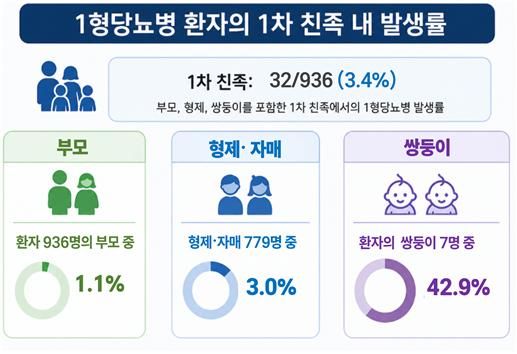
The study found that 32 of the 936 patients, or 3.4%, had a family history of type 1 diabetes involving a parent or sibling. In 1.1% of all patients, a parent had the disease.
In particular, an analysis of 779 siblings of the patients found that 23, or 3.0%, had developed type 1 diabetes. This was more than 10 times higher than the incidence rate of 0.26% among children in the general Korean population. Among twins, the disease occurred in both siblings at a high rate of 42.9%, demonstrating the strong influence of genetic factors.
The study also found that patients diagnosed second within a family had lower blood glucose and glycated hemoglobin levels at diagnosis than the first diagnosed patient. They also had a significantly lower incidence of diabetic ketoacidosis, a major acute complication that can be life-threatening. The findings once again highlight the importance of appropriate management of type 1 diabetes in children and adolescents.
The researchers explained that greater awareness of the disease, gained after a family member was diagnosed first, may have contributed to earlier detection in subsequent patients.
Kim Jae-hyun, a professor of pediatrics at Seoul National University Bundang Hospital, said, "This study has significant public health value because, through the first large-scale domestic analysis of its kind, it identified the actual patterns of type 1 diabetes associated with family history among Korean children and adolescents and clarified the specific risk of onset among their siblings." He added, "The findings suggest that a new paradigm shift may be possible, in which type 1 diabetes can also be prevented before pancreatic dysfunction develops through appropriate management."
Kim Won-ho, director of the Department of Chronic Disease Convergence Research at the Korea National Institute of Health, said, "This study is significant as the first domestic case to show that the families of patients with type 1 diabetes, particularly their siblings, are a high-risk group. It demonstrates that type 1 diabetes can be diagnosed and prevented early, before pancreatic dysfunction develops." He added, "Going forward, we will establish a national registry for diabetes in children and adolescents and continue research to produce scientific evidence suited to conditions in South Korea."
[email protected] Medical Specialist Reporter Jung Myung-jin Reporter