International oil prices to rise further at year-end; attention focused on Chinese demand amid Saudi supply instability
- Input
- 2026-09-13 16:26:02
- Updated
- 2026-09-13 16:26:02
[Financial News] International oil prices, which have been reeling from various negative factors throughout the year, are expected to rise further at the end of the year. This is because oil supplies from the Middle East are declining as the war intensifies, while China is preparing to stockpile oil again.
Saudi exports disrupted by the war
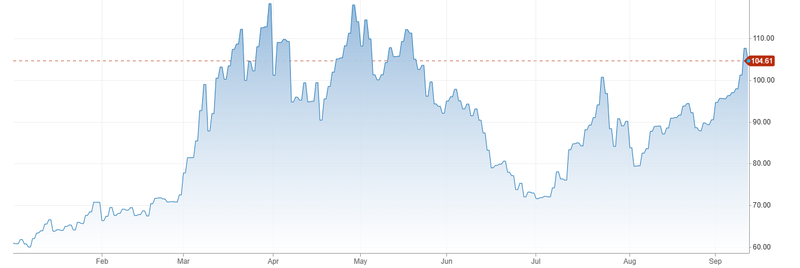
According to U.S. media outlets including Yahoo Finance on the 12th (local time), a research team led by Dan Stryburn, co-head of international commodities research at Goldman Sachs, predicted that North Sea Brent Crude Oil and West Texas Intermediate crude oil (WTI) would be priced at $85 and $80 per barrel, respectively, in December. These forecasts were each raised by $5 per barrel from the previous outlook. As of the 11th, Brent Crude Oil and WTI futures closed at $104.61 and $100.05 per barrel, respectively.Goldman Sachs cited declining production by Middle Eastern oil-producing countries as the reason for the higher oil price forecast. Oil-producing countries must reduce production when exports are blocked because of limited storage capacity, and it takes time to increase production again. Saudi Arabia, the leader of the Organization of the Petroleum Exporting Countries (OPEC) and the world's largest oil exporter as of last year, is facing difficulties with both exports and production as the war with Iran intensifies. Bordered by the Red Sea to the west and the Persian Gulf to the east, Saudi Arabia previously extracted oil from fields concentrated in the east and exported it to Asia through the nearby Strait of Hormuz. However, the Strait of Hormuz became dangerous again after the United States and Iran clashed again in July. Saudi Arabia therefore used a pipeline running east to west across the country to send oil extracted from its eastern fields to the port of Yanbu on the western Red Sea coast. From Yanbu, the oil traveled south through the Red Sea and passed through the Bab al-Mandeb Strait toward Asia, but this route also became dangerous as pro-Iranian Houthi rebels in Yemen became active.
After capturing Mocha, a major port city on the Red Sea, on the 10th, Houthi rebels completely seized control of the Bab al-Mandeb Strait on the 11th. Also on the 11th, an official from the Saudi Ministry of Energy said that operations of the east-west oil pipeline had been temporarily suspended after a drone launched from Iraq attacked it the previous day. Goldman Sachs predicted that Brent Crude Oil could rise to $120 per barrel next year if the average daily oil production of Middle Eastern oil-producing countries falls by 4 million barrels from pre-war levels.
'Big Buyer' China May Increase Crude Oil Purchases
Goldman Sachs identified China as one of the variables affecting oil prices this year. In a statement last June, U.S. Secretary of Energy Chris Wright noted that China, which had recently been the world's largest crude oil importer, had reduced its import volume. CNN also reported that China was using its existing strategic reserves while cutting imports. Regarding China's reduced imports, Wright said, "They have stopped accumulating strategic oil reserves." He continued, "They are releasing some of their reserves, lowering refinery operating rates to reduce product output, and weakening economic activity. But this is not a permanent change." According to Kpler, a U.S. maritime data company, China's crude oil imports averaged about 6 million barrels per day in June, half the level in February, when they were about 11.5 million barrels. In July and August, they rose slightly to about 7 million barrels per day.In a report on the 12th, U.S. economic media outlet CNBC analyzed that the direction of oil prices this year would depend on China. Rebecca Babin, a senior trader at CIBC Private Wealth, a Canadian asset management firm, explained that diesel refining margins had risen as major refining facilities were destroyed in the wars in the Middle East and Ukraine. She estimated that Chinese refineries, which had not been affected by the war, would resume buying crude oil to take advantage of the margins. Babin said, "Refining margins are so enormous right now that they literally cannot be ignored," and predicted, "They will buy crude oil and flood the refining market with products."
Meanwhile, at a press conference on the 12th, Donald Trump answered a question about when the war with Iran would end, saying, "I think it will be very soon. It will probably be immediately after the midterm elections (November 3)." He claimed, "Iran is trying to hold out as long as possible to complicate the election, but I think people know that." He added, "If that happens, oil prices will plummet." When asked whether Iran was behind the attack that halted Saudi Arabia's oil pipeline, Donald Trump replied, "I think so. Probably."
[email protected] Park Jong-won Reporter