"We Can't Trust ChatGPT-Generated Personal Statements"—Banks Raise the Hiring Bar With AI
- Input
- 2026-09-14 17:07:16
- Updated
- 2026-09-14 17:07:16
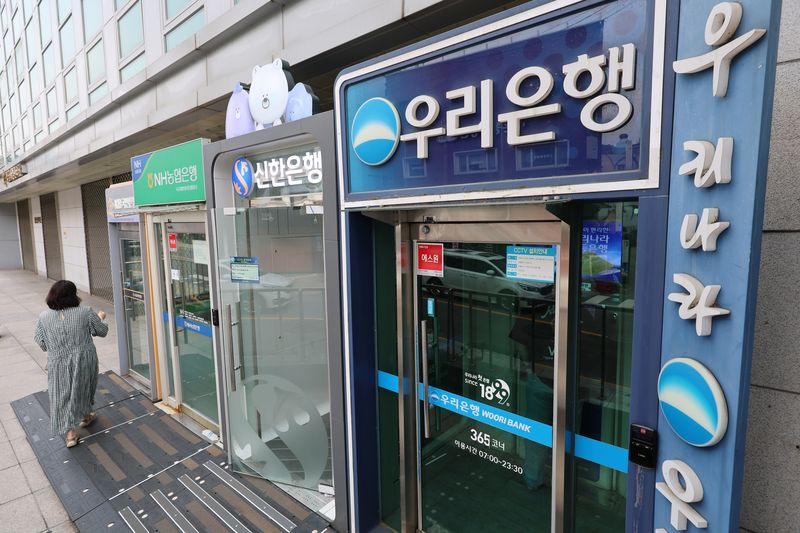
[Financial News] Banks are rapidly expanding how they use artificial intelligence (AI) in recruitment. While AI was previously used mainly as a supplementary tool to reduce the risk of hiring corruption, it is now increasingly being used to assess applicants’ actual capabilities and job fit.
AI applied across recruitment, including interview analysis
According to the financial sector on the 14th, Shinhan Bank eliminated the existing personal-statement questions and introduced video interviews for its second-half recruitment of new employees this year.
Applicants answer questions on video, after which AI analyzes the interview results and makes an initial determination on whether they pass. Applicants who fail the AI assessment then undergo a separate review by human evaluators.
Banks are changing their evaluation methods because the existing recruitment process is becoming less effective at distinguishing among applicants. In particular, as the use of generative AI to write personal statements has become widespread, it has become difficult to identify differences in applicants’ capabilities based solely on written applications.
Banks are also concerned that quantitative measures, such as grade-point averages and language-test scores, have limitations when it comes to assessing job fit. Communication skills and the ability to respond to unexpected situations—both needed in sales roles—as well as the problem-solving skills required for digital positions are difficult to evaluate using figures on an application alone.
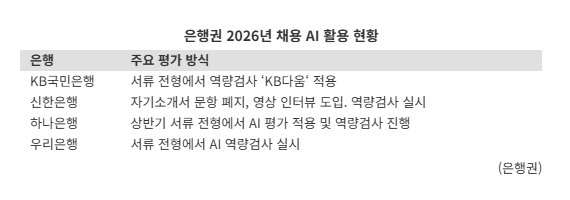
Using AI in recruitment is not a new trend. KB Kookmin Bank was the first bank in the sector to introduce AI into its recruitment process in 2018. During online interviews, AI analyzed applicants’ characteristics, strengths and weaknesses, and suitable job categories, with the results used as reference material for in-person interviews.
At the time, the spread of AI-based recruitment was driven by hiring corruption in the banking sector. After inspecting 11 domestic banks from December 2017 to January of the following year, the Financial Supervisory Service uncovered 22 suspected cases of recruitment irregularities. Subsequent prosecutors’ investigations led to 38 current and former employees of six banks being indicted and put on trial. Following KB Kookmin Bank, Bank of Hope and other banks also began actively using AI, including at the document-screening stage. The possibility of reducing subjective judgments by evaluators and outside influence was another factor behind the adoption of AI.
Confusion over evaluation standards; AI remains a supplementary tool
The purpose of using AI in recruitment has recently changed. In the past, the focus was on reducing the possibility of outside interference in the hiring process. Now, AI is increasingly being used to distinguish applicants’ actual capabilities.
The decline in hiring numbers compared with the past is also affecting changes in evaluation methods. The four major commercial banks—KB Kookmin Bank, Shinhan Bank, Bank of Hope, and Woori Bank—publicly recruited a total of 485 new employees in the first half of this year. That was 110 fewer than the 595 hired in the first half of last year, a decrease of 18.5%. A similar trend is expected in the second half. Because the number of applicants remains similar while the number of positions has fallen, banks are changing their evaluation methods to improve their ability to distinguish among candidates.
Applicants are also experiencing considerable confusion over evaluation methods that change every year. AI competency assessments and video interviews are particularly challenging because it is difficult to know which behaviors and answers receive high scores. Job seekers have responded, "Even after taking the tests several times, it is difficult to figure out the evaluation standards" and "It is more burdensome when AI, rather than a person, decides whether I pass the initial screening."
The banking sector maintains that AI does not replace the entire recruitment process. A banking-sector official said, "AI assessment results are not used as they are to make the final decision," adding, "They are used for initial screening or as reference material, while a supplementary process involving human evaluators is also in place."
[email protected] Seo Ji-yoon Reporter