Four Rounds of Supplementary Investigation...Victims Ask, “When Will a Decision Be Made?” as Case Is Bounced Back and Forth [Suspected Rental-Deposit Fraud Involving 500 Households, Part 2]
- Input
- 2026-09-13 14:21:44
- Updated
- 2026-09-13 14:21:44
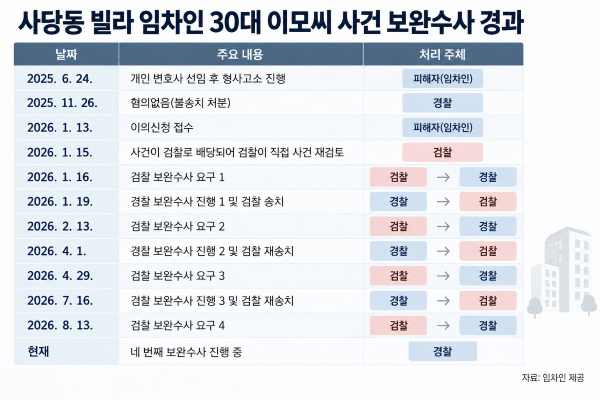
[Financial News] Mr. Lee, a tenant in his 30s who was unable to recover his 60 million won rental deposit, filed a criminal complaint against his landlord and others more than 14 months ago. However, the case remains under supplementary investigation by police. After police decided not to forward the case and Mr. Lee filed an objection, prosecutors have requested supplementary investigations four times. His biggest concern is whether the case’s direction will be determined before October 2, when the Supreme Prosecutors’ Office of the Republic of Korea is abolished.
According to a comprehensive review by Financial News on the 13th, Mr. Lee filed a complaint last June against Mr. Cho, the landlord of a villa in Sadang-dong, Dongjak District, Seoul, and Mr. Lee, the head of real estate development and construction company A, on suspicion of fraud. Police decided not to forward the case in November last year, citing a lack of evidence of wrongdoing. However, after Mr. Lee filed an objection in January this year, the case was transferred to prosecutors.
Prosecutors requested a supplementary investigation on January 16, and police determined three days later that there were grounds for suspicion and forwarded the case. However, further requests for supplementary investigations followed in February, April, and August. Mr. Lee said, “It seems the case will be transferred to prosecutors before October, but I am anxious about whether a conclusion can be reached before then.”
■“More evidence is needed” every time supplementary investigations are ordered...victims effectively work a second job to investigate their own cases
The victims say they had to find and submit evidence themselves to prove fraud and deception while the case moved back and forth between police and prosecutors. Each time a supplementary investigation was ordered, they repeatedly tracked down people involved and financial records to fill gaps in the evidence.
During the supplementary investigation, Mr. Lee personally tracked down materials supporting his claim that the senior-priority tenants’ rental deposits had been reported differently from the actual amounts at the time of contracting, as well as information about the Company A representative’s debts at the time. After checking past compulsory auction records for a building owned by the Company A representative, he contacted people familiar with the creditor relationships at the time. He also examined the contractual relationships of other tenants based on account transaction records belonging to the nominal landlord and submitted the findings to investigators.
Mr. Lee said, “At first, no matter how much I explained, the response was, ‘Why is this fraud? Why is this deception?’” He added, “Only after I found and presented physical evidence so compelling that even the police thought something was wrong did the case make some progress.” He also said that investigators had asked him to resubmit materials he had already provided.
Mr. Lee, a tenant in his 20s at a villa in Sillim-dong, had a similar experience. He said, “I reported the case because I had suffered damage and wanted it investigated, but I felt the authorities were demanding that the victim provide the evidence as well.” He added, “I felt that I was even being asked for materials such as financial records. How is an individual supposed to obtain those?” He continued, “Someone has to take action to gather scattered clues and put the puzzle together. After work, I kept searching for documents and connecting people, so it felt almost like working a second job.”
The victims eventually connected through online communities and began sharing information about people and companies that repeatedly appeared in multiple buildings. Some even spent several million won to hire lawyers. Mr. Geum, a victim from the Sadang-dong villa, filed his first criminal complaint based on information obtained through this process. He said, “If the victims had not gathered and shared information, we would have been at a significant disadvantage when filing the complaint.”
■What happens if the case extends beyond October 2?
The victims are already worried about what will happen after the Supreme Prosecutors’ Office is converted into the Public Prosecution Office on the 2nd of next month. At the Public Prosecution Office, prosecutors will not be able to conduct supplementary investigations themselves even when an investigation into a forwarded case is insufficient. Instead, they will have to request supplementary investigations from police or other investigative agencies.
Under the revised Criminal Procedure Act, when a complainant files an objection to a case that police decided not to forward, prosecutors may request a reinvestigation within three months, and police must complete it within three months of receiving the request. If the decision not to forward the case is maintained afterward, prosecutors may request another reinvestigation.
For victims whose investigations have continued for more than a year, however, the immediate concern is whether the case’s direction can be determined before the system changes. Mr. Lee, who is in his 30s, said, “I am worried that the people involved will act as if they have been found not guilty while the decision is delayed.”
A prosecution official explained, “Among cases involving objections, there are instances in which police reach a conclusion immediately and send the case on as if they were simply tossing it over.” The official added, “If the requested supplementary investigation is not properly carried out, or if newly collected evidence reveals additional points that need to be checked, we request another supplementary investigation.” Regarding the period after the abolition of direct supplementary investigations, the official said, “The frustrating part is that there is no guarantee that cases will come up with everything sufficiently checked to the extent prosecutors deem necessary.”
Experts have raised similar concerns. In a presentation at a criminal policy seminar on the 11th, attorney Kim Ye-won of the Disability Rights Law Center said, “The basic structure remains unchanged: investigative agencies that have already completed an investigation and decided not to forward a case are asked to investigate it again. If inadequate investigations are repeated, the case will once again shuttle between prosecutors and police.” She added, “Evidence may be lost in the meantime, and neither the missing evidence nor the victim’s case can be restored.”
[email protected] Choi Eun-sol, Park Seong-hyeon Reporter