Teacher: "Professional occupations are students’ top career choice these days... Only 7% plan to start a business or join a startup"
- Input
- 2026-09-13 11:48:40
- Updated
- 2026-09-13 11:48:40
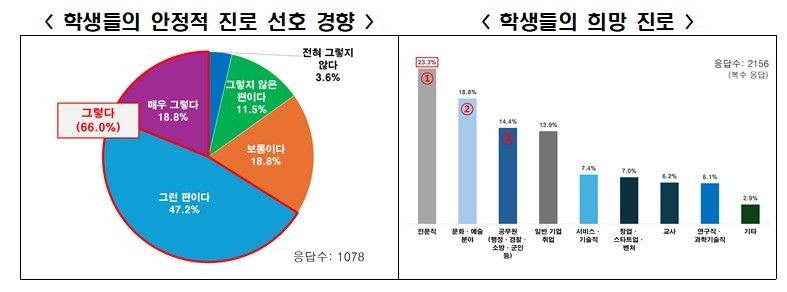
[Financial News] Two out of three teachers believe students tend to prefer stable career paths over challenging ones. The survey also found that students have low levels of entrepreneurship.
The Federation of Korean Industries (FKI) and the Entrepreneurship Development Center announced on the 13th the results of a survey on teachers’ perceptions of economic and entrepreneurship education. The survey was commissioned to the Korean Federation of Teachers’ Associations (KFTA) and covered 1,078 elementary, middle, and high school teachers nationwide.
Two out of three teachers (66.0%) said students tend to prefer stable career paths over challenging and new ones.
Among the career paths teachers identified as students’ preferred choices, professional occupations ranked first at 23.3%. They were followed by culture and the arts (18.8%) and public-sector jobs, including administration, police, firefighting, and the military (14.4%). By contrast, only 7.0% selected the challenging career category of business startups, startups, and ventures—about one-third the figure for professional occupations.
Teachers also gave low assessments of students’ levels of entrepreneurship and economic knowledge. Some 81.3% of respondents said students’ level of entrepreneurship was “low,” while only 2.7% said it was “high.”
Perceptions of students’ economic knowledge were similar. A total of 77.3% of respondents said students’ level of economic knowledge was “low,” while only 3.3% said it was “high.”
The survey found a considerable gap between teachers’ recognition of the importance of entrepreneurship education and the actual level of such education in schools.
Some 82.8% of respondents said entrepreneurship education for students was “important.” However, 70.3% said entrepreneurship education was not being provided sufficiently at schools. Only 7.8% said it was being provided adequately. Teachers believed that both entrepreneurship and economic education should appropriately begin at the elementary school level.
The upper grades of elementary school (44.2%) were identified as the most appropriate starting point for entrepreneurship education. For economic education, 75.5% of respondents selected either the lower or upper grades of elementary school as the appropriate starting point. Park Ji-woong, a teacher at Songgwang Elementary School, said, “Problem-solving skills, a core element of entrepreneurship, cannot be developed in a short time through simple methods,” adding, “Students need to encounter entrepreneurship education through diverse methods and perspectives from an early age.”
Experts also advised that abilities such as identifying and solving problems, as well as collaboration and communication—key entrepreneurship competencies—are essential for students to develop the skills needed to respond to changes in the future society.
Jung Cheol, FKI’s chief research executive and head of the Entrepreneurship Development Center, said, “In an era when AI quickly provides answers, the ability to discover new problems and create solutions will become more important than the ability to find the correct answer.” He added, “Entrepreneurship education should not stop at delivering knowledge. It should be designed to help students experience challenges and failure, collaborate with others, and develop the ability to respond proactively to change.”
[email protected] Park So-hyun Reporter