Jeju Makes Bold Push for 40MW Green AI Center, Seeking National GPUs and Preliminary Feasibility Exemption
- Input
- 2026-09-13 11:55:26
- Updated
- 2026-09-13 11:55:26
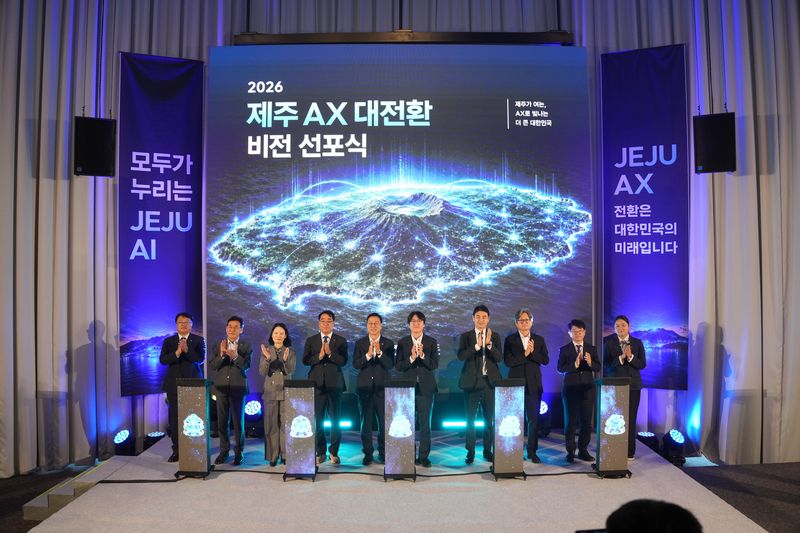
【Financial News Jeju=Yong-bok Jeong】 Jeju Province, which is planning to build a 40MW-class artificial intelligence (AI) data center powered by renewable energy, has formally asked the government to prioritize Jeju in the allocation of national GPU infrastructure and exempt its regional AI transformation (AX) project from a preliminary feasibility study.
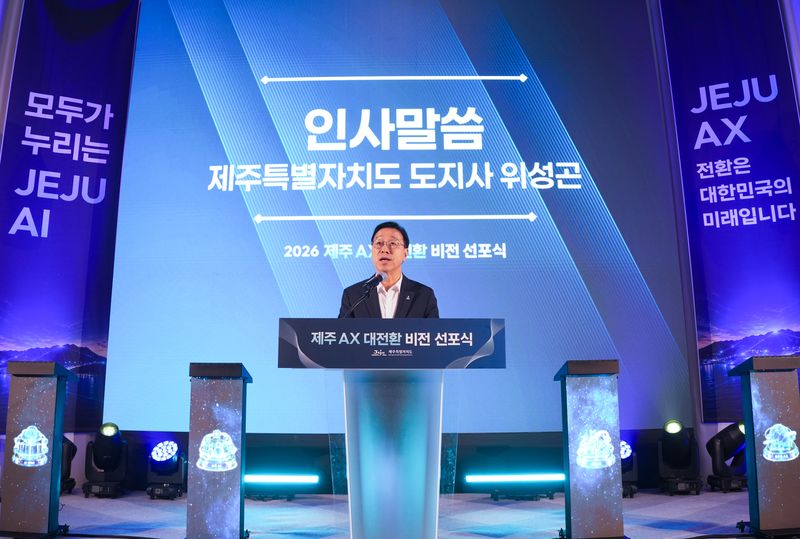
According to Jeju Special Self-Governing Province on the 13th, Governor Wi Seong-gon proposed five national-budget and institutional-improvement initiatives to Ha Jung-woo, vice chair of the National AI Strategy Committee, at the 2026 Jeju AX Transformation Vision Declaration Ceremony held on the 11th at Kakao Space.1 on Cheomdan-ro in Jeju City.
Jeju’s requests are the creation of a global AI hub in Jeju; the establishment of a comprehensive plan for a joint campus involving the four institutes of science and technology and Jeju; priority allocation of national GPU infrastructure to Jeju; exemption from the preliminary feasibility study for the Jeju-region AX transformation project; and designation of Jeju as a government-wide AI demonstration region covering the entire project life cycle.
The most notable request concerns GPUs. GPUs are core computing devices needed to train and run inference on generative and industrial AI systems. Even if data center space and electricity are secured, a shortage of high-performance computing resources such as GPUs would limit actual AI research and service development.
Jeju’s plan is to combine the AI computing resources secured by the national government with the region’s renewable energy, including wind and solar power.
The core foundation is the green AI data center being planned by Jeju Province. The direction disclosed at the Jeju Provincial Council is to consider a facility with a long-term capacity of about 40MW. The plan is to connect the large electricity demand required for AI computing with Jeju’s renewable energy and supply the resulting computing capacity to strategic industries in the region.
The 40MW figure indicates the scale of the data center’s electricity consumption. It would be closer to computing infrastructure designed for large-scale AI training and inference than to a conventional data center used to store administrative information.
The industries targeted by Jeju’s AX initiative are also broad. Jeju Province plans to apply AI not only to renewable energy, aerospace and biotechnology, but also to tourism and agriculture, livestock and fisheries. Potential applications include forecasting renewable power generation and demand, analyzing space and satellite data, conducting biotechnology research, analyzing tourism demand, and managing agricultural and livestock production.
Government administration and residents’ daily lives are also targets of AX. The plan is to use AI and data to proactively guide residents to the administrative and welfare services they need and build a foundation that enables everyone in Jeju to learn and use AI.
Jeju Province has organized these efforts into five core strategies: AI infrastructure, resident AX, administrative AX, industrial AX and global AX. Its goal is to become an “AX demonstration city” where AI technologies and services are applied and tested first in Jeju, after which proven models are expanded to other regions.
The National AI Strategy Committee has also taken note of the potential to combine Jeju’s renewable energy with AI.
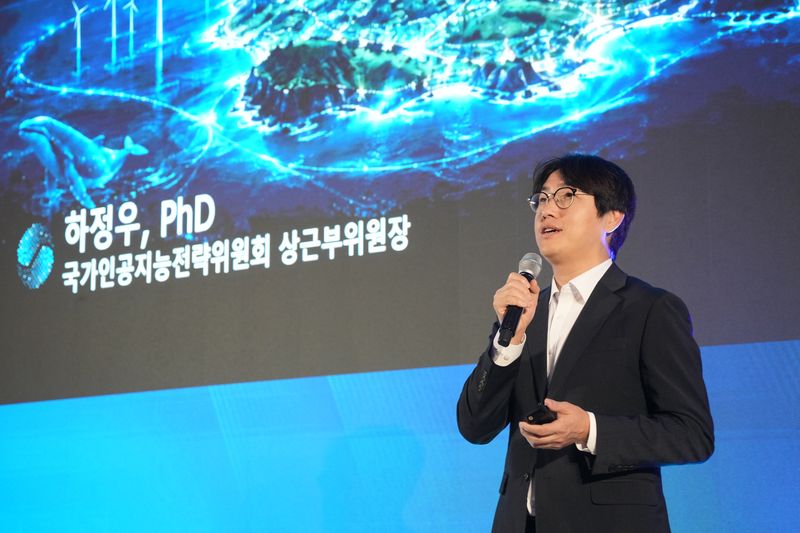
In a special lecture titled “Jeju Meets the Future Through AX” on the same day, Vice Chair Ha Jung-woo proposed connecting wind and solar power generation, AI data centers, energy storage systems (ESS), electric vehicles and buildings into a single system.
The idea is that electricity can be stored when renewable energy production is high, while AI forecasts generation and consumption and supplies power when needed. This would allow the entire island of Jeju to operate like one enormous ESS.
If a power-intensive AI data center is incorporated into this system, Jeju could address both its renewable-energy supply-and-demand challenges and the electricity demand of the AI industry.
However, it is difficult to conclude that building a data center would immediately reduce renewable-energy curtailment. The actual impact would depend on the data center’s utilization rate, its power procurement method, the size of the ESS and grid conditions, among other factors.
Models for applying AI to tourism and safety were also presented. AI, intelligent closed-circuit television (CCTV) systems and drones could be deployed at tourist sites, volcanic cones, Olle trails, airports, ports and roads to detect risks early and respond to them.
Before the vision declaration ceremony, officials from the National AI Strategy Committee also visited sites in Jeju. After test-driving the Tamna Autonomous Vehicle and visiting the Bukchon Battery Energy Storage System Power Plant, they inspected the use of AI and digital technologies to manage livestock environments and demonstrate carbon reduction at an AX smart farm for pig farming in Ara 1-dong, Jeju City.
Jeju’s request for a joint campus with the four institutes of science and technology also reflects its judgment that infrastructure alone cannot create an AI ecosystem.
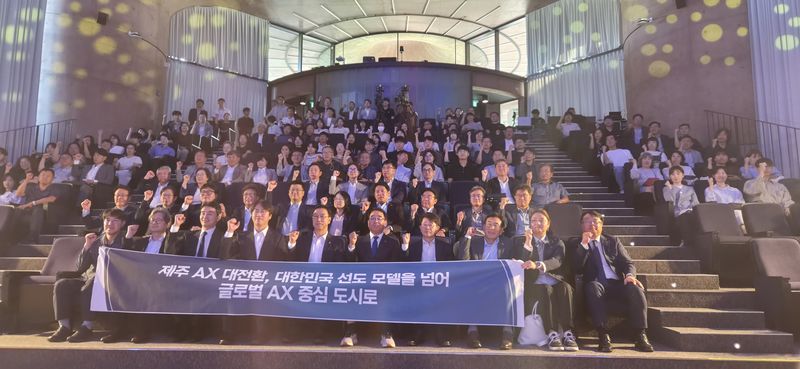
Even if computing resources are built, the impact on local industries could remain limited unless researchers, developers and companies that use them settle in Jeju. Education, research, demonstrations, startups and corporate activities must be connected into a single continuum.
Governor Wi Seong-gon said, "We will expand AI innovation models tested in Jeju nationwide and enhance South Korea’s competitiveness," and asked, "So that this can become not only Jeju’s undertaking but also a national undertaking, we ask the government to conduct experiments in Jeju."
Vice Chair Ha Jung-woo said, "Jeju’s unique strengths could create major synergies when combined with AI transformation," adding, "Ultimately, what matters is execution and attention to detail."
The key issue is the government’s follow-up decisions. It has not yet been decided how much national GPU capacity will actually be allocated to Jeju, whether the preliminary feasibility exemption for the Jeju-region AX project will be approved, or whether Jeju will be designated as a government-wide AI demonstration region. For the 40MW-class data center, the final site, total project cost, operating entity, participating companies and power procurement method must also be specified.
Whether Jeju AX can move from a declaration as a “global AX hub city” to actual industrial transformation depends on integrating national computing resources and financial support, private investment, and Jeju’s renewable energy into a single project structure.
[email protected] Yong-bok Jeong Reporter