Three Models for Customized Integrated Student Support Released
- Input
- 2026-09-13 11:15:21
- Updated
- 2026-09-13 11:15:21
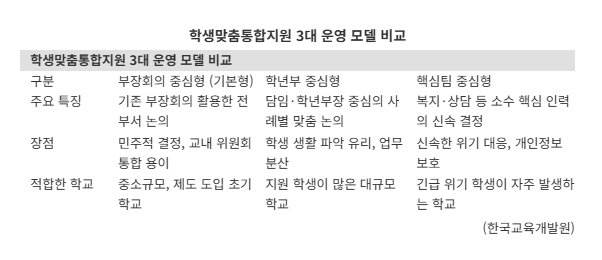
[Financial News] Three models have been presented for schools to operate student support systems in accordance with the implementation of the Student-Tailored Integrated Support Act. These include a method utilizing existing department head meetings, a method centered on grade-level departments and homeroom teachers, and a method in which a small core team responds quickly in schools with many students requiring urgent support.
The Korean Educational Development Institute (KEDI) announced on the 13th that it had presented these school-level operating models after analyzing cases from nine pilot schools for Customized Integrated Student Support operated by the Ministry of Education from 2023 to 2025. The analysis covered five elementary schools and four middle schools, and the Student-Tailored Integrated Support Act came into effect on March 1 of this year.
The core of Customized Integrated Student Support is to move away from providing necessary support—such as learning, welfare, health, career guidance and counseling—separately by program, and instead connect relevant support around the student. Previously, because support was divided and operated by program, it was difficult to coordinate the support needed by students facing multiple challenges.
The basic model proposed by KEDI is the 'department head meeting-centered model.' The principal presides over the meeting, while the vice principal or department heads serve as coordinators, making use of existing department head meetings. Its advantages are that multiple departments can participate together to assess students' situations comprehensively and that it can be easily linked with existing school committees. However, it has limitations in responding quickly to urgent cases, so small case conferences may be held separately when necessary.
The 'grade-level department-centered model' is suitable for schools with many students requiring support or where urgent cases occur frequently. Homeroom teachers, grade-level department heads and relevant staff assess students' situations together and discuss support measures. Its advantages are that it improves understanding of students and enables work to be shared through cooperation at the grade level, with homeroom teachers who know the students closely. However, it may be difficult to operate without sufficient understanding and cooperation across the school.
The 'core team-centered model' is intended for schools with many urgent cases or strong principal leadership. A small core team is formed from department heads and staff in areas that frequently provide student support, such as welfare and counseling, enabling rapid decision-making. Although the model allows quick responses to urgent matters and is advantageous for protecting student information, work may become concentrated among core team members, and operational continuity may decline when members transfer or leave.
Schools do not have to choose only one model. KEDI suggested that two or more models can be operated together depending on school conditions. For example, cases requiring routine support can be discussed through department head meetings, while urgent or complex cases can be handled by a core team.
Schools should be cautious about creating a separate dedicated department and concentrating tasks on specific personnel. This could repeat the previous problem of student support being divided and operated by program. KEDI's analysis indicates that Customized Integrated Student Support should not be assigned to a particular person, but operated as a system in which all members of the school participate.
The principal's leadership and the participation of all school staff were also identified as key conditions. KEDI analyzed that the principal's active leadership is important for staff to understand the system and for a cooperative school culture to take shape. A structure is needed in which middle managers, such as vice principals and department heads, coordinate the process and all school staff participate in student support.
It is also necessary to reduce redundant work by linking existing school committees and to secure the expertise and continuity of the team responsible for student support. KEDI proposed that "external experts should be able to participate when necessary, and guardians should also participate as partners who cooperate with the school in the student support process."
KEDI stated, "Although the Student-Tailored Integrated Support Act has come into effect, specific methods for organizing and operating the system at the school level have not been established. Therefore, each school must develop an operating system that takes into account student support needs and the circumstances of its members."
[email protected] Kim Man-gi Reporter