Applicants to regional national universities increased more than those to regional flagship national universities... Early admissions up 12.6%
- Input
- 2026-09-13 11:14:23
- Updated
- 2026-09-13 11:14:23
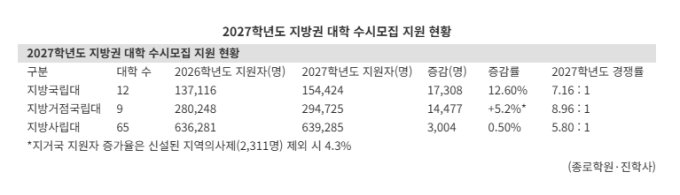
[Financial News] It was found that the growth rate of applicants to regional national universities in the 2027 academic year's early admissions exceeded that of regional flagship national universities by more than double. While the number of applicants to 12 regional national universities increased by 12.6% compared to the previous year, the number of applicants to 9 regional flagship national universities increased by only 5.2%.
According to an analysis of early admission application results for major regional universities nationwide for the 2027 academic year conducted by Jongno Academy and Jinhak Co., Ltd. on the 13th, the number of applicants to 12 regional national universities reached 154,424, an increase of 17,308 from 137,116 the previous year. This represents a growth rate of 12.6%. The average competition rate also rose from 6.44 to 1 to 7.16 to 1.
The number of applicants to the nine regional flagship national universities was 294,725, an increase of 14,477 from 280,248 the previous year. The growth rate was 5.2%, and the average competition rate rose from 8.65 to 1 to 8.96 to 1. However, if the 2,311 applicants for the newly established Regional Doctor System are excluded, the growth rate of applicants to regional flagship national universities drops to around 4.3%. Based on this, Jongno Academy analyzed that it is difficult to conclude that policies such as tuition-free admissions caused the rapid shift toward regional flagship national universities.
Regional private universities showed relatively small changes. The number of applicants to 65 regional private universities was 639,285, an increase of 3,004 from 636,281 the previous year. The growth rate was 0.5%. The average competition rate rose slightly from 5.75 to 1 to 5.80 to 1.
Within regional national universities, there were significant differences in the increase or decrease of applicants by institution. Kumoh National Institute of Technology saw an increase of 3,139 applicants compared to the previous year, reaching a growth rate of 58.2%. Gyeongkuk National University saw an increase of 2,406 applicants (42.1%), while Kunsan National University increased by 2,779 applicants (36.9%). Suncheon National University and Mokpo National University also saw increases of 2,100 and 2,256 applicants, respectively, recording growth rates of 29.9% and 29.3%.
On the other hand, the number of applicants to Mokpo National Maritime University decreased by 881, reaching a decline rate of 16.2%. Korea Maritime University saw a decrease of 982 applicants (9.2%), while Korea National University of Transportation dropped by 545 applicants (4.4%). This indicates that the trends in applicants diverged significantly even within the same regional national universities.
Differences were observed even among regional flagship national universities. The number of applicants for Pusan National University, Chungnam National University, and Chonnam National University—universities designated for the 'Creating 10 Seoul National Universities' initiative—increased by a total of 10,414, recording a growth rate of 11.6%. Pusan National University saw an increase of 6,599 applicants, a 19.0% rise, while Chungnam National University and Chonnam National University also saw increases of 2,541 and 1,274 applicants, respectively, representing increases of 8.6% and 5.1%.
The number of applicants for the remaining six regional flagship national universities increased by 4,063, resulting in a growth rate of only 2.1%. While Jeonbuk National University saw a 23.5% increase and Gyeongsang National University an 11.2% increase, Chungbuk National University dropped by 4,831 applicants, a decrease of 17.1%. Kyungpook National University also saw a decrease of 553 applicants, a decline of 0.9%.
The admissions industry believes that the results of this year's early admissions applications were influenced by a combination of factors, including expectations regarding government policies and the admissions environment ahead of the 2028 academic year college admissions reform.
Woo Yeon-cheol, head of the Admissions Strategy Research Institute at Jinhak Co., Ltd., analyzed, "Expectations regarding the government's intensive 'creation of 10 Seoul National Universities' initiative and the elimination of tuition at national universities have led to a practical preference among prospective students for flagship national universities." He further explained, "As the 2027 academic year is the last admissions exam to be held under the current system before the reform of the college entrance examination system for the 2028 academic year, the tendency of regional students to utilize flagship national universities as a safety net, considering both their chances of admission and financial burden, has also influenced the increase in applications."
Lim Seong Ho, CEO of Jongno Academy, analyzed that the indirect benefits of the zero-tuition policy were relatively greater at regional national universities than at regional flagship universities. CEO Lim observed, "Amidst the ongoing job shortage, there is a continuing tendency for students in regional areas to remain at local universities rather than relocating to other regions." He added, "Given the significant disparities among national universities—with some seeing a 58.2% increase in applicants and others a 16.2% decrease—there is a possibility that the gap in applicants between regional flagship universities, regional national universities, and regional private universities will widen further in the future."
[email protected] Kim Man-gi Reporter