Hyundai Research Institute Raises This Year’s Growth Forecast to 3.5%, Projects 2.4% for Next Year
- Input
- 2026-09-13 11:51:27
- Updated
- 2026-09-13 11:51:27
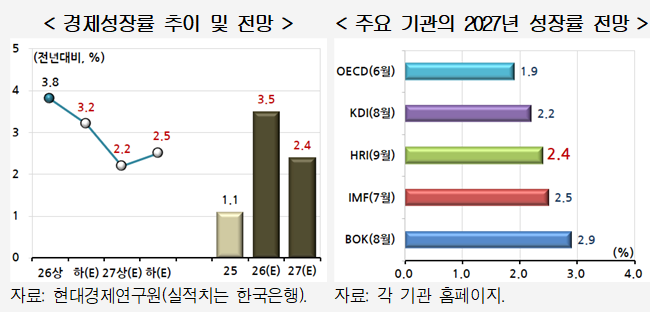
[Financial News] South Korea’s economy is expected to grow 3.5% this year, driven by a boom in the Semiconductor industry. Exports and government spending are expected to support growth next year as well, but the growth rate is projected to fall to 2.4% because of the base effect and slowing domestic demand.
In a report released on the 13th titled “Challenges Left by 3% Growth: Qualitative Growth Through Structural Improvements Is Needed,” the Hyundai Research Institute (HRI) raised its forecast for this year’s economic growth from 2.7% to 3.5%, an increase of 0.8 percentage points.
HRI assessed that the domestic economy had entered an expansionary phase. Semiconductor exports, buoyed by increased global investment in Artificial Intelligence (AI), are leading growth, while a recovery in facility investment and expanded government fiscal spending are adding further momentum.
Next year, the HRI expects the recovery in global trade and strong Semiconductor exports to continue, while improved corporate earnings and household income, along with government spending totaling 820.9 trillion won, will support domestic demand. However, growth is projected to slow to 2.4% because of the base effect from this year’s high growth. The economy is expected to follow a “weaker first half and stronger second half” pattern, with growth of 2.2% in the first half and 2.5% in the second half.
Private consumption growth is projected to decline from 2.4% this year to 2.0% next year. Although income conditions and consumer sentiment are expected to improve, the burden of household debt and higher policy rates could constrain the recovery in consumption, the HRI analyzed.
Facility investment growth is also expected to slow from 5.3% this year to 3.7% next year. Investment in the Semiconductor and Information Technology (IT) sectors, as well as projects related to the Three Mega-Projects, is expected to continue. However, worsening financing conditions caused by higher market interest rates and increased investment in the United States could reduce the capacity for domestic investment.
Construction investment is projected to decline 1.0% this year before rebounding slightly with 0.7% growth next year. Expanded social overhead capital (SOC) budgets and increased construction orders are positive factors, but the recovery is expected to remain limited because of high construction costs and weak regional real estate markets.
Export growth is expected to fall sharply from 50.8% this year to 2.9% next year. Strong performance is expected to continue in the first half of next year, led by IT products such as Semiconductors. However, the HRI said exports could decline 1.4% in the second half as growth slows because of the base effect.
Next year’s consumer price inflation is projected to fall from 2.6% this year to 2.3%, while the unemployment rate is expected to remain unchanged at 2.9%. The increase in the number of employed people is forecast to rise from 110,000 this year to 150,000 next year.
HRI identified the direction of global AI investment and the Semiconductor cycle as key variables that will determine economic conditions next year. It warned that the slowdown in exports could be greater if demand for AI investment weakens or competition with memory Semiconductors from China intensifies.
The HRI further recommended pursuing domestic-demand revitalization and expanding growth potential in tandem, while increasing investment in AI and advanced industries and diversifying export markets and products.
[email protected] Park Ji-yeon Reporter