"You're saying banks will raise deposit rates first if the base rate goes up?"... Bank loan-deposit interest rate spread narrows
- Input
- 2026-09-13 17:28:49
- Updated
- 2026-09-13 17:28:49

[Financial News] Following the Bank of Korea (BOK)'s back-to-back hikes in the base rate, the spread between deposit and loan rates is narrowing as bank deposit rates are rising faster than loan rates. This is because banks raised deposit rates to secure deposit customers, while the increase in loan rates was relatively limited due to the time lag before changes in market rates are reflected.
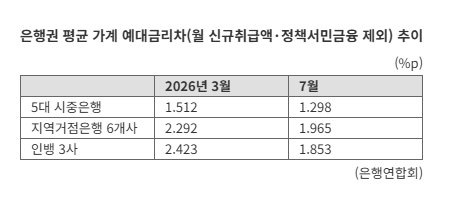
An analysis of disclosures from the Korea Federation of Banks (KFB) on the 13th reveals that the average household loan-deposit spread (excluding policy-based microfinance) based on new loan volumes for the five major commercial banks, six regional hub banks, and three internet-only banks is generally decreasing after peaking last March. The average loan-deposit spread based on new loan volume in July for the five major commercial banks, including KB Kookmin Bank, Shinhan Bank, Bank of Hope, Woori Bank, and Nonghyup Bank, decreased by 0.214 percentage points from 1.512 percentage points in March to 1.298 percentage points in July.
The decline was even greater for regional hub banks and internet banks. During the same period, the average loan-deposit spread of six regional hub banks (iM Bank, Busan Bank, Kyongnam Bank Co., Ltd., Gwangju Bank Headquarters, THE JEONBUK BANK LTD., and KB Kookmin Bank Seogwipo Branch) narrowed by 0.327 percentage points, falling from 2.292%p to 1.965%p. The average for the three internet banks, including KakaoBank Corp, K Bank, and Toss Bank, also dropped by 0.570 percentage points, from 2.423%p to 1.853%p.
The narrowing of the loan-deposit interest rate spread is attributed to intensified competition among banks regarding deposit rates, coupled with the hike in the base interest rate. Last July, the Bank of Korea (BOK) raised the base interest rate by 0.25 percentage points for the first time in three and a half years. Since then, deposit rates have continued to rise as major banks, including commercial banks, have successively raised time deposit rates.
The fact that the timing of base interest rate hikes being reflected in deposit and loan rates differs is also cited as a factor narrowing the interest rate spread.
"For deposits, the applicable interest rate is applied immediately upon a customer signing up for the product, whereas loans take time from application to review and execution," said a banking industry official. "When the base rate rises, deposit rates reflect this quickly and increase, whereas loan rates rise with a time lag, resulting in a narrowing of the interest rate spread between deposits and loans in the short term." The official added, "Loan rates vary by product, such as financial bonds or the COFIX based on new loan origination amounts, and even for variable-rate loans, the rate adjustment cycle differs for each borrower, such as every three or six months. Therefore, while the direction of rising interest rates due to the increase in the base rate remains the same, not all loan rates change uniformly at the same time."
The composition of borrowers for new household loans also had an impact. Analysis suggests that amidst the policy of managing the total volume of household loans, limited lending capacity was concentrated on borrowers with relatively high creditworthiness and repayment ability, thereby limiting the rise in the average loan interest rate based on new loan originations.
With the Bank of Korea (BOK) raising the base rate by an additional 0.25 percentage points last month, upward pressure on interest rates is expected to continue for the time being. If the narrowing trend in the spread between deposits and loans continues, it could also exert downward pressure on the Net Interest Margin (NIM), an indicator of banks' interest profitability.
Another banking industry official said, "The future direction of the loan-deposit interest rate spread will be determined by the speed at which the increase is reflected in lending rates," adding, "Since NIM also reflects interest generated from the operation of securities such as bonds, it does not necessarily move in the same direction as the household loan-deposit interest rate spread."
[email protected] Lee Hyun-jung Reporter