AI to Transform Future Airports... 1,300 Gather in Incheon to Explore an "Aviation Paradigm Shift"
- Input
- 2026-09-13 09:37:23
- Updated
- 2026-09-13 09:37:23
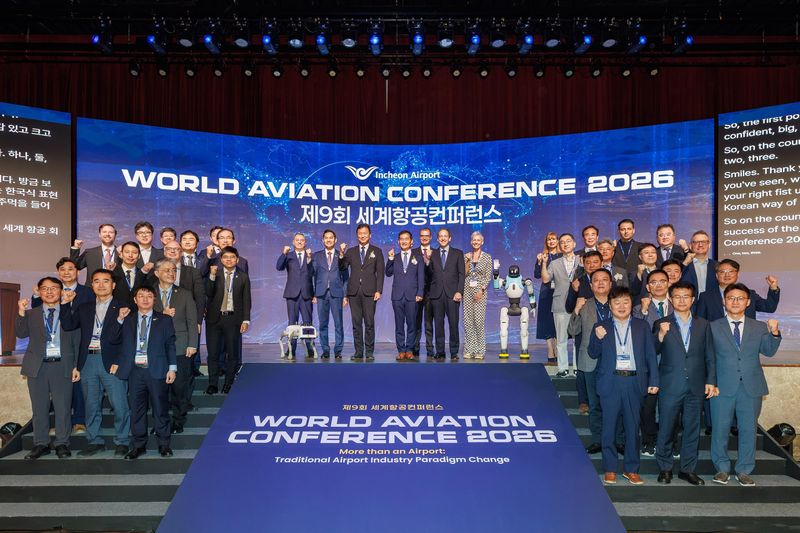
[Financial News] Some 1,300 experts from around the world gathered in Incheon to discuss the global aviation industry's transition to artificial intelligence (AI) and its future paradigm. Despite geopolitical conflicts and supply chain uncertainty, they identified the development of intelligent terminals and innovation in cargo systems as the aviation industry's next-generation survival strategies. Incheon International Airport, which ranked first worldwide in international passenger traffic in the first half of this year, also strengthened its position as a key information-sharing platform for the global aviation industry through the event.
Incheon International Airport Corporation announced on the 13th that it had successfully hosted the 2026 World Aviation Conference at Paradise City in Incheon from the 8th to the 10th. Now in its ninth year, the event was held under the theme "Airports Beyond Airports: A Paradigm Shift in the Airport Industry," bringing together industry, academic and research representatives from South Korea and abroad to examine issues across the airport sector. With 1,300 global experts in attendance, this year's conference was the largest ever.
At the opening ceremony, Kim Beom-ho, acting president of Incheon International Airport Corporation, highlighted the conference's significance as a platform for global cooperation, saying, "The global aviation industry is showing remarkable resilience despite challenging conditions." Lee Sang-heon, director of airport policy at the Ministry of Land, Infrastructure and Transport (MOLIT), said in his congratulatory remarks, "Incheon International Airport recorded 38.39 million international passengers in the first half of this year, up 6.3% from the same period last year, ranking first in the world." He added, "I ask airports in each country to share technology closely."
Justin Erbacci, director general of the Airports Council International (ACI) World headquarters, delivered the keynote address and predicted that future airports would evolve beyond simple transportation facilities into intelligent, sustainable spaces centered on people.
The main event featured five panel discussion sessions. In the first session, the Korea Advanced Institute of Science and Technology (KAIST) and LG CNS shared plans to develop an aviation AI hub being pursued by the corporation. Representatives from Vienna Airport and Schiphol Airport then discussed differentiated examples of terminal innovation. Measures to improve the efficiency of aviation security operations, including simplified security screening for passengers with reduced mobility and walk-through screening, were also addressed as key topics.
Other presentations introduced global cargo innovation cases, including semiconductor cargo transportation from Taiwan and precision pharmaceutical transportation through Brussels Airport. Narita International Airport and Airports of Thailand (AOT) also unveiled strategies for expanding future infrastructure.
As a side event, an advanced equipment exhibition was held with the participation of 14 domestic and international aviation companies. This year, the exhibition space was expanded by 50% from the previous year to support overseas market expansion for outstanding South Korean companies and significantly increase business networking opportunities.
Kim Beom-ho, acting president of Incheon International Airport Corporation, said, "As successful artificial intelligence transformation (AX) has become a major topic in the airport industry, this conference allowed us to envision what future airports transformed by artificial intelligence will look like." He added, "Based on the insights from experts and overseas airport cases gained through each session, we plan to pursue service innovation suited to the AI era and provide safer and more convenient airport services to the public."
[email protected] Kim Dong-ho Reporter