Deposit rates rise, cooling loan demand...Household lending declines for the first time in six months
- Input
- 2026-09-13 09:28:11
- Updated
- 2026-09-13 09:28:11
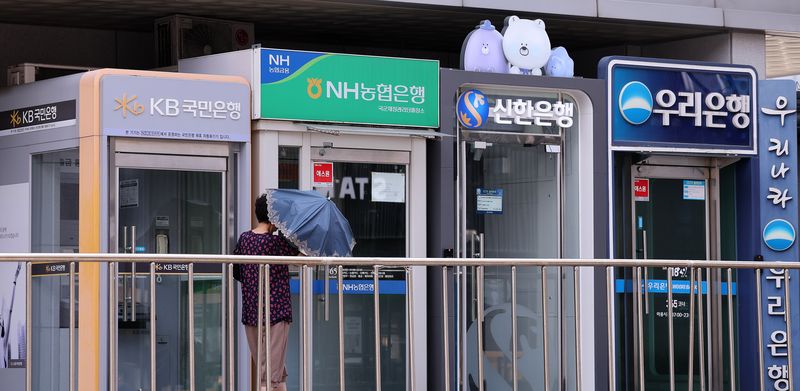
[Financial News] As major commercial banks compete to attract deposit customers by raising annual time-deposit rates to the mid-3% range, household lending has declined for the first time in six months. With bank bond yields and the Cost of Funds Index (COFIX) also rising, some analysts expect competition over deposit rates to increase banks’ funding costs and push lending rates higher.
According to financial-sector sources on the 13th, Woori Bank raised the maximum annual rate on its one-year “Woori First-Transaction Preferential Time Deposit” from 3.1% to 3.6% on the 11th, an increase of 0.5 percentage points. This is the highest rate among major commercial banks’ time-deposit products.
The product offers customers who did not hold a Woori Bank account as of the end of the year preceding their new subscription an annual preferential rate of 1 percentage point. Woori Bank raised the base rate for maturities of six months to one year from 2.1% to 2.6%, bringing the maximum rate, including the preferential rate, to 3.6% per year.
Representative time-deposit rates across the banking sector are also rising across the board. Woori Bank raised the rate on its “WON Plus Deposit” from 3.2% to 3.4% per year on the 10th. Shinhan Bank also increased the rate on its “Sol Easy Time Deposit” from 3.2% to 3.4% per year on the 9th.
Bank of Hope raised the rate on its “Hana One Time Deposit” from 3.2% to 3.3% per year, while Nonghyup Bank raised the rate on its “NH All One e-Deposit” from 3.25% to 3.45%. KB Kookmin Bank is also reportedly considering raising its deposit rates.
Unlike the flow of funds into deposits, the lending market is showing the opposite trend.
The household-loan balance at the five major banks—KB Kookmin, Shinhan, Bank of Hope, Woori and Nonghyup—stood at 780.9677 trillion won as of the 10th, down 1.1514 trillion won from the end of last month. This was the first month-on-month decline in household-loan balances in six months, since March.
Mortgage loans fell by 517.2 billion won this month, while credit loans declined by 574.8 billion won. Jeonse deposit-backed loans also decreased by 249.7 billion won. It had been eight months, since January, since household, mortgage, credit and jeonse deposit-backed loans had all declined from the end of the previous month.
Banks believe that sharply rising market rates, along with household-loan volume controls, are suppressing demand for household loans.
The five-year bank bond yield, which serves as the benchmark for periodic- and hybrid-rate mortgages, rose to 4.578% per year on the 11th. This was its highest level in two years and 10 months, since it reached 4.586% on November 3, 2023. After reaching 4.531% on July 24, it surpassed the 4.5% level again in about two months.
Meanwhile, upward pressure is also building on COFIX, the benchmark for variable-rate mortgages. COFIX based on newly handled amounts reached 3.18% per year in July, its highest level in one year and seven months since it stood at 3.22% per year in December 2024.
[email protected] Lee Dong-hyuk Reporter