Chey Tae-won: “Ulsan AI Data Center’s 900 MW Expansion Is Almost There—Announcement Could Come Soon”
- Input
- 2026-09-13 08:00:00
- Updated
- 2026-09-13 08:00:00
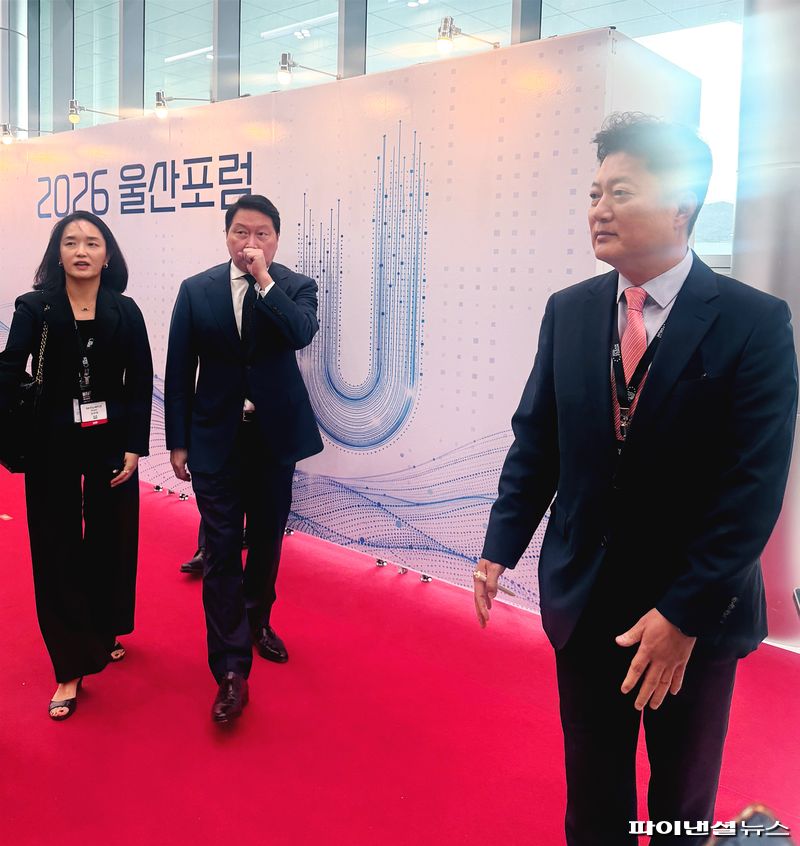
Speaking with reporters after the 2026 Ulsan Forum at the Ulsan Exhibition and Convention Center (UECO) in Ulju County, Ulsan, on the 11th, Chey said cooperation with global tech giants on AI data centers was “making quite a lot of progress” and that “the pace of progress is also quite fast.”
Regarding the Ulsan data center project in particular, he said, “Ulsan has almost reached 900 megawatts,” adding, “Once everything is completed, I think we may be able to make an announcement soon.”
SK is currently building a 100 MW AI-dedicated data center in Ulsan with Amazon Web Services (AWS). The project, which involves an investment of approximately 7 trillion won, is scheduled to begin operations in the second half of 2027. In July, SK also unveiled a plan to add 900 MW to the 100 MW facility currently under development, turning Ulsan into a 1 GW-class AI data center hub.
Starting with Ulsan, SK is expanding its AI data center business nationwide. In June, SK announced a plan to first build data centers with a combined capacity of 5 GW across the country and expand that capacity to 15 GW over the medium to long term. In July, it unveiled a plan to build more than 2 GW of AI data centers in the Yeongnam region, including Ulsan, with an investment of approximately 140 trillion won, including foreign capital.
SK is also pursuing cooperation with global tech giants. In July, the company announced cooperation in AI infrastructure—including AI semiconductors and data centers—with NVIDIA, Microsoft, and Anthropic in the United States. It also discussed with AWS ways to expand domestic AI infrastructure cooperation based on the construction of the Ulsan AI Data Center.
Chey also emphasized SK Innovation’s role in expanding AI data centers. “SK Innovation is using AI to create energy solutions and is also developing electrification solutions needed for AI data centers,” he said. “We also have partners and investment plans to expand these efforts.”
Chey also highlighted the potential for energy cooperation between South Korea and Japan. “If South Korea and Japan jointly purchase, store, and use energy, there is room for cooperation in terms of cost savings and energy security,” he said. “Rather than remaining as disconnected ‘energy islands,’ the two countries should enhance energy security through cooperation.” He added, “Because the energy sector involves many long-term purchase contracts, it is difficult to change the structure in a short period, but it could become a clear area of cooperation,” citing renewable energy, hydrogen, and nuclear power as potential areas for future collaboration.
He explained that Ulsan’s existing facilities, centered on refining and petrochemicals, are also shifting toward the application of manufacturing AI. Regarding his visit to the Ulsan AI Data Center and SK Innovation Ulsan Complex (Ulsan CLX), Chey said, “I saw how much AI is being used on the ground.” He added, “I also saw employees create and demonstrate applications themselves, and I think the spread of AI is happening quite rapidly.”
He also discussed SK Innovation’s long-term business transformation. “It is not that we deny the possibility that oil consumption will decline,” he said. “If oil declines, we will find other solutions and make new use of the current sites, land, and people.”
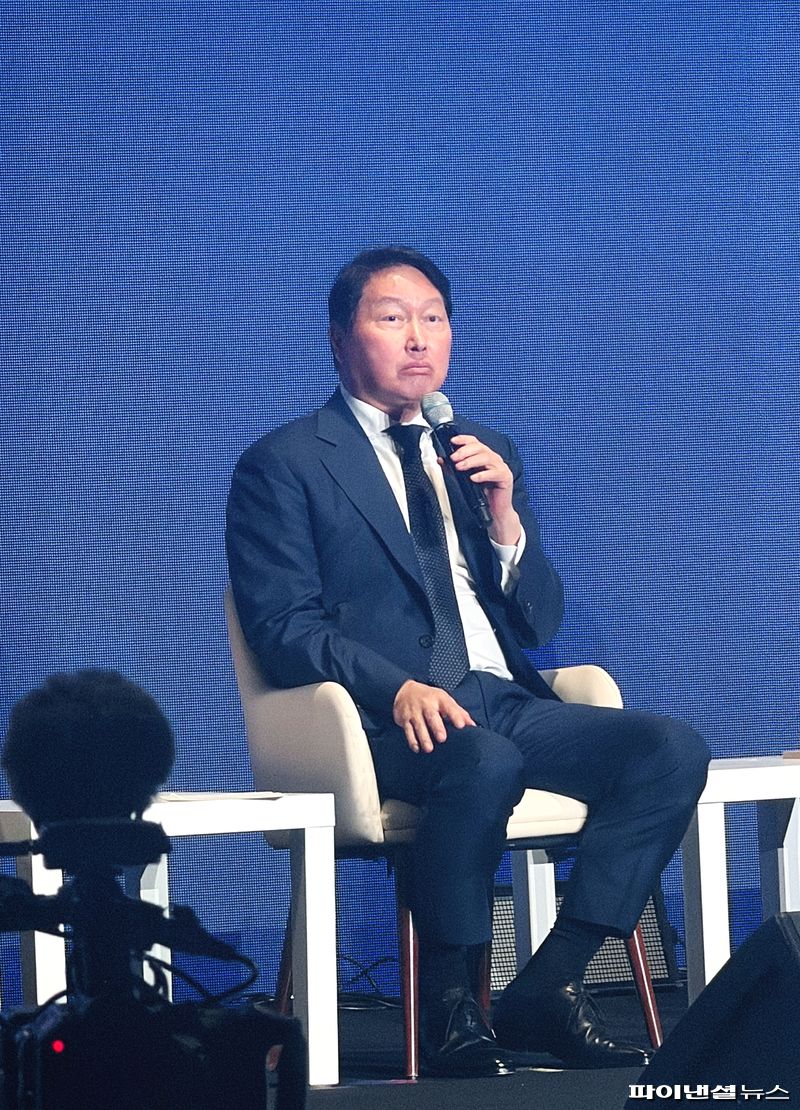
At the Ulsan Forum, Chey identified “business models” and “sustainability” as challenges facing the AI industry. These were added to the three priorities he has previously emphasized: speed, scale, and safety.
“Given the enormous resources invested, we need to create better business models and commercialize them,” Chey said. “We need to move toward a sustainable structure in which AI generates profits on its own and reinvests them.”
He particularly stressed that the scale of data beyond individual companies is crucial to securing competitiveness in manufacturing AI. “Technology is important for manufacturing AI, but it is difficult without a data platform of sufficient scale,” he said. “We need to collect data and expand its scale not only in Ulsan but across South Korea to increase the chances of success for manufacturing AI.”
For Ulsan’s future, he proposed an “AI city” combining manufacturing AI, AI services for citizens, and the arts. The concept involves using SK’s AI for Everyone to provide personalized public, welfare, and daily-life information services while expanding cultural and artistic functions in the manufacturing-centered city.
“Ulsan has historically been a strategically important industrial base for South Korea,” Chey said. “If it rapidly pursues AI transformation (AX) and becomes a leading model, there is potential for AI to spread throughout South Korea.”
The Ulsan Forum, now in its fifth year, was jointly hosted by SK and the Ulsan Chamber of Commerce and Industry. According to SK, more than 10,900 online and offline participants, including university students and residents of Ulsan, attended this year’s event—5.7 times more than last year.
[email protected] Kim Mi-hee Reporter