Why Was Seongnam Mayor Lee Jae Myung Indicted for “Not Making More Money”? The Prosecution’s Bad Weapon: Breach of Trust [Lee Hwan-joo’s View]
- Input
- 2026-09-12 14:00:00
- Updated
- 2026-09-12 14:00:00
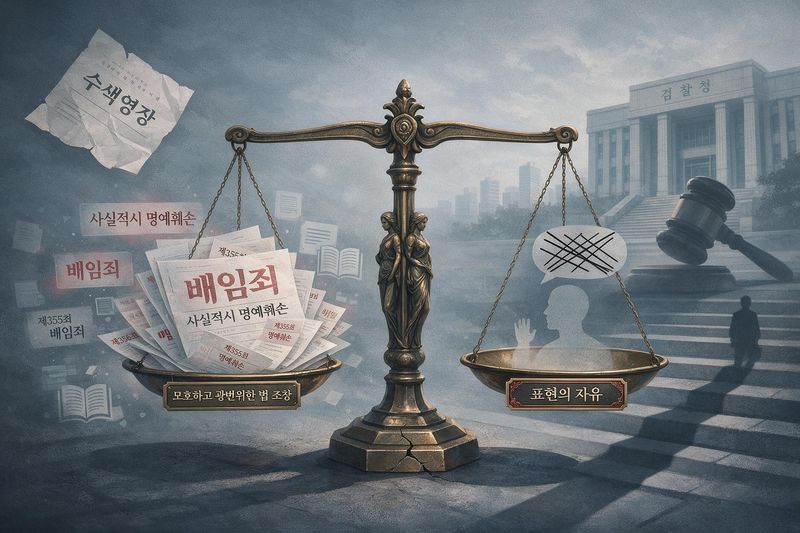
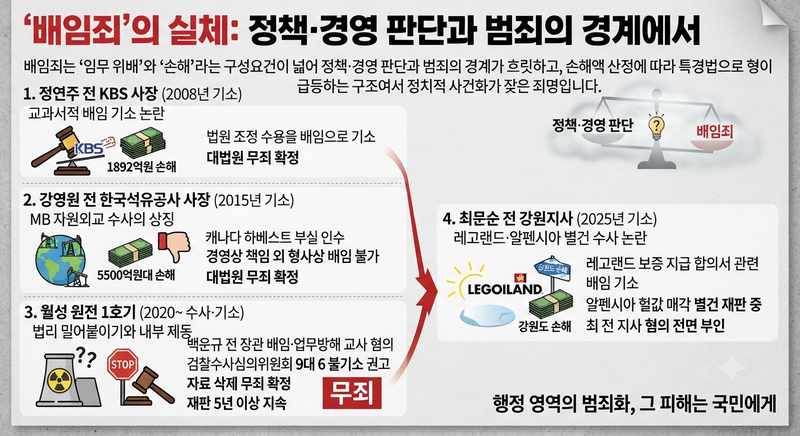
[Financial News] Breach of trust is widely regarded, alongside defamation based on true statements, as one of the most representative toxic provisions that prosecutors can readily abuse at their discretion. Just as defamation based on true statements can chill freedom of expression, breach of trust is also vulnerable to prosecutorial abuse because its elements are vague and broad. In fact, the cases of former KBS President Jung Yeon-joo, who was indicted in 2008 and acquitted by the Supreme Court of Korea in 2012, and former Korea National Oil Corporation President Kang Young-won, who was indicted in 2015 and acquitted by the Supreme Court of Korea in 2020, are often cited as representative examples of abuse of the breach-of-trust law. As concerns over the potential abuse and adverse effects of the offense have gained broader public support, calls are emerging in political and government circles to abolish breach of trust under the Criminal Act or substantially narrow its requirements.
The ambiguity of applying breach of trust
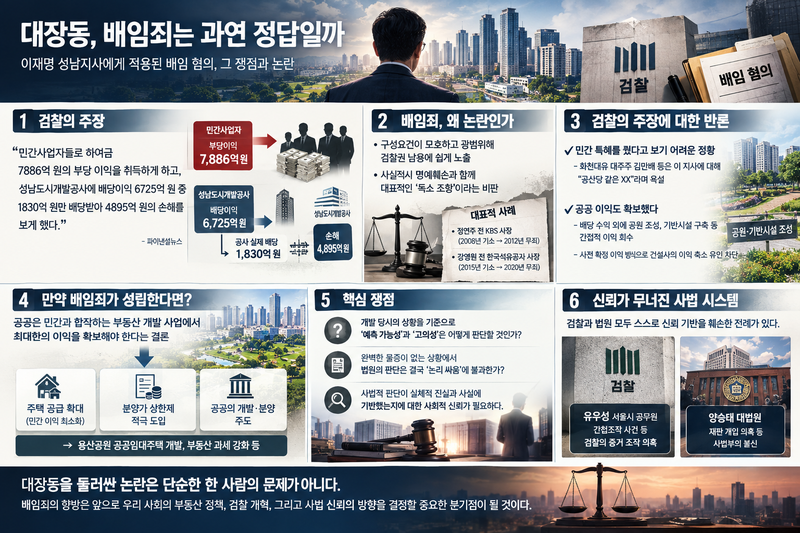
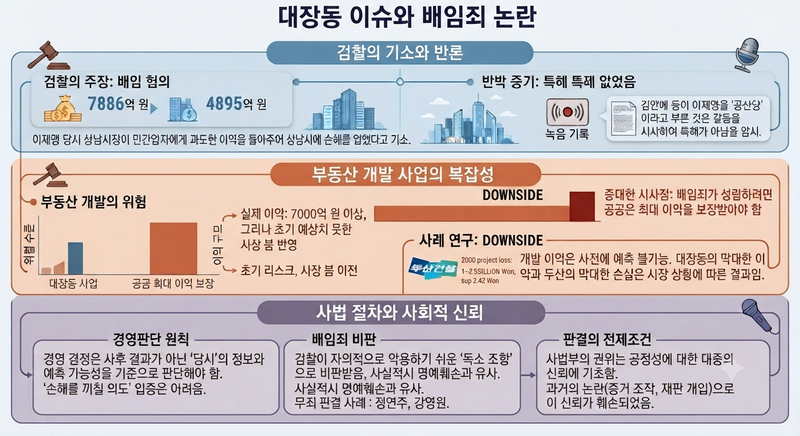
Regarding the Daejang-dong scandal, prosecutors alleged that “Lee Jae Myung, who was then mayor of Seongnam City, allowed private developers to obtain 788.6 billion won in undue profits and caused Seongnam Urban Development Corporation to suffer a loss of 489.5 billion won by receiving only 183 billion won out of the 672.5 billion won in dividend profits.” They therefore concluded that breach-of-trust charges were warranted.
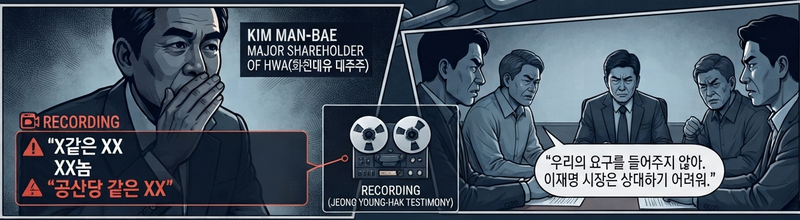
Put roughly, the prosecution’s argument was, first, that Seongnam Mayor Lee Jae Myung gave preferential treatment to private developers, and second, that he harmed Seongnam City by failing to secure greater profits. Kim Man-bae, the largest shareholder of Hwacheon Daeyu Asset Management, and others once bitterly resented and cursed Lee, calling him “a communist party-style bastard” (in a recording). This suggests that it is difficult to view the arrangement as preferential treatment for the private sector. In addition to dividend revenue, Seongnam City also recovered value indirectly by requiring profits from the project to be used to build a park and urban infrastructure.
Setting the development profits as a “predetermined” return rather than settling them afterward was another shrewd solution proposed by Mayor Lee at the time. If profits were determined after development, construction companies and others would have an incentive to inflate construction costs, reduce profits to zero and avoid sharing them with the public sector. In reality, the Daejang-dong project generated enormous profits only because several coincidences overlapped, and it is difficult to predict the profits of a real estate development project in advance. Doosan Engineering & Construction, for example, pursued a 2,700-unit mixed-use apartment project in Goyang City, Gyeonggi Province, in 2009. But the global financial crisis and a downturn in the housing market combined to leave the company with massive losses estimated at 1 trillion to 2 trillion won. The total group-wide support provided to improve its financial structure was reportedly as much as 2.4 trillion won.
Breach of trust carries the risk that a management decision may be judged criminal solely on the basis of its outcome, even though managers must make decisions when they cannot know whether a particular choice will ultimately harm or benefit the company. The decision’s “predictability” and whether there was intent are assessed retrospectively based on the circumstances at the time.When there is no conclusive physical evidence, a court’s decision ultimately amounts to “giving the victory to whichever side—the prosecutor or the defense attorney—makes the more logically plausible argument.”
South Korea’s unusually powerful breach-of-trust law compared with other countries
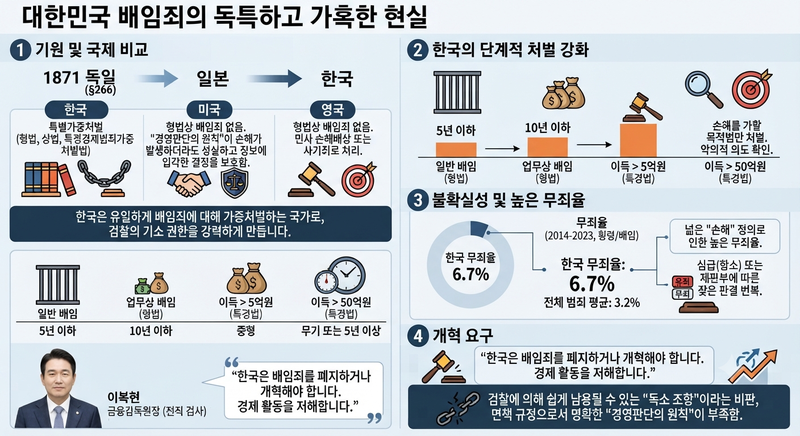
Breach of trust is known to have entered South Korea through Japan after being codified in Article 266 of the 1871 Criminal Code of the German Empire. The United States has no breach-of-trust offense under its criminal law; instead, it has established the “business judgment rule.” If a manager made a good-faith decision for the benefit of the company, the manager is not held liable even if the decision ultimately causes a loss.The United Kingdom, like the United States, handles such cases through civil damages or fraud charges and has no separate breach-of-trust offense. Japan punishes only “specific-purpose offenders” in breach-of-trust cases—those who intended to cause harm—and therefore examines intent strictly.What makes South Korea’s breach-of-trust law unusual is that, in addition to general breach of trust under the Criminal Act, punishable by up to five years in prison, and occupational breach of trust, punishable by up to 10 years, it also has a special breach-of-trust offense under the Commercial Act. If the amount of gain is at least 500 million won, the punishment is aggravated under the Act on the Aggravated Punishment of Specific Economic Crimes. If it is at least 5 billion won, the sentence rises to life imprisonment or at least five years in prison. South Korea is the only country that imposes aggravated punishment for breach of trust. In other words, prosecutorial indictments for breach of trust carry that much greater force.The United States establishes the business judgment rule through case law, while Germany does so through legal interpretation. South Korea, however, has no exemption provision. Critics also say the scope of losses considered in breach-of-trust cases is broad, meaning conduct may or may not constitute a crime depending on the court’s interpretation.
An analysis by the Korea Chamber of Commerce and Industry of the Judicial Yearbook published by the National Court Administration found that the average acquittal rate for embezzlement and breach of trust from 2014 to 2023 was 6.7%, more than twice the 3.2% average for all crimes under the Criminal Act. Breach-of-trust cases also have a high acquittal rate, and it is common for different panels to reach different conclusions on guilt or innocence, or even for the outcome to change at different levels of the court system. Lee Bok-hyun, a former prosecutor who served as head of the Financial Supervisory Service under the Yoon Suk Yeol administration, has also argued that breach of trust should be abolished.
If, for the sake of argument, Lee Jae Myung, now president, were found guilty of breach of trust as prosecutors claim, the conclusion would be that “in real estate development projects jointly undertaken by the public and private sectors, the public sector must secure the maximum possible profit.” As noted above, the Daejang-dong project is widely regarded as a leading example of the public sector recouping excess profits in South Korean real estate development.
Applied to South Korea’s current real estate situation, this logic leads to the conclusion that private-sector profits should be minimized to increase housing supply, price ceilings should be actively introduced, and the public sector should take a more active role in development and sales projects. Developing Yongsan Park as public rental housing, or strengthening real estate taxation, using the resulting revenue as government funds and investing it in public real estate development, could be ways for the government to avoid breach-of-trust charges while advancing the public interest.
However, for the public to trust the conclusions of judicial decisions, there must first be a social belief that prosecutorial indictments and court rulings are fair and just, and based on the substantive truth and facts. The authority of courts to make final determinations of guilt or innocence rests on that belief.Yet prosecutors and courts have previously undermined their own foundations of trust, including through allegations of evidence fabrication by prosecutors—such as the Yoo Woo-sung case involving the fabrication of a spy case against a Seoul Metropolitan Government official—and allegations that former Supreme Court Chief Justice Yang Sung-tae interfered in trials.The first trial in President Lee Jae Myung’s Daejang-dong case is currently suspended. Prosecutors indicted him in March 2023, and the trial proceeded at the Seoul Central District Court before being suspended in July 2025 under Article 84 of the Constitution. Article 84 of the Constitution provides that the president is not subject to criminal prosecution while in office, except for insurrection or foreign aggression.
The special counsel bill on fabricated prosecutions proposed by the Democratic Party of Korea would allow a special counsel to take over the president’s case and withdraw the indictment. Eight cases are reportedly under consideration, including the Daejang-dong scandal, Baekhyeon-dong, Wirye New Town, the Seongnam Football Club case, the Ssangbangwool remittances to North Korea case and the Gyeonggi Province corporate credit card case. The Democratic Party maintains that the special counsel should withdraw the indictments if the cases themselves resulted from fabricated prosecutions by prosecutors. Critics, however, say it is contradictory for a special counsel to withdraw indictments in cases it did not investigate, even though the stated purpose of prosecutorial reform was to prevent abuse of prosecutorial authority.(To be continued)