"Called 'Manager,' but just 'Middle-aged Man' after retirement" Dads who want to work until 73 but are pushed aside at 53 [Recorder of the Lowly Places]
- Input
- 2026-09-13 06:00:00
- Updated
- 2026-09-13 06:00:00

Office workers in their 50s often have to find their next job immediately after leaving their current company. It is difficult to find work similar to the duties they have performed for a long time, and it is not easy to maintain previous wage levels. Based on the accounts of middle-aged individuals interviewed by this reporter, we examined the reality of job insecurity and re-employment, which are difficult to explain solely by employment indicators.
[Financial News]I was a department head and a team leader inside the company, but once I stepped outside, I became just an older applicant.Mr. A (in his 50s), whom we met near the Seoul Metropolitan Library in front of Seoul Metropolitan Government on the morning of the 11th, said this while checking a job posting on his mobile phone. He confided, "If I list all my work experience, I feel like they won't hire me because of my age, but if I leave some things out, I can't explain what I've done," adding, "I get stuck right from the moment I start writing my resume."
It was difficult to conduct interviews inside the Seoul Metropolitan Library on this day due to citizens using the reading and reference rooms. The reporter met with middle-aged individuals around the library, on nearby sidewalks, and near Gwanghwamun to hear about their job-seeking process after retirement and the anxiety they feel about losing their jobs while employed.
Mr. A left the company at the end of last year through a voluntary retirement program. At first, he thought he could just take a break for two or three months and look for his next job. However, he rarely made it to the interview stage. "It may seem like I'm holding on because I have severance pay, but the rate at which my monthly living expenses are draining away is different," Mr. A said.In a household where children's tuition and loan interest are paid together, the job loss of a head of household in their 50s changes the entire family's life.He confided that
Middle-aged and older workers met near Gwanghwamun also did not consider unemployment to be someone else's problem. Employee B (52) said, "The company doesn't openly talk about restructuring, but,It has become more common for names of people in their 50s to be excluded from new projects."I check job postings even on weekends because I'm worried my name might be on the next voluntary retirement list," he said.
Office worker Mr. C (54) also said, "When talk of the wage peak system and voluntary retirement comes up together, staying at the company itself is unsettling," adding, "The scariest thing is that if I lose my job now, there is nowhere else to go under the same conditions."At home, I still look like someone who works, but inside the office, I feel like someone who could leave at any moment.He added.
Retirement anxiety that cannot be seen in numbers
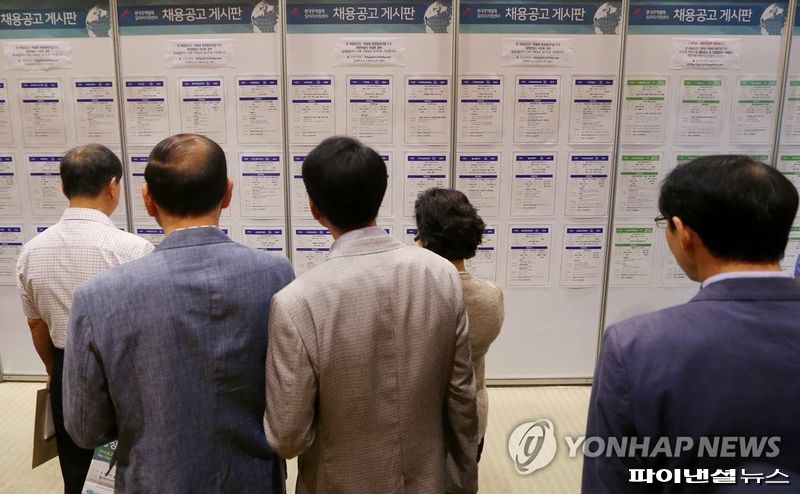
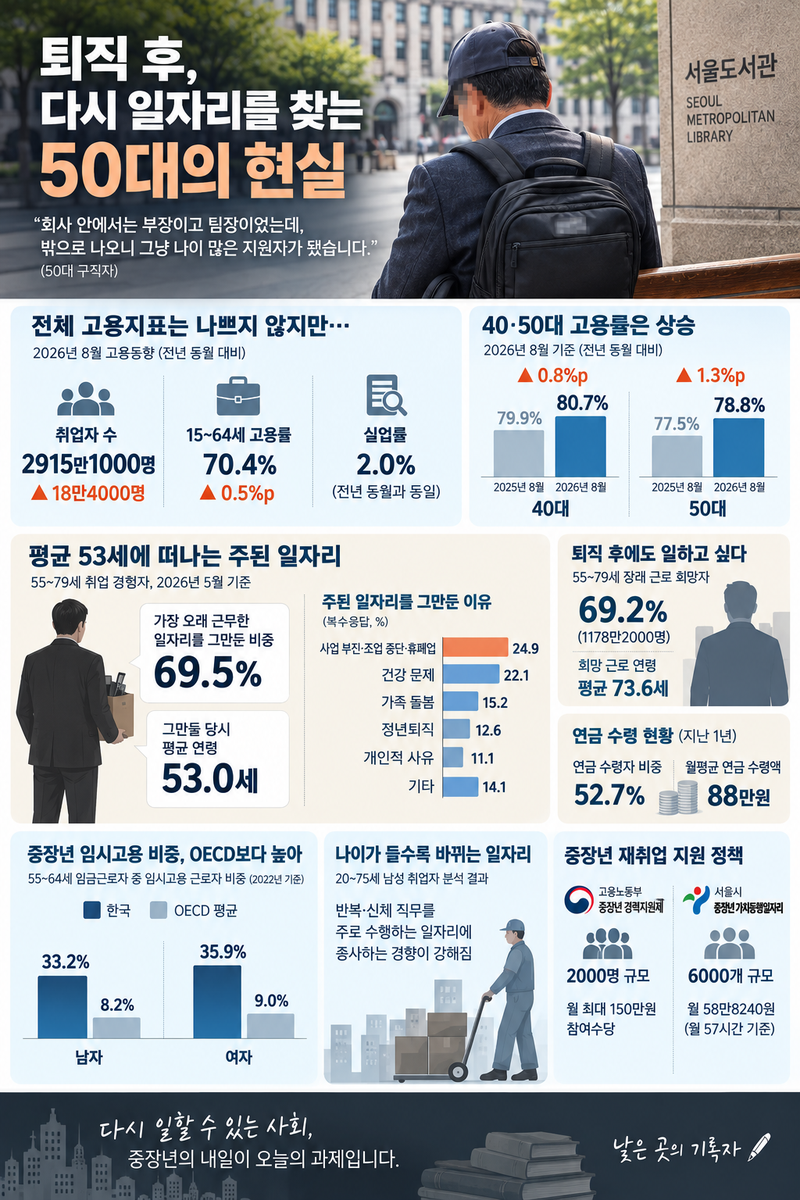
Looking solely at overall employment indicators, the employment situation for middle-aged and older workers does not appear to be bad. According to the Ministry of Data and Statistics' "August 2026 Employment Trends," the number of employed people last month was 29,151,000, an increase of 184,000 from a year ago. The employment rate for those aged 15 to 64 was 70.4%, up 0.5 percentage points from the same month last year, while the unemployment rate remained unchanged at 2.0%. Employment rates by age group also rose for those in their 40s and 50s. According to data analyzing the August employment trends by the Ministry of Employment and Labor (MOEL), the employment rate for those in their 40s was 80.7%, up 0.8 percentage points from the same month last year.The employment rate for those in their 50s rose 1.3 percentage points to 78.8%.did.
However, the anxiety expressed by middle-aged and older adults in the field cannot be explained solely by the question of "whether or not to work." This is because they repeatedly experience the difficulty of re-entering the same role, wage, and employment type after leaving their primary jobs. "When I go for job counseling, the first thing I hear is to lower my expectations," said A.I don't know if being told to lower my expectations means taking a pay cut, changing my job, or forgetting what I've been doing so far.He said.
Jobs left at average age of 53
Employment issues for middle-aged and older adults are linked to the timing of their retirement from primary jobs. According to the Ministry of Data and Statistics’ ‘Results of the Supplementary Survey on the Elderly Population in the May 2026 Economic Activity Survey,’ 69.5% of those aged 55 to 79 with work experience had quit their longest-held job. The average age at the time they left that job was 53.0.
The most common reason for leaving their longest-held job was business downturn, suspension of operations, or temporary or permanent closure, accounting for 24.9%. Health issues followed at 22.1%, and family caregiving at 15.2%. This indicates a structure where leaving a primary job is not solely a matter of personal choice, but rather a combination of company circumstances, health, and caregiving burdens. A significant number of people wish to continue working even after retirement. In the same survey, 69.2% of those aged 55 to 79—a total of 11,782,000 people—expressed a desire to continue working in the future. These individualsThe average desired working age is 73.6 years.The proportion of pension recipients over the past year was 52.7%.The average monthly pension is 880,000 won.It was.
Mr. A also said that the pressure to return to work was greater than the desire to rest after resigning. He said, "For the first month, it felt awkward not going to work in the morning, and after three months, I felt like I didn't belong anywhere."Losing my business card was less realistic than having my monthly salary cut off.He said.
A market where it is difficult to return to regular employment
The Korea Development Institute (KDI) pointed to a shortage of demand for regular labor as a cause of employment instability among middle-aged and older workers. The research paper, "Measures to Restore Labor Market Functions to Overcome Employment Instability Among Middle-aged and Older Workers," explained the increasing proportion of non-regular workers as the superficial reason for the growing employment instability after middle age.
As of 2022, the proportion of temporary workers among wage earners aged 55 to 64 was 33.2% for men and 35.9% for women. The OECD average was 8.2% for men and 9.0% for women. The proportion of temporary employment among middle-aged people in Korea was much higher than the OECD average.
The researcher, as a more fundamental causeThere is a lack of demand for regular employment for middle-aged workers.It was cited that if one leaves a regular job for any reason, it is difficult to find re-employment as a regular employee, and as a result, the proportion of non-regular workers increases. The report explained that the rigidity of regular wages and an excessive seniority-based wage structure are factors that increase companies' incentives for early retirement.
Job roles are also changing. The research institute's report, "Current Status and Improvement Measures for the Middle-aged Labor Market Examined Through Job Analysis," analyzed the job composition of employed men aged 20 to 75. The data revealed that as age increases, there is a tendency to engage in jobs primarily involving repetitive and physical duties rather than analytical or social roles. In particular, it explained that the propensity for analytical and social roles declined sharply after the age of 50.
For middle-aged job seekers, a gap in their career history often leads to a decline in wages. It is not uncommon for people who have worked in office jobs for a long time to move to positions after retirement that do not directly match their previous experience, such as facility management, security, delivery, or short-term administrative assistance. "I looked into facility management after hearing during re-employment training that I should get a certification," said Mr. A. "It is not that I look down on that job, but..."The feeling that the work I've done for 20 years is disappearing in an instant."It was tough," he said.
Talking about certifications for the 'second act of life' at company dinners
Middle-aged and older workers were looking into what to do after retirement even while employed. Mr. B, whom I met near Gwanghwamun, said, "These days, even at company dinners, people talk about certifications."People say things like, "Someone is preparing for the Craftsman Electrician certification," or "Someone is looking into the Caregiver course."He said."We used to talk about promotions, but now the topic of conversation is what to do after leaving."He said.
Mr. C said he cannot easily talk about his anxiety to his family. "I tell my child not to worry, but I am actually calculating how much my salary will drop after retirement," he said. "It is difficult to talk about it because I am afraid the atmosphere at home will change the moment I mention the possibility of losing my job."
Unemployment among middle-aged people is not just a matter of one person's career.The 50s are a time when the burden of children's education expenses, supporting parents, and housing costs all come together.C. Losing a job not only cuts off earned income but also creates an income gap until one begins receiving the National Pension Service (NPS). If re-employment is delayed, severance pay is quickly depleted to cover living expenses and loan repayments.
Need for 'Good Jobs' for Middle-aged and Older Adults
The central and local governments are also expanding support for the re-employment of middle-aged and older workers. The Ministry of Employment and Labor (MOEL) this yearImplementing the 'Middle-aged Career Support System' on a scale of 2,000 peopleThis program provides work experience opportunities to middle-aged individuals in their 50s who are preparing for a career transition after retiring from their primary jobs, such as office work. Participants are paid a participation allowance of up to 1.5 million won per month.
The Seoul Metropolitan Government operates the "Value Companion Jobs" program for middle-aged and senior citizens aged 40 and older. The program is set to provide 6,000 jobs this year. Participants work in public sectors such as caregiving, safety, and the environment, and an activity allowance of 588,240 won is provided based on 57 hours of work per month.
The Seoul 50 Plus Foundation also operates one-on-one employment counseling, resume coaching, job placement, and post-employment adaptation support for middle-aged individuals preparing for career transitions. Starting this year, it is also promoting a system through the Middle-aged Employment Academy that provides employment counseling, training, job matching, and follow-up care all in one go.
Experts suggested that to reduce employment instability among middle-aged and older workers, individual re-employment training alone is insufficient, and the labor market structure must also be overhauled. Joseph Han, head of the Education and Labor Innovation Research Team at the Korea Development Institute (KDI), pointed out in the KDI FOCUS report "Measures to Restore Labor Market Functions to Overcome Employment Instability Among Middle-aged and Older Workers" that "job interruptions and employment instability among middle-aged and older workers can arise from a lack of good jobs available for them to re-enter the workforce." He added, "The seniority-based wage system excessively increases the cost of employing middle-aged and older workers, leading to early retirement and potentially lowering the quality of jobs upon re-employment."
We record sincere stories of life in print. We capture words gathered from the field exactly as they are, even if they are rough around the edges. From alleys, markets, and someone's workplace, records of the ordinary days we have passed by are coming to you, our readers. To conveniently receive [Recorder of the Lowly Places], please subscribe to the reporter's page.
[email protected] Han Seung-gon Reporter