Eight Cameras Took on Seoul’s Urban Roads...“Autonomous-Driving Data Will Surpass Competitors Within Five Years”
- Input
- 2026-09-13 09:00:00
- Updated
- 2026-09-13 09:00:00
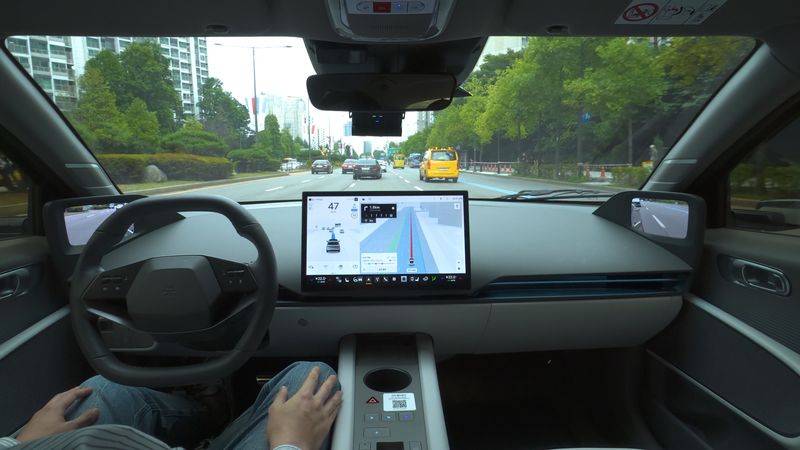
Hyundai Motor Group has chosen data as the foundation of that competitiveness. At the Vehicle Workshop visited that day, vehicles lined up to collect data on the roads and validate technologies trained on that data. Among them was a Hyundai Ioniq 6 that had traveled through downtown Seoul without driver intervention. Two cameras were mounted on the windshield, four on the sides, and two fisheye cameras at the front and rear. These eight cameras, along with a single radar on the front bumper, served as the vehicle’s eyes as it interpreted the urban environment.
■Hyundai Motor Group Opens Pangyo Autonomous-Driving Development Site to the Public
The Vehicle Workshop is a secure facility housing vehicles and technologies under development. It serves as the first checkpoint for verifying whether software-based technologies operate properly in actual vehicles. When new software is developed, it undergoes a “smoke test” there before going onto public roads, allowing engineers to quickly check feature execution and communication with control units. Park Ji-yeol, 42dot’s TL in charge of autonomous-driving testing, explained, “Vehicles that pass this verification process can finally begin full-scale testing on actual roads.”
Information collected by the sensors mounted on the Hyundai Ioniq 6 is processed by a high-performance automotive computer in the glove compartment. 42dot operates more than 20 such test vehicles, including about 10 to 20 dedicated autonomous-driving vehicles.
The Hyundai Ioniq 5 parked beside it served a different purpose. A lidar unit mounted on its roof made it visibly distinct. It is a dedicated data-collection vehicle used to gather data for training Atria AI, the company’s proprietary autonomous-driving artificial intelligence. Depending on the purpose, these vehicles generally carry 12 cameras, one lidar unit, five radars, and 12 ultrasonic sensors. More than 40 such vehicles operate day and night, collecting over 80 hours of data per vehicle each week.
Seonggyun Jeong, 42dot’s GL, said, “About half of the collected data consists of similar scenes, such as steady driving in a straight lane,” adding, “Because we do not know when or where edge cases will occur, we first need to secure a sufficient number of data-collection vehicles.”
Hyundai Motor Group also released footage for the first time of an SDV testbed equipped with Atria AI driving through downtown Seoul. The technology is at Level 2++, and the vehicle traveled from Pangyo via the Gyeongbu Expressway and Olympic-daero to Dongjak Bridge, Sungnyemun Gate, and Gwanghwamun. The company also showed an unedited one-take video filmed during morning rush hour in Gangnam District and in rainy downtown Pangyo, along with footage of the vehicle handling 10 edge cases, including avoiding vehicles stopped or parked on the shoulder and making an unprotected left turn.
■“We Delayed It Strategically”...The 2029 Gamble
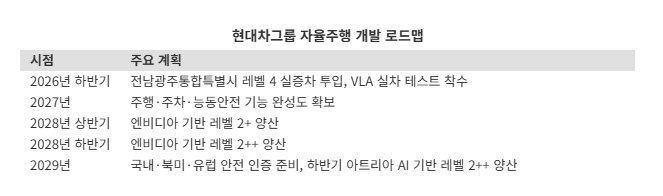
The strategy has two tracks. Hyundai Motor Group plans to launch mass-produced Level 2+ vehicles in the first half of 2028 and Level 2++ vehicles in the second half of the same year using NVIDIA’s AI computing platform. Level 2++ vehicles based on its proprietary Atria AI are scheduled for the second half of 2029. Production vehicles will use 10 cameras, one forward-facing radar, and 12 ultrasonic sensors, based on NVIDIA’s Drive Hyperion 10 standard.Lidar will be excluded for the time being. President Minwoo Park, who also heads 42dot and previously worked on the early development of Tesla Autopilot and in NVIDIA’s perception organization, did not specify a timeline. He said, “Because sensor redundancy is important for safety, we may consider applying lidar when taking Level 3 into account.”
He said, “Just as it is difficult to imagine a car without wheels, autonomous driving will become a fundamental capability inseparable from automobiles,” adding, “In the future, cars without autonomous-driving capabilities will become difficult to sell.”
The company also explained why it will take more than three years for the technology shown in the footage to reach mass production. President Minwoo Park said, “We could move faster if we devoted all our resources to it, but we strategically set a later schedule,” adding, “If we rush it to market now, we would end up mass-producing an awkward Level 2++ system.” Junghyun Kwon, head of Hyundai Motor Company and Kia’s Autonomous Driving Development Center and a vice president, explained, “We will improve the completeness of driving and parking functions through 2027. The year 2028 will be devoted to collecting edge cases, and 2029 will be used to prepare for safety certification in South Korea, North America, and Europe.”
The link between the two tracks is a “data flywheel”: collecting data, training AI on it, and then installing the improved model back into vehicles to obtain new data. Hyundai Motor Group’s mass-production capabilities, with more than seven million vehicles sold annually in more than 190 countries, provide a potential starting point. The model installed in vehicles has about 100 million parameters, just one-eightieth of the more than eight-billion-parameter large language models (LLMs). Seonggyun Jeong predicted, “Once full-scale mass production begins, we will be able to surpass the cumulative data of global competitors within five years.”
President Minwoo Park emphasized, “The speed of technology development and safety are not conflicting values,” adding, “The more exceptional situations we discover and learn from, the safer autonomous driving becomes. Under the principle of applying only sufficiently validated technologies to vehicles, we will continue to improve both development speed and safety.”
[email protected] Dongchan Kim Reporter