Korea Food Industry Association and Korea Energy Agency Join Forces to Respond to Climate Change
- Input
- 2026-09-11 11:49:46
- Updated
- 2026-09-11 11:49:46
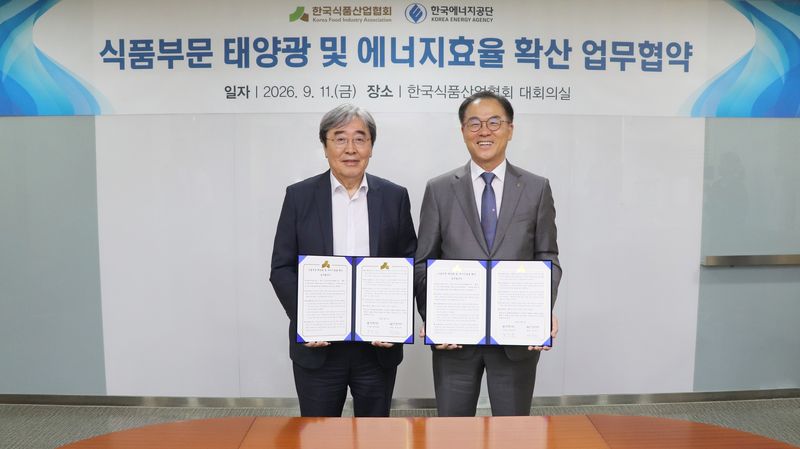
[Financial News] The Korea Food Industry Association and the Korea Energy Agency are joining forces to reduce greenhouse-gas emissions and respond to climate change.
The Korea Food Industry Association said on the 11th that it had signed a memorandum of understanding with the Korea Energy Agency to expand solar power and energy efficiency in the food sector.
The agreement was established to support the deployment of solar power and improvements in energy efficiency at food manufacturing and production facilities, while building a cooperative framework to reduce greenhouse-gas emissions and respond to climate change.
Key areas of cooperation include expanding solar power; improving energy efficiency; supporting food companies’ carbon-neutrality and environmental, social, and governance (ESG) efforts through climate-change response; promoting policies and systems related to solar power, energy efficiency, and climate change; providing information on support programs; surveying and sharing data on the status of solar power deployment, energy efficiency, and climate-change response at food-sector plants; and identifying other ways to cooperate on solar deployment and energy-efficiency improvements.
In particular, the association will assess its members’ current status and needs regarding solar deployment, energy-efficiency improvements, greenhouse-gas reduction, and climate-change response. It will also provide members with information on relevant policies and support programs and seek companies to participate.
The agency will provide the association with information on related policies, systems, and support programs, while gathering food companies’ opinions and reflecting them in the implementation of its programs.
Park Jin-seon, president of the Korea Food Industry Association, said, "Following this agreement, we will strengthen field-oriented support so that our members can more easily use solar-power and energy-efficiency support programs and enhance their capabilities in carbon neutrality and ESG response."
[email protected] Kim Seo-yeon Reporter