KDCA issues 'Influenza Epidemic Advisory' starting today... Epidemic season earlier than usual
- Input
- 2026-09-11 09:43:24
- Updated
- 2026-09-11 09:43:24
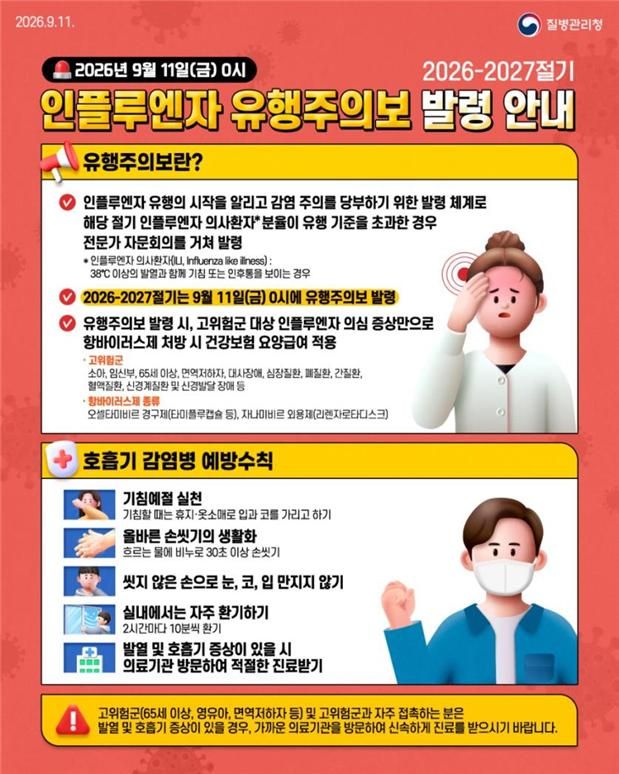
[Financial News] The Korea Disease Control and Prevention Agency (KDCA) announced that it will issue an 'Influenza Epidemic Advisory' starting at midnight on the 11th, as the incidence of influenza is higher than in previous years. An epidemic advisory is issued following expert consultation when the proportion of suspected influenza (ILI) cases exceeds the epidemic threshold for the season and the virus detection rate is 5% or higher.
On the 8th, the Korea Disease Control and Prevention Agency (KDCA) held the '9th Meeting of the Inter-Ministerial Joint Task Force on Respiratory Infectious Diseases' with medical experts and relevant ministries including the Ministry of Health and Welfare (MOHW), the Ministry of Food and Drug Safety, and the Ministry of Education, and reviewed the current status of influenza and COVID-19 outbreaks and response measures.
According to the results of the sample surveillance of influenza-like illness (ILI) at clinics, the proportion of ILI cases in the 36th week of 2026 (Aug. 30–September 5) was 25.3 per 1,000 outpatients, exceeding the epidemic threshold for this season (12.9). This is significantly higher than the same period last year (6.6), and the figure increased more than threefold in just four weeks, rising from 7.5 in week 33 to 9.2 in week 34, 13.3 in week 35, and 25.3 in week 36.
By age group, the rates were 7 to 12 years old (75.1 people), 1 to 6 years old (49.8 people), and 13 to 18 years old (31.3 people), showing a relatively high and rapid increase in the school-age and infant/child age groups.
In the 36th week, the number of inpatients at sample hospital-level medical institutions was 300, approximately double the previous week (166) and a significant increase compared to the same period last year (23). Among the inpatients, those aged 65 and older accounted for the largest share at 60.0%. The influenza virus detection rate also continued its upward trend, rising from 5.4% in the 33rd week to 16.3% in the 36th week. The virus primarily circulating is Influenza A(H1N1)pdm09 virus, which is similar to the vaccine strain for this season, and no mutations affecting resistance to treatment were identified.
During the period when an influenza epidemic alert is issued, if high-risk groups such as children, pregnant women, the elderly aged 65 or older, and patients with chronic diseases are prescribed antiviral drugs (oral oseltamivir, topical zanamivir) based on a doctor's judgment, medical benefits are approved without testing.
The early outbreak of influenza this season is appearing similarly overseas. Japan has entered the epidemic season with 1.76 reported patients per medical institution in week 35, and southern China also showed a high influenza positivity rate of 17.7% as of week 35.
In the case of COVID-19, the number of inpatients at hospital-level sample surveillance medical institutions in week 36 was 193, which is lower than the same period last year (433), but has been continuously increasing since August, with the elderly aged 65 or older accounting for 65.3% of the total. The virus detection rate in week 36 was 16.3%, an increase from the previous week (11.7%), and regarding variant viruses, the BA.3.2 Omicron subvariant, which was first detected in January of this year, was the dominant type until July, but in August, PQ.16.1.1 was found to be the most dominant at 53.9%.
The Korea Disease Control and Prevention Agency (KDCA) plans to sequentially implement the national influenza vaccination program starting September 21, but it also plans to review measures to adjust the vaccination schedule to focus on high-risk groups, including immunocompromised individuals, taking into account the epidemic situation and vaccine supply schedule.
Starting this season, the Korea Disease Control and Prevention Agency (KDCA) is expanding the number of sample surveillance institutions at the clinic level from 300 (0.6 per 100,000 people) last year to 800 (1.6 per 100,000 people) to identify outbreaks more sensitively, and plans to increase the ratio of designated sample surveillance institutions in cities, counties, and districts from 56.3% to 91.3% to provide regional outbreak information at the city and provincial level.
For nursing hospitals and facilities where the elderly reside, vaccination will be permitted from the time vaccines become available, regardless of age-specific vaccination schedules, depending on the epidemic situation in the community. The Ministry of Food and Drug Safety and the Ministry of Health and Welfare (MOHW) plan to continuously monitor the supply and demand of medicines, such as fever reducers and painkillers, as well as the distribution of COVID-19 treatments. The Ministry of Education will also continue to provide guidance on preventive measures for respiratory infectious diseases to households and students, and will inspect school infectious disease response systems through councils with city and provincial education offices.
Experts attending the meeting emphasized the need to strengthen education and promotion of preventive measures, such as students wearing masks, as influenza is increasing most rapidly among school-age children. Furthermore, they suggested that preparations are necessary to ensure vaccinations proceed without disruption, given that this season's outbreak has started earlier than in previous years.
Im Seung-kwan, Commissioner of the Korea Disease Control and Prevention Agency (KDCA), emphasized, "As the influenza season is starting rapidly, high-risk groups vulnerable to the virus need to be especially careful," adding, "Seniors aged 65 or older and immunocompromised individuals should visit a medical institution early to receive appropriate diagnosis and treatment if they experience fever or respiratory symptoms."
"He added, 'In order to provide active treatment for high-risk groups when an epidemic alert is issued, health insurance covers the prescription of antiviral drugs without testing for high-risk groups, such as children, pregnant women, and seniors aged 65 or older, if they have suspected symptoms based on a doctor's judgment.'"
Commissioner Im urged the public to observe preventive measures, such as washing hands, practicing cough etiquette, and wearing masks when visiting crowded places, to prevent respiratory infectious diseases like influenza. He added, "As vaccinations will begin sequentially for each target group starting September 21, I hope that seniors aged 65 and older, pregnant women, children, and others will get vaccinated according to the schedule."
He continued, "If the public and relevant ministries prepare together and implement necessary response measures from the onset of the outbreak, we can minimize the damage caused by this winter's influenza epidemic," adding, "The Korea Disease Control and Prevention Agency (KDCA) will closely monitor the status of respiratory infectious diseases this season, provide necessary information to the public in a timely manner, and actively formulate and implement countermeasures."
[email protected] Jeong Myeong-jin, Medical Specialist Reporter