"Don't Bet on Trump Weakening"... How Will Korea Respond After the United States Midterm Elections?
- Input
- 2026-09-11 02:42:51
- Updated
- 2026-09-11 02:42:51
Accordingly, it is pointed out that Korea should abandon the expectation that Trump will weaken after the midterm elections and instead establish a strategy toward the United States that engages the White House, the Senate and House of Representatives, state governments, and local communities simultaneously.
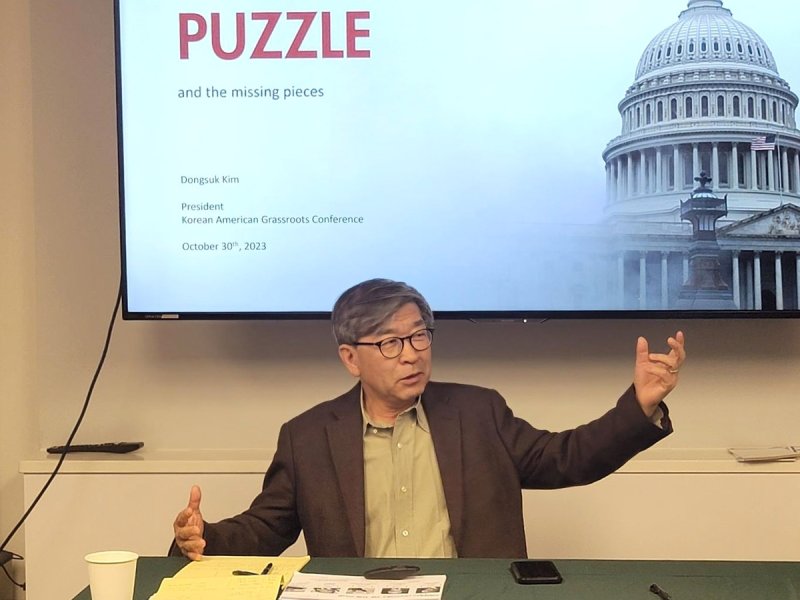
Kim Dong-seok, president of the Korean American Grassroots Conference (KAGC), presented the most probable election outcome at a seminar titled "Outlook for the U.S. Midterm Elections and Response Strategies for Korean Companies" held in New Jersey on the 10th (local time), suggesting that the Democratic Party would retake the House and the Republican Party would retain the Senate. This is a scenario in which the Democrats retake the House by a narrow margin, while the Republicans hold onto the Senate by a small margin.
Trump Won't Weaken Even if the Democrats Retake the House
If the Democratic Party gains control of the House, President Trump's legislative drive for additional tax cuts, immigration and election reforms, and large-scale budget adjustments could be stalled. The chairmanship of House standing committees, the agenda, and the authority to hold hearings, issue subpoenas, and request documents would also shift to the Democrats.
However, Kim emphasized that this should not be immediately interpreted as a weakening of Trump's power. He argued that if the House falls to the Democratic Party while the Republicans retain control of the Senate, there is a high probability that the center of Trump's power will shift from legislation through Congress to the administration, encompassing presidential executive orders, regulations, enforcement priorities, veto powers, and authority over tariffs and sanctions.
Kim predicted that "even if legislative power weakens, the President's authority remains in tariffs, sanctions, diplomacy, and the military," adding that the President's control within the administration could actually strengthen as House investigations and budget pressure intensify.
These changes directly affect U.S.-Korea relations. The Democratic House can strongly oversee United States Forces Korea (USFK), joint exercises, extended deterrence, and North Korea policy through hearings and budgetary authority of the Defense, Foreign Affairs, and Appropriations Committees. On the other hand, regarding trade, pressure is not expected to easily disappear as the President's tariff authority based on existing laws, such as Section 301 of the Trade Act of 1974 and Section 232 of the Trade Expansion Act of 1962 (Section 232), remains in place.
"Don't Bet Policy on the Expectation That Trump Will Weaken"
Accordingly, Kim emphasized that Korea should not stake its policies on the expectation that "Trump will weaken."
The point is that a multilayered network is needed to simultaneously engage not only in summit and administration diplomacy dealing with the White House and the Office of the United States Trade Representative (USTR), but also the House Ways and Means, Appropriations, and Foreign Affairs Committees, which the Democratic Party is likely to control, and the Senate Foreign Relations and Armed Services Committees, which the Republican Party is likely to retain.
He urged that regarding Korean companies' investments in the United States, rather than simply emphasizing the total investment amount, individual lawmakers should be shown how many jobs were created in each constituency and how much the companies contributed to supply chains, tax revenue, and technical training. He also stated that cooperation in shipbuilding, defense, semiconductors, batteries, and energy should demonstrate the value provided to U.S. manufacturing, military deterrence, and the Indo-Pacific supply chain.
In particular, he emphasized that instead of relying solely on promises between heads of state, possible agreements should be institutionalized through budgets, legislation, congressional reporting, and local investment. He explained that while the President's policies may change, local jobs and legislative mechanisms do not easily disappear.
"The Era of Industrial Policy"... Korean Companies Must Speak Up
Hyun-jung Je, a senior fellow at the Korea Economic Institute (KEI), also emphasized that attention should be paid to structural changes in U.S. trade policy rather than the results of the midterm elections.
Je assessed that while the current trend of containing China is similar to how the United States checked Japan's economic rise in the past, "China is an opponent of a different class." She stated, "We are now in the era of industrial policy," adding that "we are returning to a time when every country fends for itself."
Tariffs are a key immediate variable for Korean companies. According to Je, approximately 50% of Korea's exports to the United States are subject to Section 232 tariffs, and about 20% are affected by Section 301 tariffs. There is also a possibility that the scope of tariffs could expand to include not only automobiles, semiconductors, and key minerals, but also derivative products containing copper and aluminum.
Je urged Korean companies to participate more actively in the U.S. policymaking process. She emphasized, "In the United States, companies make policies and laws," adding, "If we do not speak up, only policies favorable to U.S. companies will be produced."
[email protected] Correspondent Lee Byeong-cheol Reporter