"Policies Must Be Created to Sustain Cable Television as a Universal Broadcasting Service"
- Input
- 2026-09-10 17:18:55
- Updated
- 2026-09-10 17:18:55
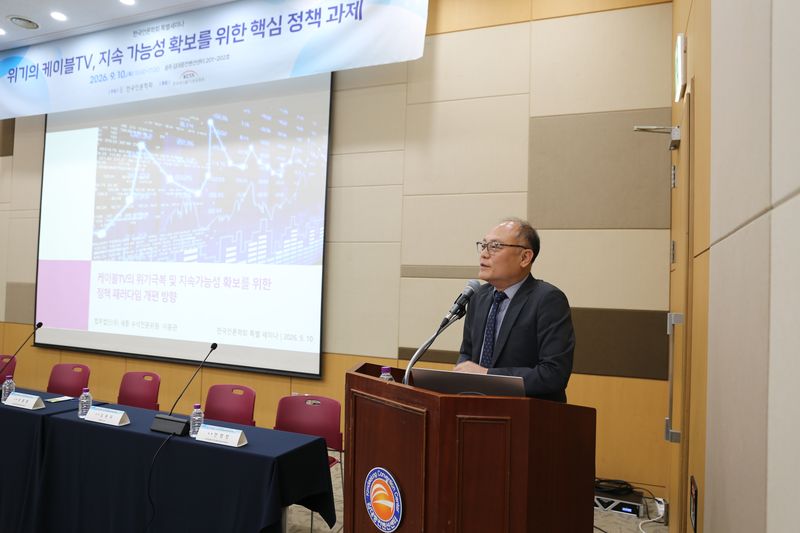
[Financial News] As cable television is an essential medium that guarantees the public's right to access broadcasting and connects local communities, experts have called for a shift in media policy toward protecting the industry's foundation for survival. They said support measures are needed to maintain low-cost broadcasting services and local channels, including more rational standards for calculating content fees and reductions in the Broadcasting and Communications Development Fund levy.
At a seminar held on the 10th at the Kim Daejung Convention Center, Lee Jong-kwan, a senior expert adviser at Shin & Kim LLC, said, "Cable television's media functions and public responsibilities are essential to building a basic media society." He added, "Cable television policy must be reorganized around sustainability and regionality."
"The market is shrinking, but regulations remain as expansive as they were during the growth phase"
The cable television operator (SO) market has seen total revenue, broadcasting-business revenue, and operating profit decline continuously since 2013, while the burden of content fees has grown. Regulations concerning license renewals, rates and terms, channel lineups, and local-channel obligations also remain based on a system designed during the industry's expansion phase. Experts say an urgent policy shift is needed to reflect the industry's life cycle and market position.
Lee emphasized, "Cable television is a regional service that provides real-time broadcasting at the lowest rates among pay-TV services and is responsible for the broadcasting access rights of one-third of the population." He added, "With broad accessibility across regions, generations, and social groups, minimal financial burden, and content availability, it strongly embodies the characteristics of a universal service."
As of 2024, cable television's average revenue per user (ARPU) was 2,471 won, up to 81.4% lower than that of other pay-TV services. It serves to ease the financial burden on economically vulnerable groups and narrow the digital divide between generations and social groups, according to the explanation.
The one-way digital broadcasting service known as 8VSB, offered only by cable television operators, also provides high-definition broadcasts to older viewers who are less familiar with two-way media services.
"Cable television is distribution infrastructure for the broadcasting ecosystem"
Lee also emphasized that cable television serves as distribution infrastructure for Korea's broadcast media ecosystem by bundling real-time channels from terrestrial broadcasters and program providers (PP). "Real-time broadcasting still accounts for a significant share of the public's media use," he said. "According to a 2025 Statistics Korea survey, people watched real-time broadcasts for 1 hour and 30 minutes on weekdays, far longer than the 36 minutes spent using video media."
Lee therefore proposed shifting the policy paradigm to two pillars—'ensuring sustainability' and 'enhancing regionality'—if cable television is to continue serving as an essential medium. Key policy tasks for securing sustainability include rationalizing standards for calculating content fees, providing universal broadcasting-welfare support for 8VSB, reducing retransmission fees, and switching to a voluntary reporting system for rate terms. The aim is to ease cable television operators' cost burdens and increase their autonomy while preserving universal media welfare and the coexistence and infrastructure functions of the real-time broadcasting ecosystem.
Regarding regionality, he emphasized that cable television is a locally focused medium that is difficult to replace in the era of the 'five poles and three special regions.' He proposed reducing the Broadcasting and Communications Development Fund levy, supporting investment in local-channel production, and giving priority to advertisements from local governments and public institutions as ways to protect the communication base of local communities and revitalize local channels.
[email protected] Choi Hye-rim Reporter