KT Deploys AI Welding Robots at Shipyard, Bringing AI Networks to Industrial Sites
- Input
- 2026-09-10 15:56:44
- Updated
- 2026-09-10 15:56:44
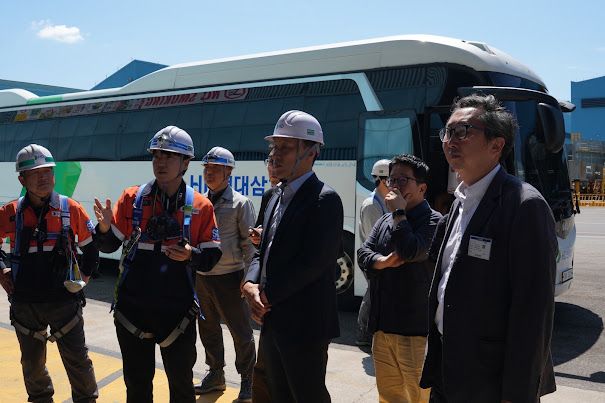
[Financial News] KT will build a high-performance artificial intelligence (AI) network at HD Hyundai Samho’s shipyard in Yeongam County, South Jeolla Province, and demonstrate AI welding robots. The plan combines 5G standalone (SA) mode, an AI radio access network (AI-RAN), and graphics processing unit (GPU)-based computing infrastructure to accelerate robotic automation and improve productivity at the shipyard.
KT announced on the 10th that it will deploy physical AI robots at HD Hyundai Samho’s shipyard, where the Ministry of Science and ICT’s on-site inspection of the High-Performance AI Network Infrastructure Development Project was conducted.
Demonstration of AI Network Deployment at an Industrial Site
The High-Performance AI Network Infrastructure Development Project is led by the Ministry of Science and ICT and the National Information Society Agency (NIA). Its goal is to verify whether AI networks can be applied at industrial sites. KT was selected as a preferred negotiating party in July along with Samsung Electronics and HD Hyundai Samho.
A high-performance AI network is a next-generation network that uses AI to operate communications networks intelligently and provides the communications and computing environment required for physical AI services. KT plans to build such a network at HD Hyundai Samho’s shipyard and use it to demonstrate physical AI technologies, including AI welding robots. The goal is to create next-generation industrial infrastructure that organically links networks, AI, and robots.
The high-performance AI network being built at the shipyard will incorporate 5G SA and network slicing, AI-RAN, GPU-based AI computing infrastructure, and autonomous network technologies.
Combining 5G SA, AI Radio Networks, and GPUs to Accelerate Industrial AI Transformation
5G SA and network slicing will provide the AI welding robots with dedicated communications resources separate from those used by other services. This will enable stable communications quality for robot control even if data usage increases within the shipyard.
AI-RAN will integrate and manage communications resources and GPU-based AI computing resources. Depending on the work situation, it will allocate the communications capacity and AI computing power required by the robots, helping the network and AI infrastructure operate efficiently.
GPU-based AI computing infrastructure will distribute the AI processing required by the robots according to the characteristics of each task. Tasks requiring rapid decisions will be handled by the robots themselves or on-site servers, while large-scale analysis and training will be performed at data centers, improving AI response times and efficiency.
Autonomous network technology will analyze traffic and quality information in real time and automatically adjust communications resources. It detects abnormal conditions, such as network congestion or deteriorating quality, and maintains communications quality autonomously.
Jongsik Lee, executive vice president of KT’s Future Network Lab in the Network Business Division, said, "Through the demonstration with HD Hyundai Samho, we will verify the technological capabilities of a high-performance AI network that integrates AI-RAN, AI computing infrastructure, and autonomous networks. We will also contribute to building AI infrastructure that improves productivity and safety at industrial sites."
[email protected] Choi Hye-rim Reporter