Jeju Connects Three Private Security Firms’ Dispatch Networks to Nighttime Public Safety, Extending Patrols to Alleys and Lodgings
- Input
- 2026-09-10 14:40:04
- Updated
- 2026-09-10 14:40:04
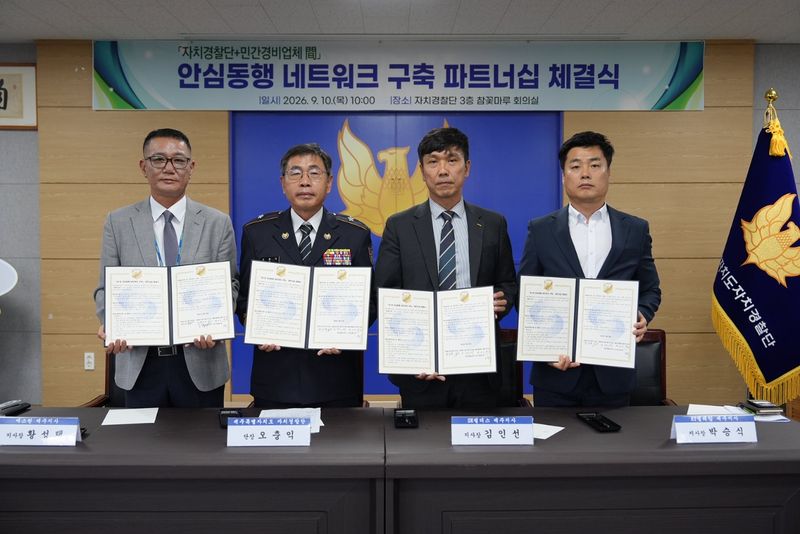
【Financial News Jeju = Jung Yong-bok】 Jeju is connecting the existing dispatch networks of three private security firms—S-1, SK Shieldus and KT Telecop—to its nighttime public-safety network. Private security personnel will help monitor alley-based commercial areas, lodgings for school-trip groups and other vulnerable areas where police officers cannot remain around the clock, immediately notifying the police or fire authorities of unusual situations.
According to the Jeju Special Self-Governing Province Autonomous Police Agency on the 10th, the agency and S-1, SK Shieldus and KT Telecop signed the “Partnership for Building a Safe-Companion Network” that morning in the Chamkkotmaru conference room on the third floor of the agency.
The partnership’s core objective is to use the nighttime dispatch networks already operated by private security firms to inspect blind spots in local public safety.
The three private security firms will establish field posts in alley-based commercial areas, lodgings used by school-trip groups and other areas vulnerable to nighttime crime. If they discover unusual situations, including crimes, fires or safety accidents, they will promptly report them to 112 or 119.
Everyday hazards, such as broken streetlights and damaged facilities, will also be reported. After verifying the reports on site, the Autonomous Police Agency will work with the relevant departments to take follow-up measures.
Patrol information will also be shared. The Autonomous Police Agency and the three private security firms agreed to exchange lists of dangerous and vulnerable areas across the province and incorporate them into the firms’ dispatch and patrol routes. The aim is to combine the autonomous police’s public-safety information with the private companies’ access to sites, reducing repeated inspections of the same areas and the number of places left out of management.
This does not mean that private security personnel will take over police investigations or enforcement duties. The focus is on connecting private security workers who move throughout local areas at night to a safety network that identifies hazards first and reports them.
The agreement is also a follow-up measure to the Autonomous Police Agency’s efforts to expand a community-based public-safety network. The agency is pursuing its “Jeju All-Out Safety Response” initiative, which links 1,543 people—including resident autonomous police units, senior clubs, private organizations, private security personnel and drone operators—to residential areas, tourist destinations, Olle trails and coastal areas, and nighttime vulnerable areas.
In Jeju, lodging and commercial areas frequented by tourists and school-trip groups are widely dispersed, making it difficult for administrative and public personnel alone to inspect every area continuously at night. The initiative seeks to connect the on-the-ground presence private companies gain while carrying out their existing duties with the public-safety network.
The Autonomous Police Agency plans to analyze reports from private security firms, joint patrol records and the results of hazard improvements, and use the findings to refine its operating methods.
Lee Cheol-woo, head of the Community Safety Division at the Jeju Special Self-Governing Province Autonomous Police Agency, said, “Private security firms are important partners in community safety because they operate close to residents. We will strengthen a community-based public-safety system in which private organizations and the autonomous police work together to monitor every part of Jeju.”
[email protected] Jung Yong-bok Reporter