Apple Enters Samsung’s Stronghold... ‘Foldable Phone War’ Ignites After Seven Years
- Input
- 2026-09-10 15:23:11
- Updated
- 2026-09-10 15:23:11

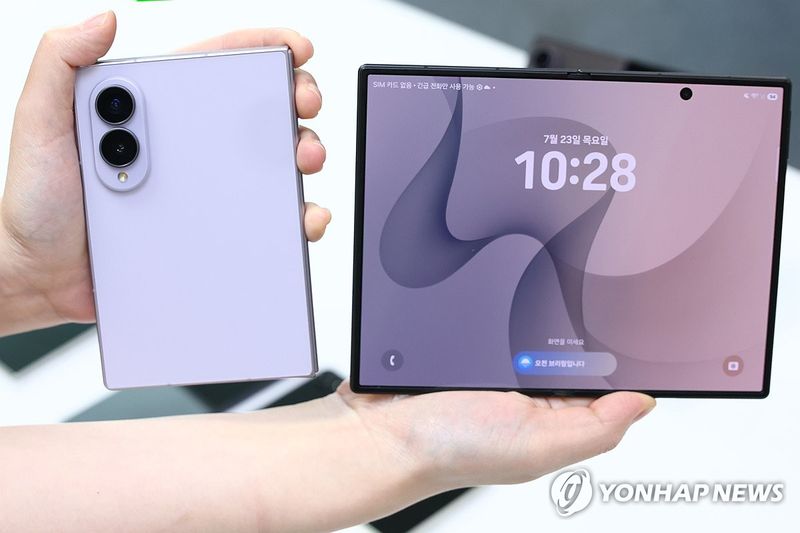
The Duo measures 5.4 inches when folded, roughly the size of a passport, and expands to 7.6 inches when unfolded. Its screen size is similar to that of the Samsung Galaxy Z Fold 8, but the two devices differ in weight and thickness. The Fold 8 weighs 201g and measures 4.5 mm thick when unfolded, making it 53g lighter and 0.7 mm thinner than the Duo. The top-tier ‘Galaxy Z Fold 8 Ultra’ weighs 215g and measures 4.1 mm thick, making it 39g lighter and 1.1 mm thinner than the Duo.
Weight and thickness, which affect portability and usability, are considered key competitive factors for foldable phones. On the 9th, the day before the Duo’s unveiling, Samsung Electronics highlighted its seven years of accumulated foldable technology in a post on its newsroom, showing how its first Galaxy Fold, which weighed 276g, had become 75g lighter by the eighth generation.
The domestic retail price of the ‘Duo’ is set at 3.29 million won for the base 256-gigabyte (GB) model. The 512GB version costs 3.59 million won, while the 1-terabyte (TB) model is priced at 4.19 million won. The highest-spec 2TB model costs 5.09 million won.
Compared with the Samsung Galaxy Z Fold 8, priced at 2,278,100 won for the 256GB model, the Duo’s base model is more than 1 million won more expensive. The Galaxy Z Fold 8 Ultra is also priced at 2,577,300 won for 256GB and 3,451,800 won for 1TB—more than 700,000 won less than the Duo models with the same storage capacities.
The Duo’s high price is expected to be a variable as Apple seeks to draw its loyal customer base into the foldable-phone market. Online communities have also shown concern over the high retail price, with some users commenting that a single smartphone costs more than large appliances such as refrigerators.
According to Counterpoint Research, Samsung Electronics ranked first last year with about 40% of global foldable-phone shipments, followed by Huawei with about 30%. This year, Samsung Electronics is expected to retain the top spot with 38%, while Apple is projected to quickly capture 25%, overtaking Huawei (22%) to rank second. The market is watching whether Apple’s entry will go beyond a battle for market share among existing players and help expand the foldable-phone market itself. Although foldable phones were commercialized in 2019 and have now reached eighth-generation products, they still account for only about 2% of the overall smartphone market.
With Apple bringing its powerful iPhone user base into the market, growth could accelerate, analysts say. Consumers who have used conventional bar-type iPhones may switch to foldable phones, while existing players such as Samsung Electronics and Huawei could respond by intensifying product and price competition, broadening the market’s consumer base.
Counterpoint Research forecasts that cumulative global foldable-phone shipments will exceed 100 million units by the end of this year. International Data Corporation also expects foldable-phone shipments to increase by about 30% year on year.
An industry official said, “Apple’s launch of a foldable phone is significant because it could bring iPhone users who had hesitated to buy a foldable phone into the market. As consumers gain more choices, the overall foldable-phone market is expected to expand.”
[email protected] Yoon Hong-jip Reporter