[Exclusive] Overseas Fugitives Rise, but Repatriations Decline for Four Straight Years—Gaps in Passport Invalidation and Local Cooperation
- Input
- 2026-09-13 12:44:08
- Updated
- 2026-09-13 12:44:08
[Financial News] As the number of overseas fugitives surges, the government has stepped up passport invalidations, but repatriations to South Korea have shown little progress. A significant delay occurs before a fugitive’s passport is rendered invalid, and even after invalidation, securing the person requires cooperation from local judicial authorities. With scam crime hubs spreading across Southeast Asia, particularly Cambodia, experts say a two-track response is needed: block fugitives’ movement from the early stages of their escape while strengthening local judicial cooperation.
Serious Crimes Require Rapid Passport Invalidation
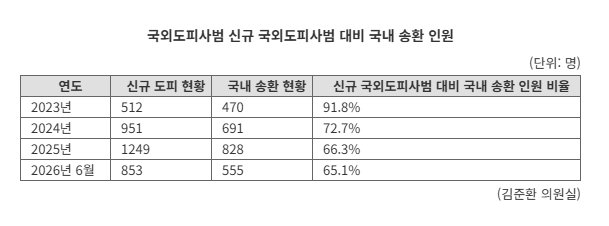
According to data submitted by the Korean National Police Agency to Kim Jun-hwan, a lawmaker of the Democratic Party of Korea on the National Assembly’s Foreign Affairs and Unification Committee, the ratio of people repatriated to South Korea compared with newly identified overseas fugitives fell from 91.8% in 2023 to 65.1% in the first half of this year. By year, the figure declined for four consecutive years: 91.8% in 2023, 72.7% in 2024, 66.3% in 2025, and 65.1% in the first half of this year.
Although the number of criminals fleeing overseas is rising rapidly, considerable delays are occurring in passport invalidation, an initial measure intended to prevent cross-border movement.
According to the Ministry of Foreign Affairs (MOFA), invalidating the passports of people staying overseas who have been indicted or had their investigations suspended for crimes punishable by at least three years in prison, or who are subject to arrest or detention warrants, normally takes one to two weeks because of notification and public-notice procedures. For people who have not served their prison sentences, the process requires two notices to surrender their passports, a 14-day public notice period, and an additional 14-day surrender period, meaning that actual invalidation can take even longer.
The problem is that, unlike departure bans and departure suspensions, the current passport invalidation system has no separate procedure for responding to emergencies. Some experts note that although restrictions on fundamental rights must be imposed cautiously, an institutional mechanism is needed to rapidly restrict passport validity when there is a specific concern that a suspect in a serious crime may flee overseas.
Lee Woong-hyuk, a professor in the Department of Police Science at Konkuk University, explained, "Once a passport is invalidated, movement between countries is inevitably restricted. If it is invalidated even one day earlier, authorities can narrow a fugitive’s range of movement and gain time for investigative agencies to determine the person’s whereabouts and make an arrest."
Kim Dae Geun, a senior official at the Korean Institute of Criminology and Justice (KICJ), also said, "If an arrest warrant or similar warrant has been issued for a suspect in a serious crime and the person’s overseas travel route has been specifically identified, authorities should consider a procedure for urgently and temporarily suspending the passport’s validity."
A Two-Track Approach: Passport Invalidation and Local Cooperation
Even rapidly invalidating a passport will not resolve every issue surrounding the repatriation of overseas fugitives. South Korean investigative agencies cannot exercise investigative authority directly overseas. Therefore, even when they identify a fugitive’s whereabouts, cooperation from local judicial authorities is essential for an actual arrest and repatriation to South Korea.
The importance of international cooperation has grown further as Southeast Asia, including Cambodia, has recently emerged as a major refuge for fugitives from South Korea. A senior prosecution official explained, "The flight of scam organization members to Southeast Asia is an international phenomenon. From the perspective of criminals, the region has better-established criminal infrastructure than other countries because investigative networks are less stringent and fellow operators are concentrated there."
Ultimately, experts say a two-track response is needed: rapidly restrict passport validity in the early stages of a flight to block movement to third countries, then secure the fugitive through cooperation with local judicial authorities. There are also calls to build a more comprehensive investigative and judicial cooperation system, particularly with Southeast Asian countries where South Korean fugitives are concentrated.
Lee Yoon-ho, a professor in the Department of Police Administration at Dongguk University, said, "In countries such as Cambodia where many South Korean fugitives gather, we need to strengthen cooperative systems such as the Korean Desk. To improve effectiveness, information that a South Korean passport has been invalidated must be shared promptly with the other country so that the passport cannot be used there either."
Kim said, "We must strengthen substantive cooperation with local judicial authorities and establish early-repatriation measures so that criminal organizations cannot use overseas locations as safe havens."
[email protected] Lee Dong-hyuk and Kim Dong-gyu Reporter