[Exclusive] Serious Crimes Investigation Agency's First Report Card: '70% of Cases Processed Within One Year'... 60% of Investigation Budget for Economic Crimes
- Input
- 2026-09-10 14:24:33
- Updated
- 2026-09-10 14:24:33
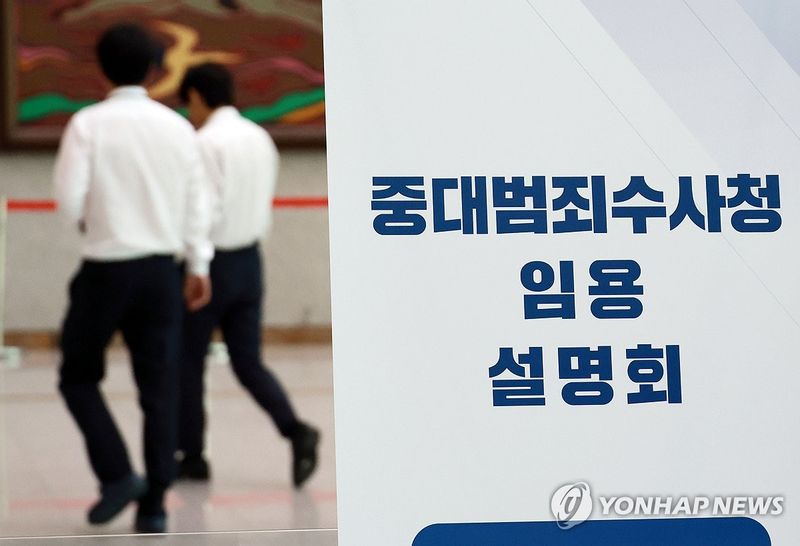
[Financial News] The Serious Crime Investigation Agency (SCA), set to launch on October 2, has set a performance goal to handle 70% of serious crime cases next year within one year of the investigation beginning. In the new criminal justice system where investigation and prosecution are separated, this effectively makes "investigation speed" its first report card. More than 60% of the investigation support budget has been allocated to the economic crime sector, placing emphasis on the successful establishment of the direct investigation function for large-scale economic and financial crimes transferred from the prosecution.
According to the Serious Crimes Investigation Agency's '2027 Performance Plan' obtained by Financial News on the 10th, the agency has set a target of 70% for the '12-month processing rate of serious crime cases,' which is one of next year's performance indicators. This refers to the percentage of serious crime cases concluded in the relevant year that were decided as either forwarded or not forwarded within 12 months from the start of the investigation.
Simply put, this means that seven out of every ten serious crime cases closed by the Serious Crimes Investigation Agency in 2027 will be concluded within one year of the investigation beginning. Cases where the statute of limitations is suspended or prosecution is suspended due to the suspect's whereabouts being unknown or fleeing overseas are excluded from the calculation. Performance is automatically aggregated based on case numbers in the Serious Crimes Investigation Agency's statistical system and then cross-verified using data linked to the Korea Information System of Criminal Justice Services (KICS).
In its performance plan, the Serious Crimes Investigation Agency explained, "In a system where investigation and prosecution are separated, the unique performance of an investigative agency lies in swift and thorough investigation," adding that it is "a key indicator for preventing human rights violations of suspects and the waste of investigative resources caused by prolonged investigations, and for assessing whether investigative functions transferred (from the prosecution) have been established without gaps."
However, the Serious Crimes Investigation Agency explained that it did not set unreasonably high targets from the first year. The agency stated, "As it is the second year since its launch and has no track record of its own, we set the prosecution's performance in handling special and economic crime cases within 12 months prior to the transfer as the baseline." Furthermore, considering the proficiency of transferred personnel, the stabilization period of the investigation information system, and initial inefficiencies resulting from organizational integration, it stated that it "conservatively set the target at or slightly below the baseline level."
The characteristics of major cases were also taken into account. The Serious Crimes Investigation Agency determined that, given that investigations into major corruption cases can be prolonged due to accounting analysis or international cooperation, it is necessary to consider the complexity of the cases rather than simply increasing the processing rate. The agency stated, "After securing actual results in 2027, we will gradually raise the target figures starting in 2028 and consider introducing detailed indicators that distinguish between major cases and general cases."
The budget allocated to actual investigations was concentrated in the field of economic crimes. Of the 91.779 billion won allocated for next year's 'Investigation Support and Capacity Building,' 56.187 billion won (61.2%) was allocated to 'Investigation of Serious Economic Crimes.' Investigation of serious economic crimes includes direct investigation and enforcement activities regarding not only general economic crimes such as fraud and embezzlement, but also financial, securities, and virtual asset crimes.
The Serious Crimes Investigation Agency assessed corruption and economic crimes as "the field with the largest number of cases and social impact among the agency's investigative targets." Regarding the concentration of the budget on the economic crime sector, an official from the agency's preparatory team explained, "We allocated the budget for the relevant projects through close consultation with financial authorities to stably carry out the investigation functions for major serious economic crimes, which were previously handled by the prosecution's direct investigation departments."
In addition, the budget for investigation support and capacity building was allocated in the following order: strengthening scientific investigation capabilities 13.219 billion won (14%), drug crime investigation 10.28 billion won (11%), anti-corruption and public crime investigation 8.171 billion won (8.9%), and crime investigation targeting the socially vulnerable 3.922 billion won (4.27%).
The Serious Crimes Investigation Agency also included anticipated institutional limitations in its performance plan. The agency assessed that "due to the separation of investigation and prosecution, the Serious Crimes Investigation Agency lacks control over procedures following referral, making it difficult to directly attribute the results of final dispositions to institutional performance." It also stated that "given the possibility of overlapping investigative jurisdictions with the Public Prosecution Office and the Korean National Police Agency, it is necessary to establish criteria for the transfer and reassignment of cases." Regarding the newly established crime of Not_found, it noted that "since precedents regarding the elements of the crime have not yet been formed, it is necessary to first establish internal criteria for initiating investigations."
[email protected] Choi Eun-sol, Lee Hae-ram Reporter