Kakao Strengthens AI Capabilities of NGO Workers
- Input
- 2026-09-10 14:07:47
- Updated
- 2026-09-10 14:07:47
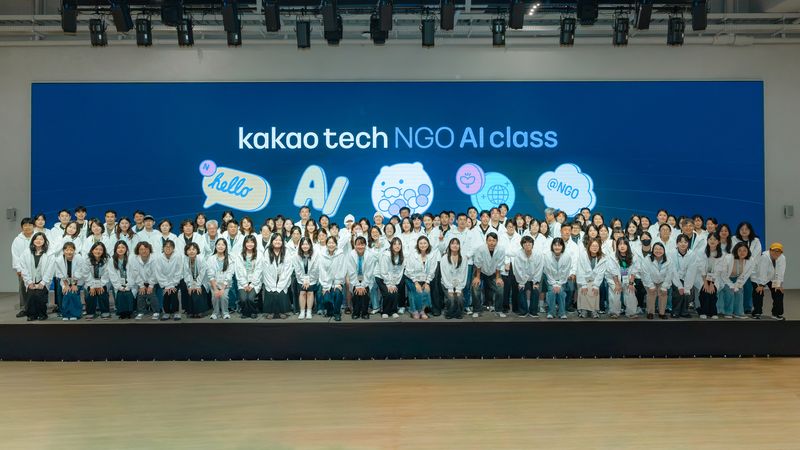
[Financial News] Kakao has launched a program to strengthen artificial intelligence (AI) capabilities among workers at domestic nongovernmental organizations (NGOs). The initiative aims to help nonprofit organizations increase their use of AI in response to strong demand for AI training across the sector.
According to industry sources on the 10th, Kakao held the Kakao Tech NGO AI Class, a practical generative AI training program for NGOs, on the 9th.
The Kakao Tech NGO AI Class expanded its target audience to nonprofit workers, following last year’s Kakao Tech AI School Owners’ Class, which was designed for small-business owners.
A total of 206 people from 106 organizations applied during the recruitment period. Of these, 106 people from 53 organizations were ultimately selected. All of the selected organizations participated in the training.
Organizations from 10 fields took part: consumer affairs and economic justice; the environment and climate; international cooperation, development and aid; children, women and families; human rights and peace; intermediary support; social welfare and housing; civic participation and political reform; disability and minorities; and youth and education.
The training consisted of a two-day course. During the introductory session held on the 2nd at Kakao AI Campus in Yongin, participants completed practical exercises that could be applied immediately to their work, including work automation using generative AI, PPT creation, and preparing Excel quotations.
The advanced course was held in two sessions at Kakao Pangyo Agit on the 8th and 9th. It focused on using AI to make the work performed by NGO workers more efficient, with exercises ranging from setting up customized AI environments to monitoring key issues, producing newsletters, and automating data management.
The training was specifically designed for each organization’s leader and working-level staff member to participate as a two-person team. Its goal was not only to improve individual AI skills but also to apply the training to each organization’s work and expand AI use across the organization. All graduates received support for one month of paid Claude Pro access. An open chat room where participants could ask the instructors questions was also operated for one month after the training to support practical implementation.
Lee Seong-beom, CEO of Wonders International, said, "We had already been using AI for work, but we joined because we were considering how to apply it across the organization together with our employees." He added, "The training and exercises helped us learn ways to apply AI to our actual work and gave us time to think concretely about how to expand its use throughout the organization."
Hong Shin, Kakao’s ESG Cooperation Performance Leader, stated, "This training allowed us to confirm the strong demand for AI education in the nonprofit sector and the potential for organization-wide use." Hong added, "We will continue to develop practical training tailored to the needs of various fields and expand the range of organizations we support."
Meanwhile, Kakao continues to operate programs designed to strengthen AI capabilities among diverse members of society and foster AI talent. It has run the Kakao AI Rookie Camp for teenagers, Kakao Tech Campus, a practical training program for university students in regional areas, and Kakao Tech Bootcamp, which trains aspiring developers. More recently, Kakao launched Kakao AI Dot with the Korea Advanced Institute of Science and Technology (KAIST), Gwangju Institute of Science and Technology (GIST), Daegu Gyeongbuk Institute of Science and Technology (DGIST), and Ulsan National Institute of Science and Technology (UNIST) to foster regional AI talent and companies, while also working to broaden the AI ecosystem.
[email protected] Jang Min-kwon Reporter