Cement, Ready-Mixed Concrete and Construction Industries Join Forces to Expand Low-Carbon Concrete
- Input
- 2026-09-10 14:46:25
- Updated
- 2026-09-10 14:46:25
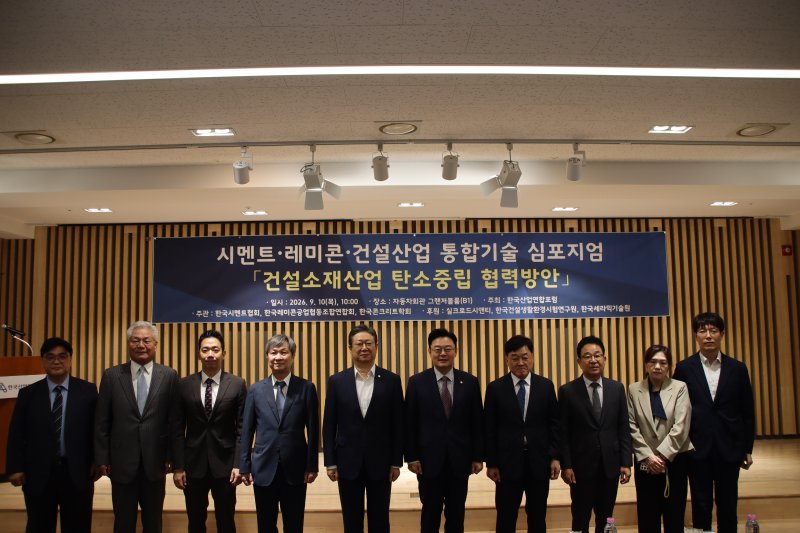
According to the Korea Cement Association on the 10th, the Integrated Technology Symposium for the Cement, Ready-Mixed Concrete and Construction Industries was held that day at Korea Automobile Hall in Seocho-gu, Seoul. Hosted by the Korea Industry Alliance Forum and organized by the Korea Cement Association, the Korea Ready-Mixed Concrete Industry Cooperative Federation and the Korea Concrete Institute, the event addressed the status of carbon-neutral technology development in the cement, ready-mixed concrete and construction industries, as well as ways to link the sectors.
Industry participants agreed that applying low-carbon building materials at actual construction sites requires not only material development but also cooperation across the entire industry, including ready-mixed concrete mix design and quality control, as well as design, construction and procurement by construction companies.
In his congratulatory remarks, Jeon Geun-sik, chairman of the Korea Cement Association, said, "The cement industry is pursuing process-efficiency improvements with the goal of achieving carbon neutrality by 2050, and it is also working to improve the KS system to support the replacement of raw materials and fuels through government research and development (R&D)." He emphasized, "To use low-carbon cement, the ready-mixed concrete industry's mix-design technology and quality control, along with choices made during the design standards, construction and procurement stages of the construction industry, must move together."
He added, "Alongside the development of carbon-neutral technologies, we must also establish relevant standards by strengthening trust among the industries."
In the keynote presentations, Lee Jae-yoon, a senior researcher at the Korea Institute for Industrial Economics & Trade, spoke on "Supply Chain Innovation and Policy Tasks for Carbon Neutrality in the Construction Industry," while Park Jung-joon, a research fellow at the Korea Institute of Civil Engineering and Building Technology, presented on "Ways to Link Technologies in the Construction Materials Industry amid the Global Transition to Carbon Neutrality."
Presentations by sector shared the latest developments in low-carbon technologies and response measures for each industry. The cement session introduced expanded use of supplementary materials to reduce greenhouse gas emissions generated during the heating of limestone raw materials, reductions in clinker use, and technologies for producing high-performance clinker and blended cement.
The ensuing discussion highlighted the need to improve systems to facilitate the field application of low-carbon technologies, as well as the need for joint R&D among the industries. Kim, Ui-Cheol, an executive director at the Korea Cement Association, said, "Although the cement industry's expanded use of supplementary materials and clinker-reduction technologies have already reached the demonstration stage, carbon neutrality is being delayed because the institutional conditions, including KS and standard specifications for concrete, have not been established." He proposed "updating KS and the standard specifications for concrete" and "supporting joint R&D by the cement, construction and ready-mixed concrete industries."
[email protected] Kim Hyun-chul Reporter